Whale season in Réunion: a 4-day easy itinerary
Four days is enough to combine Réunion Island’s whale season with its two easiest big-view stops, without a single night of trekking. This itinerary keeps every base within an hour or two of the west coast and times day 1 around a boat departure, not the other way around. It skips the real Mafate trek and the full hiking week on purpose: those belong to Mafate in three days and a full hiking week if you have more time and want to walk in on foot.
Whale season, and why it is not “summer”
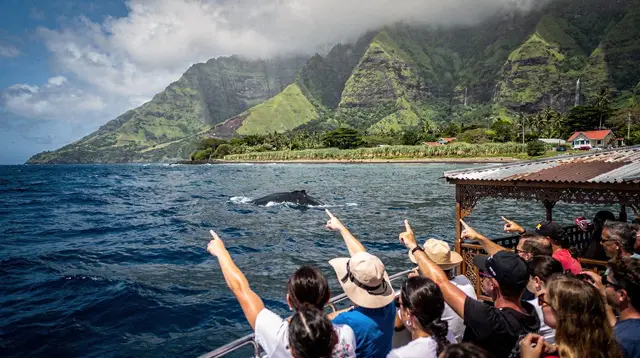
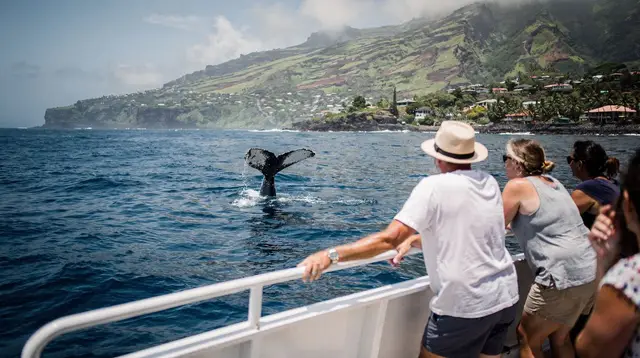
Humpback whales pass along Réunion’s west coast roughly from June-July to October, with sightings usually picking up through August and September. That window falls in the island’s austral winter — the dry, cooler season, and also the best time of year for hiking, since the wetter, hotter austral summer (November to April) brings the cyclone season instead. If you are used to a European calendar, resist the instinct to call this trip “a summer break”: on Réunion, winter is when things are pleasant and dry.
No boat operator can promise a sighting. Approaches follow a charter with minimum distances from the animals, and trips sometimes end without a whale in sight. Treat the whale-watching outing as the best chance you will get on this trip, not a guarantee, and plan the rest of the days so they hold up on their own.
Getting there and getting around
Most visitors land at Roland-Garros airport (RUN) near Saint-Denis in the north. A rental car is close to essential for this route: the Maïdo road climbs through switchbacks with real drive time, not just kilometres, and the volcano road starts well inland at Bourg-Murat. See driving in Réunion Island and renting a car before you land. If you would rather skip driving altogether, Réunion without a car lays out what is realistic on the Car Jaune network — though the Maïdo and volcano legs get considerably harder.
Day 1: Saint-Gilles-les-Bains and a whale-watching trip
Base yourself in Saint-Gilles-les-Bains for the first two nights. Spend the morning easing in around the marina and the lagoon — things to do in Saint-Gilles covers the town itself, and the beaches at the Hermitage and La Saline-les-Bains are a short drive or walk from the centre if you want lagoon time before the boat.
The whale-watching outing is the anchor of the day. Boats leave from the port de Saint-Gilles-les-Bains, and most trips run a few hours, scanning the coastal waters where humpbacks are known to pass during the season.
Book a whale and dolphin watching boat trip from Saint-Gilles-les-BainsA second option covers the same stretch of coast with a focus on the seabed alongside the whale search.
Book the Saint-Gilles-les-Bains dolphin, whale and seabed boat tripIn the evening, walk the marina at sunset and pick a table with a lagoon view — the west coast, being the dry side of the island, delivers reliably clear evenings compared to the east.
Day 2: Saint-Leu and l’Étang-Salé
Drive roughly 20-30 minutes south to Saint-Leu, one of the best paragliding launch points in Europe, with takeoffs above the coast and a wide view over the lagoon on the way down.
Fly tandem paragliding over the bay of Saint-LeuIf flying is not for everyone in your group, Kélonia, the sea turtle observatory in Saint-Leu, is a solid alternative for an hour or two, and the old Stella Matutina sugar-mill museum sits nearby for context on the island’s plantation history. For a second look at whales and dolphins from a different stretch of coast, a supervised launch point at l’Étang-Salé further south combines the search with snorkeling in calmer water.
Book the Étang-Salé supervised whale, dolphin and snorkeling launchL’Étang-Salé is also worth a stop on its own for its black-sand beach, a contrast to the white sand around Saint-Gilles. Remember that swimming and water activities outside the lagoon and supervised zones are restricted by prefectural order because of shark risk — stick to the lagoon beaches and marked launch points, here and everywhere on the west coast.
Overnight again in Saint-Gilles-les-Bains, or shift toward Saint-Leu if you prefer to wake up closer to the coast for a slower morning.
Day 3: the Maïdo belvedere over Mafate
This is the one early start on the trip, and it is worth it. Drive up to the Maïdo, a viewpoint at around 2,200 metres reached by road from Saint-Paul, roughly 45 minutes to an hour from Saint-Gilles depending on traffic through Saint-Paul. Clouds tend to roll in from mid-morning, so aim to be at the top by sunrise or shortly after for the clearest view down into the Cirque de Mafate.
Mafate has no road into it at all — everything you see from the Maïdo is reached on foot, from trailheads like the Maïdo itself, the Col des Boeufs, or Dos d’Âne. This itinerary stays at the belvedere; walking into the cirque is a separate multi-day undertaking covered in Mafate in three days and the Mafate planning guide. If you would rather see the cirque from the air instead of the road, a guided half-day tour to the Maïdo with a Mafate overlook is a lower-effort option that also covers some of the driving logistics for you.
Join a half-day tour to the Maïdo with a Mafate view
Spend the rest of the morning back down in Saint-Paul or return to Saint-Gilles for a relaxed lagoon afternoon — after an early start, this is a good day to keep light. Overnight in Saint-Gilles-les-Bains, or move toward the south coast or Bourg-Murat to shorten tomorrow’s drive to the volcano.
Day 4: Piton de la Fournaise
The Piton de la Fournaise, at 2,632 metres, is one of the most active volcanoes in the world, and this is the only day dedicated to it. From Saint-Gilles, the drive to Bourg-Murat and up the volcano road is around 1.5 to 2 hours; if you moved south or inland the night before, it is considerably shorter.
The road climbs through the Plaine des Sables, a stark, mineral landscape that feels closer to another planet than a tropical island, before reaching the Pas de Bellecombe at about 2,311 metres, a belvedere over the enclos and the small cone known as the Formica Leo. If the enclos is open — access is closed by the prefecture during eruptions or safety alerts, and this is never guaranteed in advance — the trail down to the Dolomieu crater rim takes about five hours round trip, more than this easy itinerary is built for. Treat the Pas de Bellecombe viewpoint as the plan, and the crater hike as a bonus only if you have the time and the trail is open.
Go early: fog tends to build by late morning, and it can be close to freezing at the top at dawn even in the dry season, so bring a warm layer and a windbreaker regardless of how hot the coast felt that morning. The Cité du Volcan museum in Bourg-Murat is a good fallback if the weather closes in, or simply a worthwhile stop on the way up.
For a different angle on the same volcano, and on the cirques you saw from a distance on day 3, a scenic helicopter flight covers Piton de la Fournaise from the air — worth considering if you have budget left and want the aerial view this itinerary otherwise skips.
Book a scenic helicopter flight over Piton de la Fournaise
Head back down in the afternoon, either toward Saint-Pierre for a night in the south before flying out of Pierrefonds airport, or back to the west coast for a last lagoon evening near Roland-Garros airport.
Trip summary
| Day | Base | Main stop | Approx. drive from Saint-Gilles |
|---|---|---|---|
| 1 | Saint-Gilles-les-Bains | Whale-watching boat trip, marina | — |
| 2 | Saint-Gilles-les-Bains | Saint-Leu paragliding or Kélonia, l’Étang-Salé | 20-40 min |
| 3 | Saint-Gilles-les-Bains | Maïdo belvedere over Mafate | 45-60 min |
| 4 | Saint-Pierre or west coast | Plaine des Sables, Pas de Bellecombe | 1.5-2 h |
Whale season and this itinerary — FAQ
When exactly is whale season in Réunion Island?
Humpback whales are seen roughly from June-July through October, peaking around August and September. Sightings depend on the year and the day; no operator can guarantee an encounter, and boats follow an approach charter that sets minimum distances.
Is this the same as summer in Europe?
No. June to October is the austral winter in Réunion, the island’s dry and cooler season, and the best period for hiking. The island’s summer runs November to April and is hot, humid, and includes the cyclone season.
Do we actually go into the Cirque de Mafate on this itinerary?
No. This trip stops at the Maïdo belvedere, a road-accessible viewpoint above the cirque. Mafate itself has no road; entering it means walking in on marked trails, which this easy 4-day plan does not include. See Mafate in three days for that.
Is the whale-watching boat trip guaranteed to see whales?
No sighting is ever guaranteed. Boats operate under an approach charter with minimum distances to protect the animals, and captains adjust or cut the search short if no whales are found or conditions are poor.
Can we reach the volcano crater on day 4?
Only if the enclos is open that day. Access to the Pas de Bellecombe trail toward the Dolomieu crater is closed by the prefecture during eruptions or alerts, so this itinerary treats the Plaine des Sables and the Pas de Bellecombe viewpoint as the reliable stop, with the crater hike as a bonus if conditions allow.
Do we need a rental car for this itinerary?
Yes. The Maïdo road, the route to Saint-Leu, and the volcano road from Bourg-Murat are all easiest with your own car. Car Jaune buses connect coastal towns but are slow for the Hauts and impractical for the volcano route.
Where should we stay for these four days?
Saint-Gilles-les-Bains or the Hermitage-Saint-Leu stretch works well as a base for days 1-3, cutting drive time to the port and the Maïdo. Moving toward Bourg-Murat or Saint-Pierre for the last night shortens the early drive to the volcano on day 4.
Seasonal Réunion Island activities on GetYourGuide
Verified deep-linked GetYourGuide tours. Book through these links and we earn a small commission at no cost to you.
GetYourGuide does not provide a product photo for this activity — the image shows the meeting point, photographed by us.