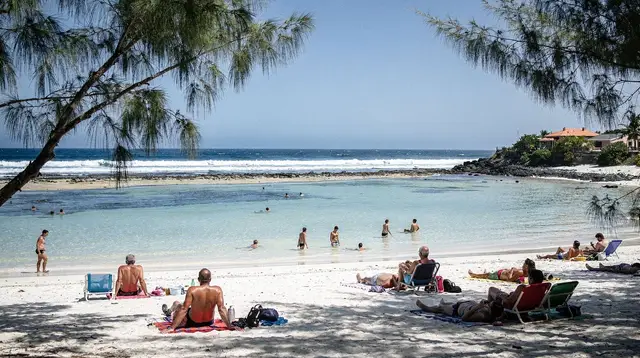
Why the west coast is different from the rest of Réunion
Réunion sits in the trade winds, and the west coast is the side that misses most of them. While the east coast soaks in rain most weeks of the year, the strip running from Saint-Paul down through Saint-Gilles-les-Bains, L’Hermitage, La Saline-les-Bains and Saint-Leu to L’Étang-Salé stays dry, warm and reliably sunny for most of the year. It’s also the only part of the island with a proper lagoon: a shallow, calm band of turquoise water held in by a coral reef, roughly 12 km long in total, broken into separate stretches at Saint-Gilles/L’Hermitage, La Saline and Saint-Leu.
That combination — sun, flat water, beach bars and a marina — is why most visitors base themselves here for at least a couple of nights, even if their real reason for coming to Réunion Island is the volcano or the cirques. This page covers the coast from Saint-Paul to L’Étang-Salé. For the belvedere at the Maido and the trek into Mafate, both reached from above this same coast, see the cirques page; for Saint-Pierre and the wild south beyond L’Étang-Salé, see the south region page.
Saint-Paul: the gateway, not the destination
Saint-Paul is the first big town on the west coast heading down from Saint-Denis, and most people pass through it rather than stop. It has a genuine local flavour — a lively Friday and Sunday market along the seafront, a Muslim quarter, and some of the oldest colonial buildings on the island — but the beaches worth stopping for start a little further south. If you’re driving down from the airport, Saint-Paul is roughly the halfway point; budget 25–35 minutes from here to Saint-Gilles-les-Bains, more at rush hour on the coastal road.
Saint-Gilles-les-Bains and L’Hermitage: the heart of the lagoon
Saint-Gilles-les-Bains is the west coast’s main resort town: a working fishing and pleasure-boat port, a strip of restaurants and beach bars, and the closest thing Réunion has to a conventional seaside holiday base. The Aquarium de La Réunion, next to the port, is a reasonable rainy-hour stop and a good primer before getting in the water yourself.
Immediately south, L’Hermitage is where the lagoon is at its widest and calmest, backed by casuarina trees that give real shade — unusual on this coast. This stretch is also the departure point for most boat trips: whale and dolphin watching, sunset cruises, and snorkeling excursions out to the edge of the reef. If you want a half-day on the water rather than just the beach, this is where it starts.
This is the one part of Réunion where swimming is genuinely encouraged — but even here, only inside the lagoon. The water beyond the reef, in the open channel, is off-limits: swimming and surfing outside the lagoon and outside supervised, protected zones have been banned by prefectural order because of shark risk, and the ban is enforced. Stay inside the reef, respect the buoyed limits, and don’t be tempted by how calm the open water looks from the beach — the ban applies whether or not anyone is watching.
The reef itself is part of the Réserve naturelle marine de La Réunion, created in 2007 to protect a coral system that’s already under pressure from heat and runoff. Standing on coral, even briefly, kills it; use reef-safe sunscreen and keep fins off the bottom.
a guided snorkeling outing inside the lagoon is the easiest way to see the reef properly without guessing where it’s safe to go, especially on a first visit. For a slower pace, a clear-bottom kayak tour of the lagoon lets you watch fish and coral from the surface without getting in the water at all, which works well with young kids.
La Saline-les-Bains: quieter, same lagoon
A short drive south of L’Hermitage, La Saline-les-Bains is the continuation of the same lagoon system, generally with fewer people and a more residential, less touristy feel. The beach here is wide and the water shallow a long way out, which makes it a good choice for families with small children — but the shark-risk rule is exactly the same: lagoon only, never past the reef line, and pay attention to any closed sections after heavy rain, when runoff can trigger temporary swimming bans even inside protected areas.
Whale season: June/July to October
From roughly June–July through October, humpback whales pass along the west coast on their winter migration, and sightings from Saint-Gilles’s marina out toward Saint-Leu are common enough that several operators run dedicated trips. It is never a guaranteed sighting — these are wild animals on their own schedule — and approach rules (minimum distances, no chasing, engines cut near a pod) are enforced under a formal approach charter, which any operator worth booking will follow without being asked.
a boat safari from Saint-Gilles for dolphins, whales and turtles is the standard way to try for a sighting in season; outside whale season the same boats still reliably find spinner dolphins and green turtles closer to shore.
Saint-Leu: paragliding, turtles and the sugar-mill museum
Saint-Leu, roughly 20–25 minutes south of Saint-Gilles, is best known for one thing: it’s one of the best paragliding sites in Europe, let alone the Indian Ocean. Thermals rising off the coastal cliffs give long, smooth flights with the lagoon and reef laid out below, and tandem flights need no experience — you’re strapped in front of a licensed pilot who does the flying. Flights typically launch from the hillside above town and land on the beach, weather permitting; mornings tend to be calmer than afternoons.
a tandem paragliding flight over the bay of Saint-Leu is the single most-booked activity on this coast, and for good reason: it’s a genuinely different view of the lagoon and the mountains behind it, condensed into 15–25 minutes in the air.
On the ground, Kélonia, just north of Saint-Leu’s town centre, is a marine turtle observatory and rehabilitation centre — part aquarium, part working conservation site, with a hospital area for injured turtles found around the island. It’s one of the better family stops on the whole west coast and works as a rainy-morning fallback. Stella Matutina, a former sugar mill turned museum a little further south, covers the island’s plantation and sugar history in more depth than most visitors expect to want, and rewards an hour if that history interests you.
Saint-Leu also has a smaller, more sheltered stretch of lagoon than Saint-Gilles, popular with snorkelers and beginner surfers on the outer swell — again, strictly inside the marked safe zones.
L’Étang-Salé: black sand, and where this coast ends
South of Saint-Leu, the coast changes character at L’Étang-Salé: the white coral sand gives way to black volcanic sand, backed by a filao (casuarina) forest that’s genuinely pleasant to walk or picnic in. This is the southern edge of what this page covers — south of here the coast becomes the South region, centred on Saint-Pierre, with its own market, nightlife and airport. See the south page for that stretch, and the wild south day trip guide if you’re planning to see both in one long day from a West Coast base.
L’Étang-Salé’s beach is more exposed and the surf stronger than at Saint-Gilles or La Saline, which is part of its appeal for surfers but means it’s less of a straightforward swimming beach for casual visitors — check conditions and any posted flags before getting in.
The Maido: this coast’s belvedere, not its destination
Above Saint-Paul, a switchback road climbs roughly 2,200 m to the Maido, a viewpoint looking straight down into the cirque of Mafate. It’s technically part of the west coast’s road network — you drive up from Saint-Paul — but it belongs, in every practical sense, to the cirques: it’s the main access point for hikes into Mafate, and the view it exists for is of a cirque this page doesn’t otherwise cover. Rather than treat it as a West Coast beach-day add-on, plan it properly on the cirques and Mafate page or the Maido and Mafate guided hikes guide — and note that cloud typically rolls in from mid-morning, so it only rewards an early departure.
Getting around the west coast
A rental car is close to essential here, as it is everywhere on the island. The coastal road (Route du Littoral / RN1) connecting Saint-Denis, Saint-Paul and Saint-Gilles is prone to closures after rockfall or heavy swell — check conditions before a Saint-Denis–Saint-Gilles run rather than assuming it’s open. Within the west coast itself, distances are short: Saint-Paul to Saint-Gilles is about 15 minutes, Saint-Gilles to Saint-Leu about 20–25 minutes, Saint-Leu to L’Étang-Salé another 15–20 minutes. The Car Jaune bus network connects these towns along the coast and is workable if you’re not planning to head up into the Hauts.
| Town | Best for | From Saint-Gilles |
|---|---|---|
| Saint-Paul | Market, colonial old town | 15 min |
| Saint-Gilles-les-Bains | Lagoon, port, restaurants | — |
| L’Hermitage | Widest, shadiest lagoon, boat trips | 5–10 min |
| La Saline-les-Bains | Quieter lagoon, families | 10 min |
| Saint-Leu | Paragliding, Kélonia | 20–25 min |
| L’Étang-Salé | Black-sand beach, surf | 35–45 min |
A realistic two-day plan
Day one: morning in the lagoon at L’Hermitage or Saint-Gilles, an afternoon boat trip for dolphins, turtles and (in season) whales, dinner on the Saint-Gilles seafront. Day two: drive to Saint-Leu for a morning paragliding flight before the wind picks up, Kélonia in the early afternoon, then either La Saline-les-Bains for a last lagoon swim or L’Étang-Salé for the black-sand beach and forest walk on the way back north or on toward Saint-Pierre. Add a half-day for the Maido only if you’re also planning a Mafate hike — otherwise it’s a detour that costs most of a morning for a viewpoint, however good.
Prices and what to expect to pay
Lagoon access itself is free — the cost on this coast is activities and boat trips. A guided snorkeling outing in the lagoon typically runs €35–60 per person; a tandem paragliding flight €70–100; a whale or dolphin boat safari in season €45–75. A simple lunch on the Saint-Gilles seafront runs €12–20 per person, more at the better-known beach restaurants. As everywhere on the island, treat these as indicative ranges and check the current price on the operator’s own listing before booking.
West coast FAQ: lagoon, swimming and Saint-Leu
Can you swim anywhere on the west coast, or only in specific spots?
Only inside the lagoon at Saint-Gilles-les-Bains, L’Hermitage, La Saline-les-Bains and the sheltered part of Saint-Leu, or in other zones specifically marked and supervised. Swimming and surfing in open water beyond the reef are banned by prefectural order across Réunion because of shark risk, and the west coast lagoon is exactly why this coast, more than any other, is where people actually swim.
Is the west coast lagoon safe from sharks?
The lagoon itself, inside the reef, is the area the swimming ban was designed to keep safe by excluding open water. It isn’t a guarantee, but it’s the reasoning behind the rule: stay inside the reef and inside marked zones, and don’t cross the line into open water regardless of how calm it looks.
When is the best time to see whales on the west coast?
Roughly June/July through October, peaking in the cooler months of the austral winter. Sightings are common in season on boat trips from Saint-Gilles, but never guaranteed — these are wild, migrating animals.
Do I need paragliding experience to fly at Saint-Leu?
No. Tandem flights pair you with a licensed pilot who controls the flight; you’re a passenger. No prior experience is needed, and flights are generally suitable from around age 4–5 upward, though age and weight limits vary by operator.
Is L’Étang-Salé’s black sand beach good for swimming?
It’s a more exposed beach with stronger surf than the lagoon beaches further north, better known for surfing than casual swimming. Check posted conditions and flags before getting in, and treat it as a beach-and-forest stop rather than a lagoon-style swim.
How far is the Maido from Saint-Gilles, and is it worth the trip?
About 45–60 minutes by road from Saint-Gilles up through Saint-Paul. It’s worth it specifically for the view into Mafate and as a starting point for a Mafate hike; as a standalone half-day from the beach, weigh the drive and the risk of cloud cover against the lagoon and coast activities on this page.
Can I base myself on the west coast for a whole Réunion trip?
You can, and many visitors do for the beach portion of a longer stay, but it isn’t central for the volcano, the cirques’ interiors or the wild south — all of those involve a real drive. Most itineraries treat the west coast as 2–4 nights within a longer loop rather than a single base for the whole island.
What’s the difference between this page and the South region page?
This page covers the coast from Saint-Paul down to L’Étang-Salé — the dry, leeward side with the lagoon. The south region picks up from Saint-Pierre onward: the market town, Pierrefonds airport, and the wild south’s lava coast around Saint-Joseph and Saint-Philippe.
Plan the rest of the coast with the things to do in Saint-Gilles guide and the things to do in Saint-Leu guide, check where to swim safely across the island, and see the best beaches in Réunion for how this coast compares to the rest of the island. For a short first visit, the weekend in Réunion Island itinerary builds a West Coast base into a two-day plan, and the best time to visit guide covers how the dry season here lines up with weather elsewhere on the island.