Whale and dolphin watching from Saint-Gilles-les-Bains
When can you see whales and dolphins from Saint-Gilles-les-Bains?
Spinner and bottlenose dolphins are resident year-round in the bay off Saint-Gilles, so most boat trips see dolphins on a given morning. Humpback whales are seasonal, present roughly from June-July to October, with sightings never guaranteed on any single outing.
What a whale and dolphin trip from Saint-Gilles actually is
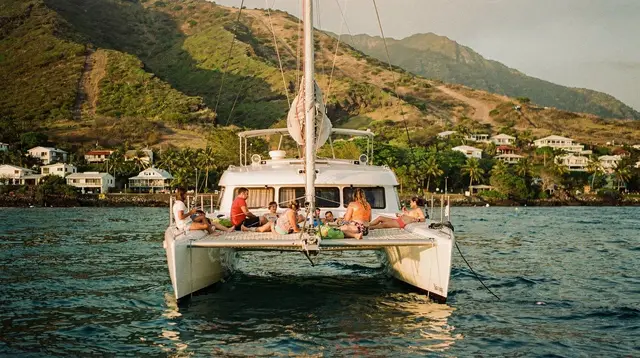
The marina at Saint-Gilles-les-Bains is the departure point for most of the west coast’s boat traffic, and one branch of that traffic is dedicated wildlife watching: small or mid-sized boats going out specifically to find spinner dolphins, bottlenose dolphins, and, in season, humpback whales, along the leeward coast between Saint-Gilles and Saint-Leu. This is a different product from the sunset catamaran cruise that leaves from the same marina: that trip is built around a relaxed sail, drinks, and the evening light, with no wildlife objective and no expectation of finding anything in particular. A dolphin and whale watching outing runs on a different rhythm, usually earlier in the day, with the crew actively scanning the water and adjusting course around what they see. If your priority is spotting animals rather than a scenic sail, book the wildlife trip, not the sunset one.
It is also worth separating this from the helicopter flights that leave from near the same stretch of coast. A helicopter shows you the coastline, the lagoon’s colours, and sometimes shapes in the water from above; a boat trip puts you at sea level, closer to the animals when conditions allow, and moving at their pace rather than yours. Both are legitimate ways to experience the coast, but they answer different questions: one is about landscape from the air, the other is about marine life from the water.
Book a dolphin and whale watching trip from Saint-Gilles-les-BainsDolphins: a near year-round presence
Spinner dolphins and, less commonly, bottlenose dolphins are resident along Réunion’s west coast, and pods are seen off Saint-Gilles on most days of the year. Spinner dolphins in particular tend to rest in sheltered bays during the morning after a night spent feeding further offshore, which is part of why many trips leave early. Groups can number from a handful of animals to several dozen, and while sightings are frequent, they are still wild animals moving on their own schedule: a boat that finds nothing on a given morning is not unheard of, just less common than a boat that does.
Because dolphins are the more reliable sighting, most operators build their standard trip around dolphins with whales as a seasonal bonus, rather than the reverse. If dolphins are your main interest and you are visiting outside whale season, this is still a trip worth doing on its own terms.
Dolphins seen from the boat are a different experience from the snorkelling and kayaking inside the Hermitage lagoon: the lagoon trip stays inside the reef, in shallow, calm water, and is about reef fish and coral rather than open-water mammals. Some visitors do both on the same stay — a morning boat trip for dolphins or whales, and a separate, slower lagoon session for snorkelling. Further down the coast, Saint-Leu offers its own snorkelling and surf spots, and boats leaving Saint-Gilles for dolphins or whales often pass along that same stretch of coast without stopping there.
Whales: a seasonal visitor, not a year-round certainty
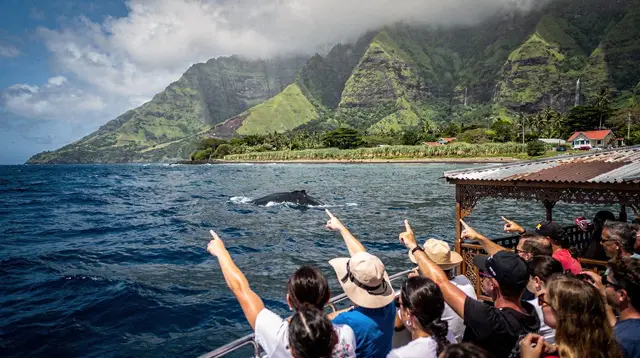
Humpback whales migrate to Réunion’s waters to breed and calve, arriving roughly from June-July and staying, in decreasing numbers, into October. Peak sightings generally cluster around August and September, when boats are more likely to encounter mothers with calves, and sometimes males engaged in competitive or courtship behaviour near the surface. Outside this window — the austral summer months from November to May — whale sightings drop close to zero, and trips during that period are effectively dolphin watching by default, whatever the marketing says.
Even within the season, a trip is not a guarantee. Whale distribution shifts from week to week, sea conditions affect visibility, and some days a boat covers a wide stretch of coast without finding an animal close enough to observe properly. Operators with strong local knowledge improve the odds, but nobody can promise a whale on a specific outing, and a guide claiming otherwise is overselling the product. Treat “whale season” as meaning good odds over several trips, not a guarantee on one morning.
| Period | What to expect |
|---|---|
| June–July | Whales arriving; numbers building, sightings possible but less consistent |
| August–September | Peak season; best odds of a whale sighting, often mothers with calves |
| October | Season winding down; whales departing, sightings less frequent |
| November–May | Whales largely absent; trips are effectively dolphin watching |
Whale season also happens to overlap with the tail end of the austral winter, the drier, cooler period generally considered the better window for hiking and outdoor activity across the island; the best time to visit Réunion Island guide covers how that overlap affects the rest of a trip, not just the boat outing. If a whale sighting is the anchor of your visit, an itinerary built around whale season can help sequence a few days between the coast and inland without wasting a morning tide.
The approach charter: why boats keep their distance
Réunion applies a formal whale and dolphin approach charter, developed with marine biologists and enforced through operator licensing. It sets minimum distances from the animals, limits how long a boat can stay near a group, restricts the number of boats converging on the same animal at once, and requires boats to disengage if an animal shows signs of avoidance, such as diving away or changing direction repeatedly. A reputable operator will not chase a whale, cut off its path, or crowd a mother and calf to get closer for photos. If you charter independently rather than through a licensed operator, the same rules still apply, and enforcement exists specifically because unregulated approaches have been a documented problem elsewhere on the animals’ migration routes. Expect the crew to explain the rules before departure and to prioritise the animals’ comfort over a closer view.
Some licensed operators offer limited, supervised in-water observation — snorkelling near, not swimming after, dolphins or whales — under conditions set by the same charter, and only when the animals’ behaviour allows it. This is never promised in advance and depends entirely on what the crew judges appropriate on the day.
This caution is not incidental to the product; it is closer to its point. The debate over whether swimming with dolphins in Réunion is ethical is a real one, and worth reading before booking a trip that advertises swimming as a feature rather than a rare possibility. Operators who present in-water time as guaranteed, or who position boats to cut off an animal’s path for a better photo, are working against the charter rather than within it, whatever their marketing says.
Consider an underwater-focused dolphin and whale watching excursion from Le PortBooking practicalities
Trips leave from the marina at Saint-Gilles-les-Bains, generally in the morning when the sea is calmer and, for dolphins, when resting pods are more likely to be found close to shore. Expect a duration of roughly 1.5 to 3 hours depending on the operator and boat type, from small rigid-hull inflatables to larger catamarans that also run other excursions. Prices typically run from about €50 to €90 per adult for a standard outing, with underwater-observation or longer combined trips priced higher; treat any figure here as a starting point and check the operator’s page for the current rate.
Morning sea conditions on this stretch of the leeward coast are usually manageable, but this is still open ocean, not the sheltered lagoon: expect some motion, bring a light layer against the wind, and consider motion-sickness precautions if you are prone to it. Book in advance during peak whale season (August–September), when demand from both visitors and school-holiday families pushes morning departures to sell out days ahead.
Since most trips leave early, where you sleep the night before matters more than it might for an afternoon activity. Staying in Saint-Gilles itself removes any transfer time before an early departure; the Saint-Gilles versus Saint-Leu comparison covers the trade-offs if you are still deciding a base on the west coast. Visitors flying in and out via Roland-Garros airport should also build in enough time on the transfer day, since the drive from the north to Saint-Gilles is not instant and an early-morning boat slot on your first full day can be tight to make.
Compare a combined dolphin, whale and seabed boat trip from the port of Saint-Gilles-les-BainsIf you’d rather combine wildlife watching with a broader look at the coastline, a general sea trip covers more ground but with less focus on any one species.
Look at a broader Réunion Island sea trip and cruise tourSwimming stays a separate question
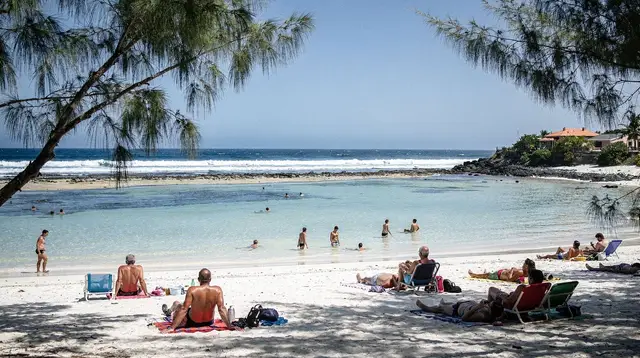
Nothing about a boat trip changes where it is safe or legal to swim on this coast. Because of shark risk, open-water swimming and water sports outside the lagoon and other supervised or protected zones are banned by prefectural order along Réunion’s west coast, including the waters off Saint-Gilles that these boats cross. The lagoon itself, from Saint-Gilles and l’Hermitage down to La Saline-les-Bains, remains the place to swim and snorkel on your own.
A whale or dolphin trip does not include, and should never be confused with, an invitation to enter the open water independently; any in-water observation on a licensed trip is supervised, brief, and only at the crew’s discretion. The broader question of where it is safe to swim around Réunion, and why shark risk shapes the rules it does, is worth reading before assuming any stretch of open coast is open water in the recreational sense, whatever it looks like from a boat.
Planning around the season
If seeing a whale is the main reason for your trip, plan your visit for August or September and treat any sighting on a specific outing as likely rather than certain. If you are visiting outside that window, or whale timing isn’t the deciding factor, dolphin watching off Saint-Gilles is a solid outing nearly any time of year. Either way, pair it with a look at things to do in Saint-Gilles or check general guidance on the best time to visit Réunion Island before locking in dates, since whale season overlaps with some of the island’s busier travel weeks. If you want month-by-month detail beyond the whale calendar — rainfall, temperature, and how the cyclone season factors in — the Réunion weather by month guide lays that out separately.
Fitting it into a wider west coast stay
A whale and dolphin trip is usually one morning inside a longer stay on the west coast, and it pairs easily with activities that do not compete for the same time slot. Divers based in Saint-Gilles often go out in the afternoon after an early boat trip; the scuba diving in Saint-Gilles guide covers sites and operators along the same stretch of reef the wildlife boats cross on their way out. Travellers building a full west coast itinerary, rather than a single activity, may also find it useful to compare this trip against the sunset catamaran cruise mentioned above, since the two together cover most of what boat traffic out of the marina actually offers: one early and wildlife-focused, one in the evening and purely scenic.
For a broader sense of what else sits within reach of Saint-Gilles on a given day, the things to do in Saint-Leu guide covers the next town down the coast, reachable by the same road the wildlife boats parallel from the water.
Frequently asked questions about whale and dolphin watching in Saint-Gilles
When is whale season in Réunion?
Humpback whales are present in Réunion waters roughly from June-July to October, with numbers usually peaking between August and September. Outside this window, boat trips focus on the resident dolphin pods instead.
Are dolphin and whale sightings guaranteed on these boat trips?
No. Operators know where pods and whales are commonly seen, but the ocean is not a zoo. Dolphins are spotted on most outings; whale sightings during the season are likely but never certain from one trip to the next.
How close can the boat get to a whale?
Boats follow a formal approach charter with minimum distances, capped approach time, and a limit on the number of boats near one animal at once. Crews will not chase a whale that is moving away or diving to avoid the boat.
Can I swim with the whales or dolphins?
Some licensed operators offer supervised in-water observation from the boat under strict conditions, but this depends on the animals’ behaviour on the day and is never promised in advance. Unsupervised swimming toward whales or dolphins is not permitted.
Where do the boats leave from?
Trips depart from the marina at Saint-Gilles-les-Bains, on the west coast, inside the lagoon channel before heading out along the leeward coast toward Saint-Leu or La Saline-les-Bains.
How long does a whale and dolphin watching trip take?
Most outings run 1.5 to 3 hours, often as an early-morning departure when the sea is calmer and sightings are considered more likely.
Is this the same as the sunset catamaran cruise from Saint-Gilles?
No. The sunset catamaran cruise is a relaxed evening sail with no wildlife objective. Whale and dolphin watching is a dedicated, slower-paced trip built around spotting and respectfully observing animals, usually earlier in the day.
Can I swim in the sea near Saint-Gilles after the trip?
Swimming and water sports are restricted to the lagoon and other supervised or protected zones because of shark risk; open-water swimming outside these areas is banned by prefectural order, regardless of what you saw from the boat.
Whale and dolphin watching cruises on GetYourGuide
Verified deep-linked GetYourGuide tours. Book through these links and we earn a small commission at no cost to you.
GetYourGuide does not provide a product photo for this activity — the image shows the meeting point, photographed by us.