A weekend in Réunion Island: lagoon, Mafate viewpoint and the volcano
Two full days is not enough to see all of Réunion Island, and this itinerary does not pretend otherwise. It skips Cilaos and the other inhabited cirques entirely — they need their own overnight and belong in a longer trip. What two days can do well is pair two zones that sit on opposite sides of the island and feel almost unrelated: the lagoon coast around Saint-Gilles-les-Bains, with a detour up to the Maïdo for the best accessible view over Mafate, and the volcano road toward Piton de la Fournaise.
The reason this works as a weekend and not as a single long day is the overnight stay. A one-day itinerary around Saint-Gilles can realistically add the Maïdo. It cannot also add the volcano — the drive back and forth from the west coast, plus the early start the volcano road demands, does not fit into a single day without turning it into a car marathon. Sleeping somewhere central between the two days is what makes the volcano possible at all.
Before you go: what this weekend does and doesn’t cover
This is a lagoon-and-viewpoints-and-lava-fields weekend, not a hiking-into-the-cirques weekend. You will look into Mafate from the Maïdo belvedere; you will not walk into it — Mafate has no road and getting inside on foot is a separate, multi-day trip covered in the Mafate planning guide. You will drive close to the Piton de la Fournaise and, conditions allowing, walk to the rim of the Dolomieu crater; you will not necessarily see lava, and no honest guide should promise that you will.
A rental car is close to mandatory for this route — see renting a car in Réunion Island and driving in Réunion Island before you land. Distances on a map are short; mountain roads are not fast, and this itinerary is built around drive time, not kilometers.
Day 1: Saint-Gilles lagoon and the Maïdo belvedere over Mafate
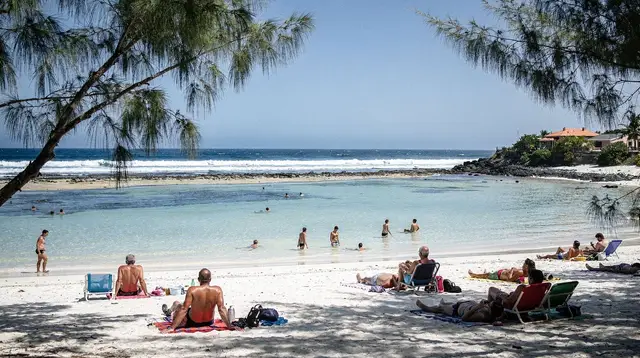
Morning — the lagoon. Base the day around Saint-Gilles-les-Bains and the neighboring lagoon at l’Hermitage. This stretch of coast is the one place on the island where swimming is straightforward: it sits inside the reef, in a marine reserve, and it’s the reference answer whenever the question “where can I actually swim in Réunion” comes up — the rest of the coastline is either open ocean, under a shark-risk swimming ban, or both. Spend the morning here: a swim, a walk along the lagoon path, maybe a first look at the port if you’re weighing a boat trip for another day.
If you want to be on the water rather than beside it, this is also where whale and dolphin trips leave from. A half-day boat trip out of Saint-Gilles watching for dolphins and, in season, humpback whales fits neatly into a lagoon morning, though sightings are never guaranteed and the whale window runs roughly June to October — outside that, expect dolphins rather than whales.
Early afternoon — up to the Maïdo. After lunch (grilled fish or a rougail on the seafront is an easy, reliable choice in Saint-Gilles or Saint-Paul), drive up to the Maïdo, at around 2,200 m above Mafate. The road climbs through the Hauts de l’Ouest and takes close to an hour from the coast, longer with traffic through Saint-Paul. Go as early in the afternoon as you can manage: clouds tend to build up from mid-to-late morning most days and can fill the cirque by early afternoon, so don’t leave this for the very end of the day if you want a clear view.
From the belvedere, the whole cirque of Mafate opens out below — the ilets, the ridgelines, the paths that are the only way in or out. There is no road down into Mafate from here or anywhere else; what you’re looking at is reached exclusively on foot, over one to three days depending on the route, or occasionally reached by the helicopters that resupply the ilets. A guided half-day trip up to the Maïdo with commentary on the Mafate view is a good option if you’d rather not navigate the mountain road yourself, and it usually times the visit for better light and clearer sky than a random afternoon arrival.
Evening. Head back down and overnight either on the west coast (Saint-Gilles or Saint-Paul) or start moving toward the center of the island if your accommodation for Day 2 is closer to Bourg-Murat — check your route before booking, since it changes your Day 2 start time.
Day 2: the volcano road, Pas de Bellecombe and the Plaine des Sables
Very early start. This is the day the overnight stay earns its place. Leave before sunrise if you can — the volcano road climbs toward Bourg-Murat and the Plaine des Cafres, and the same rule applies here as at the Maïdo: fog and cloud tend to move in as the morning goes on, often by mid-to-late morning, so an early departure is what gives you a real chance at clear views rather than a wall of grey. It’s also cold up there. Near 0°C at dawn in the cooler months is normal at this altitude — bring a warm layer and a windbreaker even if it was 28°C on the coast the day before.
Plaine des Sables and Pas de Bellecombe. Past Bourg-Murat, the road crosses the Plaine des Sables — a stretch of black volcanic desert that looks more like a different planet than a tropical island — before reaching Pas de Bellecombe, at roughly 2,300 m. This is the standard viewpoint over the volcano’s caldera, the Enclos Fouque, and the Formica Léo cinder cone. Plan on a morning here rather than a quick stop: the drive itself takes a couple of hours each way from the coast, and the road within the Plaine des Sables is slow and winding, so treat the whole outing as most of the day rather than a side errand.
If the enclos is open. Access to the Dolomieu crater rim depends entirely on whether the Enclos Fouque is open that day, and that is never guaranteed. The prefecture closes it during eruptions, heightened seismic activity, or when the volcanological observatory (OVPF-IPGP) flags elevated risk — and Piton de la Fournaise is one of the most active volcanoes in the world, so status can change with little notice. Check before you drive up. When it is open, the hike from Pas de Bellecombe to the crater rim and back takes around 5 hours round trip over exposed volcanic terrain, with no shade and no guaranteed water source. A guided hike to the Piton de la Fournaise crater is worth considering if you want local knowledge of current trail conditions rather than guessing from a noticeboard.
If the enclos is closed, or you’d rather not hike. The view from Pas de Bellecombe alone is worth the drive even without setting foot inside the enclos, and the nearby Cité du Volcan in Bourg-Murat is a solid fallback for understanding what you’re looking at, especially in poor weather. For a different angle on the same landscape without the walk, a scenic helicopter flight over the volcano covers the crater, the lava fields and often the cirques in under an hour — worth booking a day in advance since flights depend on clear morning skies, the same window you’re chasing on foot.
Afternoon — heading back. However you spend the morning, plan to be off the summit road by early-to-mid afternoon; cloud cover rarely clears once it sets in, and there’s little reason to linger once the view is gone. If you have time before your flight or the end of your stay, the drive back toward the coast passes through the Plaine des Cafres, with easy stops for local produce — lentils, honey, strawberries in season — before you reach lower altitude and warmer air again.
What this weekend leaves out
Two days, honestly used, cover a lagoon swim, one high-altitude viewpoint over Mafate, and one real attempt at the volcano — that’s already a lot of driving and altitude change for a short trip. It does not include Cilaos or Salazie, an actual trek into Mafate, the wild south coast, or the east coast waterfalls. If any of those matter to you, look at a three-day or one-week itinerary instead — trying to add them to this weekend just turns two good days into two rushed ones.
Practical notes for this itinerary
| Day | Focus | Approx. drive time from coast | Watch for |
|---|---|---|---|
| Day 1 | Saint-Gilles lagoon + Maïdo | ~1 hour up to Maïdo | Afternoon cloud building over Mafate |
| Day 2 | Volcano road + Pas de Bellecombe | A couple of hours each way to Bourg-Murat and on | Enclos closures, morning fog, cold at altitude |
- Swim only in the lagoon or a supervised zone. Open-water swimming and watersports outside the reef and marked areas are banned by prefectural order because of shark risk — this applies along the whole west and south coast, not just at Saint-Gilles.
- Don’t count on lava. Whether the Enclos Fouque is open is a daily, sometimes hourly, decision by the authorities. Build in a plan B (the viewpoint alone, the Cité du Volcan, or a helicopter flight) rather than a hike you’re counting on.
- Go early both days. Cloud on the Maïdo and fog on the volcano road both tend to build from mid-morning onward. An early departure is the single biggest factor in whether you actually see anything.
- Réunion is not Mauritius. They’re neighboring islands but separate countries — Réunion is French territory, in euros, and outside the Schengen area even though it’s in the EU, so a Schengen visa alone doesn’t cover it. See entry requirements for Réunion Island if you’re not an EU or EEA national.
- A car is close to essential. Public transport (Car Jaune) connects coastal towns but is impractical for the Maïdo and volcano roads on this schedule.
FAQ about this Réunion Island weekend itinerary
Is two days enough for Réunion Island?
Two days is enough for a focused sample — one lagoon day with the Maïdo, one volcano day — but not for the whole island. For a fuller picture including the cirques, plan on four to seven days instead.
Can I do the volcano and the Maïdo in a single day?
It’s possible only if you cut one of them short, and most travelers find it too rushed given the drive times and the early starts both viewpoints reward. Splitting them across two days with an overnight in between, as in this itinerary, gives each one a fair morning rather than a hurried stop.
Will I definitely be able to hike to the volcano crater?
No. Access to the Dolomieu crater depends on the Enclos Fouque being open, which the prefecture decides based on volcanic activity and can change with little warning. Check the current status before driving up, and have a backup plan such as the Pas de Bellecombe viewpoint alone.
Can I see Mafate up close on this itinerary?
You’ll see it from above, from the Maïdo belvedere — not from inside it. Mafate has no road, so reaching the ilets themselves means a dedicated trek of one to three days, which doesn’t fit a two-day trip built around the lagoon and the volcano.
Where should I stay for this two-day route?
Saint-Gilles-les-Bains or Saint-Paul works well for Day 1. For Day 2, somewhere closer to the center of the island (around Bourg-Murat or the Plaine des Cafres) shortens the early-morning drive to the volcano road, though returning to the west coast overnight also works if you’re comfortable with a longer first stretch before sunrise.
Is it safe to swim in Réunion Island during this trip?
Only inside the lagoon at Saint-Gilles/l’Hermitage or other supervised, protected zones. Swimming and watersports outside those areas are prohibited by prefectural order due to shark risk along the west and south coasts.
What should I pack for a weekend that includes the volcano?
Beachwear for the lagoon day, but also a warm layer, a windbreaker, sturdy shoes and sun protection for the volcano day — temperatures near the summit can approach freezing at dawn even when the coast is warm and humid.
Do I need to book the volcano hike or helicopter flight in advance?
Yes, ideally a day or two ahead. Both depend on clear morning weather and limited daily capacity, and conditions on the mountain can change the plan on short notice, so flexibility around your exact date helps.
tours.2 days
Verified deep-linked GetYourGuide tours. Book through these links and we earn a small commission at no cost to you.
GetYourGuide does not provide a product photo for this activity — the image shows the meeting point, photographed by us.