Things to do in Cilaos: canyoning, thermal springs and the road with 400 bends
What is there to do in Cilaos?
Cilaos is Réunion's most road-accessible cirque and its most varied for activities: canyoning at Fleurs Jaunes, Gobert and Bras Rouge, the classic ascent of Piton des Neiges with a night at the Caverne Dufour gîte, thermal springs, and local lentils and wine. Getting there is the real effort — the road from Saint-Louis winds through roughly 400 bends.
The road first, the cirque second
Of Réunion’s three cirques, Cilaos is the only one you can drive into. That single fact shapes almost everything about visiting it. Salazie is reachable by a gentler road from Saint-André; Mafate has no road at all. Cilaos sits in between: accessible, but not easy. The RN5 climbs from Saint-Louis on the west coast through a series of switchbacks commonly counted at around 400, gaining roughly 1,200 metres over about 35 kilometres. The distance on a map looks trivial. In practice, plan on close to an hour of continuous, low-gear driving, with no realistic stops if you want to keep momentum, and considerably longer if you pull over at the viewpoints, which are worth it, or if you’re driving in cloud or after dark, which is worth avoiding.
This is the honest starting point for a guide to things to do in Cilaos: budget the drive as an experience in its own right, not a formality between you and the activities. Car sickness is common on this road; if anyone in your group is prone to it, take the front seat, look at the horizon rather than a phone, and consider a short break at one of the pull-offs partway up rather than pushing straight through.
Once you’re in the cirque, though, Cilaos rewards the effort with more variety than either of the other two. Where Salazie is mostly about cascades and a postcard village, and Mafate is entirely about multi-day trekking with no road access, Cilaos combines a real activity menu: canyoning, a serious high-altitude hike, thermal springs, and a small but genuine local food and wine culture, all within a compact village base.
Canyoning capital: Fleurs Jaunes, Gobert, Bras Rouge
Cilaos is widely considered the canyoning capital of Réunion Island, and the reputation holds up. The cirque’s steep, water-carved terrain produces several routes within a short drive of the village, each with a different character.
Fleurs Jaunes is the best-known and most frequently run route: a vertical, mineral canyon with a sequence of jumps, slides and abseils set against panoramic views back over the cirque. Most operators pitch it as accessible to a reasonably fit beginner with a certified guide, typically taking a half-day including transfer and equipment.
a half-day canyoning descent through the Fleurs Jaunes route, jumps and abseils includedGobert and Bras Rouge sit further down the difficulty and popularity list but offer their own draws — Bras Rouge in particular is often run as a longer, more aquatic descent that finishes closer to Cilaos village, with more swimming and fewer technical abseils than Fleurs Jaunes.
a longer, water-focused canyoning route from Bras Rouge down toward CilaosWhichever route you choose, book with a certified guide and confirm conditions the day before: canyons close after heavy rain, and water levels can change fast in this terrain. None of these routes are self-guided outings — treat “canyoning in Cilaos” as shorthand for “canyoning with a licensed operator based in Cilaos,” never as something to improvise with a wetsuit and a map. For a broader look at where canyoning fits across the island, see canyoning in Réunion Island.
Piton des Neiges: the classic ascent, and why it isn’t the volcano
Cilaos is the most common starting point for climbing Piton des Neiges, at 3,070 metres the highest point on Réunion Island and the highest peak in the Indian Ocean. It is worth stating plainly, because the two names get confused constantly: Piton des Neiges is an extinct volcano at the centre of the island, above Cilaos. It is not Piton de la Fournaise, the active volcano in the south-east reached from Bourg-Murat by a completely different road. If you’re after lava fields, the Pas de Bellecombe and the Plaine des Sables, that’s a separate trip covered on the Piton de la Fournaise volcano tours guide — this page stays with the dormant giant above Cilaos.
The standard route to the summit starts from Cilaos and climbs to the Caverne Dufour gîte, roughly four to five hours of steady, sustained ascent through forest and then more open, rocky terrain. Most hikers overnight at the gîte, then set off again well before dawn — typically around 2:00 to 3:00 in the morning — to reach the summit for sunrise, a further one and a half to two hours from the gîte. The reward, on a clear morning, is a 360-degree view over the whole island as the sun comes up, often above a sea of cloud filling the lowlands.
This is not a casual add-on to a canyoning day. Gîte beds at Caverne Dufour are limited and book out, particularly through the austral winter (May to October) when clear skies make the summit push most reliable — reserve weeks in advance, not the day before. Nights near the summit can approach freezing even outside the coolest months, so pack a proper warm layer regardless of how hot it feels in the village below. If you’d rather see the peak than climb it, a scenic flight over the summit is the alternative:
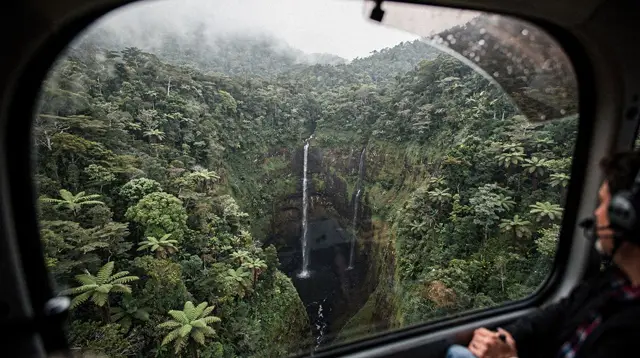
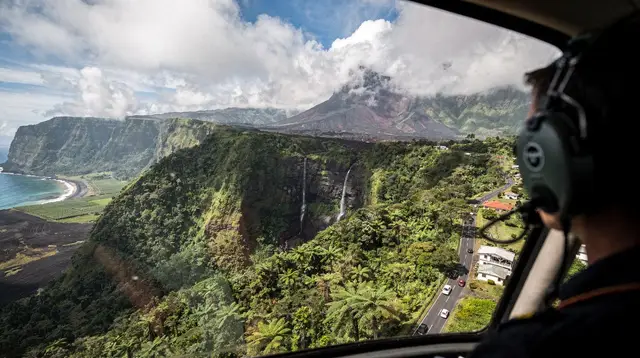
a scenic flight passing above Piton des Neiges for those who’d rather see the summit from the airFor the full planning detail on gear, timing and gîte booking, see the dedicated Piton des Neiges summit hike guide.
Thermal springs, lentils and wine: the slower side of Cilaos
Not every hour in Cilaos needs to involve a harness or hiking boots. The village has a modest thermal spring facility, a legacy of the mineral waters that gave Cilaos its name — worth an hour or two as a low-key stop after a canyoning session or before the drive back down, rather than a destination in its own right.
More distinctive is what grows here. Cilaos’s terraced slopes and altitude produce the island’s best-known lentils (lentilles de Cilaos), a genuine local specialty served in créole restaurants across the cirque and sold in small shops in the village. The cirque also sustains a small local wine production — modest by any international standard, but a curiosity worth tasting given how few places in the Indian Ocean grow wine grapes at all. A walk through the village market, when it’s running, or a stop at one of the small producers, rounds out a day that would otherwise be entirely outdoor-activity-driven.
A one-day plan versus staying overnight
Most visitors approach Cilaos as a long day trip from the west coast, and that works: leave Saint-Gilles or the surrounding coast early, allow the better part of an hour for the drive up, spend the middle of the day on a canyoning session or a walk around the village and springs, and drive back down before dusk to avoid the road at low light. A guided full-day option covers the drive, a village stop and a short activity without you needing to plan the logistics yourself:
a full-day guided tour of the Cirque de Cilaos, including breakfast and a village stopStaying overnight makes more sense if the Piton des Neiges summit hike is on your list, since the pre-dawn departure from Caverne Dufour effectively requires it, or if you simply want to spread canyoning, the springs and the village market across two unhurried days rather than one long one. For a structured day-trip itinerary from the coast, see Cilaos day trip from Saint-Gilles; for comparing Cilaos against the island’s other cirques before you commit, see Cilaos vs Salazie.
Cilaos versus Salazie and Mafate, briefly
It’s worth being clear about what sets Cilaos apart, since first-time visitors often assume the three cirques are interchangeable stops on the same list. Salazie is greener and wetter, reached by an easier road, and built more around cascades and the village of Hell-Bourg than around adventure activities. Mafate has no road whatsoever — it’s reached only on foot, from trailheads such as the Maïdo or the Col des Boeufs, and is a multi-day trekking destination rather than a day trip. Cilaos sits between the two: road-accessible like Salazie, but with the activity depth — canyoning, a genuine high-altitude summit hike, thermal springs — that neither of the others offers in the same combination. If you’re deciding where to base a trip around the cirques, that trade-off between ease of access and activity range is the one to weigh.
Planning notes and honest caveats
A few practical points worth carrying into any Cilaos plan:
| Activity | Typical duration | Booking lead time | Best season |
|---|---|---|---|
| Fleurs Jaunes canyoning | Half-day | A few days ahead | May–October (drier) |
| Bras Rouge canyoning | Half-day to full day | A few days ahead | May–October (drier) |
| Piton des Neiges summit hike | 2 days, 1 night at gîte | Weeks ahead for gîte beds | May–October for clear summit views |
| Thermal springs and village | 1–2 hours | Walk-in | Year-round |
| Full-day guided cirque tour | Full day | A few days ahead | Year-round, weather permitting |
Weather governs almost all of this. Cloud tends to build over the cirque as the day goes on, so an early start improves both the drive and the summit odds on a Piton des Neiges attempt. Canyoning routes close after heavy rain when water levels spike — a guide will tell you on the day, not in advance, so build a flexible day around it rather than a fixed one. And because Cilaos sits inland at altitude, temperatures run noticeably cooler than the coast; pack a layer even for a village stroll, and a proper warm layer if the summit hike is on your itinerary.
Finally, don’t extend a Cilaos day into Mafate or the volcano enclosure on a whim — they’re reached by entirely different roads and, in Mafate’s case, no road at all. Treat Cilaos as its own, self-contained day or two, and use driving in Réunion Island and the road to Cilaos and its 400 bends for the wider driving context before you set off. For general hiking planning across the island, best hikes in Réunion Island puts the Piton des Neiges route in context alongside other trails, and how hard is the Piton des Neiges climb goes deeper on fitness expectations for that specific ascent.
Things to do in Cilaos: frequently asked questions
How long does it take to drive to Cilaos?
Budget around an hour of steady, low-gear driving from Saint-Louis, with no stops, to cover the roughly 400 bends of the RN5. Add time if you’re prone to motion sickness, driving after dark, or stopping at the viewpoints along the way.
Is Cilaos the same as Piton de la Fournaise?
No. Cilaos is a cirque in the centre of Réunion Island, below Piton des Neiges (3,070 m), an extinct volcano and the island’s highest point. Piton de la Fournaise (2,632 m) is the active volcano in the south-east, reached from a different road via Bourg-Murat, and covered on its own guide.
Do I need to book the Piton des Neiges hike in advance?
Yes. The standard route climbs from Cilaos to the Caverne Dufour gîte for an overnight stop, then continues before dawn to reach the summit for sunrise. Gîte beds are limited and fill up, especially in the austral winter (May to October), so reserve weeks ahead.
What canyoning routes does Cilaos offer?
Fleurs Jaunes is the best-known route, a vertical, mineral canyon with panoramic views and jumps and abseils suited to most fitness levels with a guide. Gobert and Bras Rouge are further options, the latter often run as a longer, more aquatic descent toward Cilaos. All require a certified guide and booking ahead.
Are the Cilaos thermal springs worth visiting?
The thermal springs are a low-key, restorative stop rather than a headline attraction — useful after a canyoning day or before a long drive back, but not a reason on their own to plan a full day in Cilaos.
Can you visit Cilaos without hiking or canyoning?
Yes. The village itself, the lentil and wine tastings, the thermal springs, and the viewpoints along the access road make for a worthwhile day trip even without an activity booked, though most visitors combine the drive with at least one outdoor activity.
What is Cilaos known for producing?
Cilaos is known for its lentils (lentilles de Cilaos), grown on the cirque’s terraced slopes, and for a small local wine production — both sold in the village and served in local restaurants.
Trip planning tours and activities on GetYourGuide
Verified deep-linked GetYourGuide tours. Book through these links and we earn a small commission at no cost to you.
GetYourGuide does not provide a product photo for this activity — the image shows the meeting point, photographed by us.