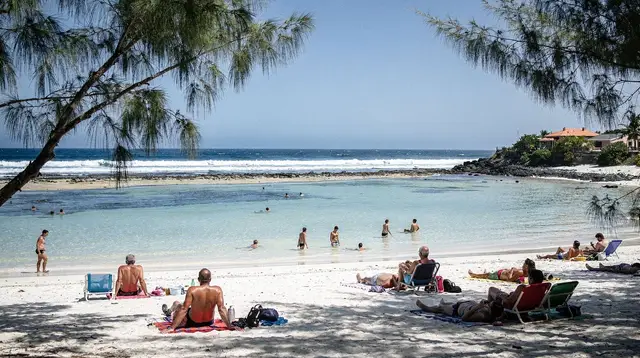
The west coast’s beach town
Saint-Gilles-les-Bains is where most visitors to Réunion Island picture the coast: white sand, a lagoon the colour of pale green glass, a working marina, and a run of restaurants and ice-cream shops along the seafront. It sits on the island’s leeward west coast, in the drier, sunnier half of Réunion, roughly 45 minutes to an hour by car from Roland-Garros airport (RUN) near Saint-Denis, and about 20 minutes north of Saint-Leu. For a first trip, it is the easiest coastal base on the island: flat streets, short walks to the beach, and enough restaurants and small hotels to not need a car every day, though you will still want one to reach the Hauts and the rest of the island.
What Saint-Gilles is not is a hiking base or a volcano base. Cilaos, Salazie and the Piton de la Fournaise are each an hour and a half to three hours away by road, and Mafate cannot be reached by car at all. Treat Saint-Gilles as the place to decompress between the mountain days: swim, eat well, go out on the water, then head back up into the Hauts. For a fuller rundown of restaurants, markets and activities beyond the beach and the boat trips covered here, see things to do in Saint-Gilles.
The lagoon: where you can actually swim
This is the single most important thing to understand about Saint-Gilles, and it applies to the whole west coast, not just here. Réunion Island has a standing prefectural order restricting swimming, surfing, bodyboarding and most other water sports to the lagoon and to other surveilled or protected zones, because of shark risk in open water off the west coast. It is not a suggestion or an old rule nobody follows: it is enforced, and it exists because of a real and documented risk, not tourist caution.
The lagoon at Saint-Gilles is part of a longer protected strip that runs north to south through L’Hermitage and on to La Saline-les-Bains, all inside the Réserve naturelle marine de La Réunion, created in 2007. Inside this reef-protected water, swimming, snorkelling and paddling are the normal, safe way to enjoy the coast. Outside the reef, in open sea, none of that applies: no swimming, no surfing, no long-distance snorkelling out past the barrier. Boat trips, whale watching, deep-sea fishing and diving with a professional operator are different from unsupervised swimming and are not affected by the same restriction.
Practically, this means you plan your beach days around where the reef is, not around how the water looks. The main public beaches at Saint-Gilles — the beach in front of the town centre and the beach near the Port de Saint-Gilles marina — sit inside the lagoon. A little further along the coast, L’Hermitage and La Saline-les-Bains offer the same calm, shallow, reef-protected water with more space and fewer crowds, and they are an easy 10–15 minute drive or a flat cycle from central Saint-Gilles.
The reef is fragile, and it is protected for a reason
The coral that creates this calm lagoon is alive and slow-growing, and it does not tolerate being stood on, kicked, or touched. Inside the Réserve naturelle marine de La Réunion, walking on coral, collecting shells or marine life, and feeding fish are all discouraged or restricted. If you are snorkelling, keep a comfortable distance above the reef rather than resting your feet on it, even in shallow patches where it looks solid.
Sunscreen matters here too. Standard sunscreens contain chemical filters (oxybenzone and octinoxate are the two most commonly flagged) that contribute to coral bleaching in shallow, enclosed lagoons like this one. Reef-safe, mineral-based sunscreen (zinc oxide or titanium dioxide) is widely sold in Saint-Gilles pharmacies and supermarkets and is the better choice for a lagoon this shallow and this visited. It is a small habit that keeps the reef worth swimming over for the next visitor.
The Port de Saint-Gilles: boats, dolphins and whales
The Port de Saint-Gilles marina is the departure point for most of the west coast’s boat trips, and it is worth building a morning around even if you are not a boat person generally. Spinner dolphins live close to this stretch of coast year-round and are seen on a large share of morning outings, often riding the bow wave. From roughly July to October, humpback whales pass through Réunion’s waters to breed and calve, and boats operate under an approach charter that sets minimum distances — sightings are common in season but never guaranteed, and no honest operator will promise a whale.
a half-day boat trip from Saint-Gilles built around spotting dolphins and, in season, humpback whales is the most popular way to do this, usually a few hours out on a catamaran or rigid-hull boat with a marine guide narrating what you’re seeing. For something closer to the marina itself, a shorter dolphin, whale and seabed boat trip departing directly from the Port de Saint-Gilles covers similar ground in less time, useful if you’re also trying to fit in a beach afternoon.
If you’d rather be in the water than on top of it, a guided water-hiking outing through the lagoon toward La Saline-les-Bains stays entirely inside the reef-protected zone and is a gentler, guided way to see the lagoon’s marine life without a boat. For a full day rather than a half-day, a longer sea cruise along the west coast combines swimming stops, snorkelling and time on the water with lunch, and suits travellers who want one full day dedicated to the sea rather than splitting it between beach and boat.
Prices for a half-day dolphin and whale trip typically run from around €50 to €90 per adult; full-day cruises and combined snorkel-and-boat outings run higher. Book a day or two ahead in whale season (July–October), since good-weather mornings sell out.
Beaches: Saint-Gilles, L’Hermitage, La Saline-les-Bains
| Beach | Character | Distance from Saint-Gilles centre |
|---|---|---|
| Saint-Gilles-les-Bains (town beach) | Central, lively, close to restaurants and the marina | On site |
| L’Hermitage | Wider sand, more shade from filao trees, quieter | About 10 minutes by car or a flat 20–25 minute walk/cycle |
| La Saline-les-Bains | Long beach, popular with families, several beach restaurants | About 15 minutes by car |
All three sit inside the same protected lagoon, so the swimming rules and the fragile-reef precautions above apply equally to each. L’Hermitage tends to have the most tree shade directly behind the sand, which matters given how strong the tropical sun is even in the cooler season. La Saline-les-Bains has the most beachfront restaurant options if you want to make a full day of it without driving back into town.
Mid-morning to early afternoon, expect the lagoon to be busiest with families, snorkellers and boat traffic heading out from the marina; the light is also better for snorkelling once the sun is higher. Early morning and late afternoon are quieter and cooler for a swim, and late afternoon light over the lagoon toward the west is one of the better sunset spots on this coast.
Snorkelling and diving beyond the lagoon
The shallow lagoon is easy snorkelling for any level of swimmer, but Saint-Gilles is also a base for scuba diving down the drop-off just beyond the reef, where the seabed falls away into deeper channels. Diving here is done with a certified local dive centre rather than independently, since the same shark-risk order that limits swimming to the lagoon also governs where diving is permitted along this coast. For a fuller look at sites, conditions and what to expect from a first dive, see scuba diving in Saint-Gilles. Saint-Leu and L’Étang-Salé, a little further down the coast, have their own dive sites and are covered separately in scuba diving in Saint-Leu and L’Étang-Salé.
If you’d rather stay on the surface, the same operators who run the whale-watching and lagoon boat trips above also run sunset catamaran outings out of the Port de Saint-Gilles — a slower way to see the coast, better suited to an evening once the beach hours are done. See Saint-Gilles catamaran and sunset cruises and, for the whale-watching side specifically, Saint-Gilles whale and dolphin watching for a deeper look at timing and what to realistically expect on the water.
Aquarium de La Réunion
For a change of pace, or for a rainy or very hot midday hour, the Aquarium de La Réunion sits right by the Port de Saint-Gilles marina and focuses on the marine life of the surrounding lagoon and reef — useful context if you’re snorkelling the same water that afternoon. It is small enough to see properly in an hour to ninety minutes and works well paired with lunch at the port.
Families, budget and who Saint-Gilles suits
Saint-Gilles’s combination of shallow, calm lagoon water, flat streets and short distances between the beach, restaurants and the aquarium makes it one of the easier bases on the island for families with young children — no long mountain drives are needed to fill a day here. See Réunion Island with kids for a wider view of what works across the island, including which day trips are realistic with children and which are better left for a return visit.
On budget, expect somewhere in the region of €40 to €120 per person per day at Saint-Gilles, excluding boat trips, depending on the level of accommodation and how often you eat out versus self-cater — supermarkets and bakeries along the seafront make self-catering straightforward if you’re watching costs. Money and payments in Réunion Island covers cards versus cash, tipping (not expected) and typical costs in more detail, and Réunion Island on a budget sets out a wider strategy for the whole trip, not just the coast.
For deciding between Saint-Gilles and its neighbour to the south, see Saint-Gilles vs Saint-Leu: where to stay, which weighs the livelier beach-town feel here against Saint-Leu’s paragliding, diving and quieter pace.
What’s deliberately left for Saint-Leu
Saint-Gilles and Saint-Leu sit on the same stretch of west coast, about 20–25 minutes apart by car, and it’s worth being clear about which activities belong where so you don’t backtrack. Paragliding — Saint-Leu is one of the best tandem paragliding spots in Europe, with launches above the coast and views down over the lagoon — is based at Saint-Leu, not Saint-Gilles. Kélonia, the sea turtle observatory, is also at Saint-Leu. If either is on your list, plan a half-day or full day there specifically; see the things to do in Saint-Leu guide for how to combine them with the town’s own beaches and reef.
Getting there and getting around
Saint-Gilles-les-Bains is reached from Roland-Garros airport (RUN) in about 45 minutes to an hour by the coastal road, and from Pierrefonds airport (ZSE) in the south in roughly an hour to an hour and fifteen minutes, traffic depending. A rental car is close to essential for the island overall, though inside Saint-Gilles and along the lagoon to L’Hermitage and La Saline-les-Bains, walking, cycling or the local Car Jaune bus service can cover a lot of ground without a car.
If you’re staying a few nights and mostly want beach, boat trips and short excursions to Saint-Leu or the Maido viewpoint, a car for part of the stay rather than the whole trip is a reasonable way to save on cost — see getting around Réunion Island for the wider picture. Renting a car is worth booking ahead of arrival, especially in whale season and school holidays when local demand rises; see renting a car in Réunion Island and driving in Réunion Island for booking timing and road notes specific to the island, including the coastal road and the mountain routes climbing out of Saint-Gilles toward the Maido.
When to visit Saint-Gilles
The austral winter, roughly May to October, is the most reliable stretch for Saint-Gilles: drier, less humid, calmer seas for boat trips, and it overlaps with humpback whale season from around July to October. The austral summer, November to April, is hotter and more humid and is also Réunion’s cyclone season, which can disrupt boat trips and flights with little notice. Best time to visit Réunion Island and Réunion Island weather by month go through this month by month in more detail; the Réunion Island cyclone season guide explains what a cyclone warning actually means for a trip in progress if you’re travelling between November and April.
Where Saint-Gilles fits in a longer trip
As a coastal base, Saint-Gilles pairs naturally with day trips rather than long stays elsewhere on the island. The Maido viewpoint over the Cirque de Mafate is about 45 minutes up into the Hauts from Saint-Gilles; Saint-Leu’s paragliding, snorkelling and Kélonia are 20–25 minutes south; Saint-Paul’s market and the drier West Coast towns are close by too. For anyone planning the full loop, see how many days in Réunion Island and the road trip around the island itinerary, both of which treat Saint-Gilles as the natural West Coast overnight stop. If a lagoon-and-boats stretch is what you’re after specifically, the whale season in Réunion, four days itinerary is built around this stretch of coast in season.
Saint-Gilles-les-Bains FAQ: swimming, boats and the lagoon
Can you swim at Saint-Gilles-les-Bains?
Yes, but only inside the lagoon protected by the coral reef, which stretches from Saint-Gilles through L’Hermitage to La Saline-les-Bains. Swimming, surfing and other water sports outside the lagoon are banned by prefectural order because of shark risk. Stay inside the marked lagoon area.
Why is swimming banned outside the lagoon in Réunion Island?
A prefectural order restricts swimming and nautical activities to the lagoon and other surveilled or protected zones because of shark risk on the west coast. It applies to the whole stretch from Saint-Paul to L’Étang-Salé, not just Saint-Gilles.
Is the water at Saint-Gilles warm enough to snorkel?
Yes, the lagoon is shallow and warm year-round, typically 24–28°C depending on season. Visibility is usually best in the dry season, from May to October.
Where do boats leave from for dolphin and whale watching?
From the Port de Saint-Gilles, the marina at the centre of town. Spinner dolphins can be seen most of the year close to the coast, while humpback whales pass through roughly from July to October.
Is Saint-Gilles-les-Bains a good base for a first visit to Réunion Island?
It works well for two to four nights thanks to easy beach access, restaurants, boat trips and a short drive to Saint-Leu, Saint-Paul and the Maido viewpoint. It is not a base for hiking the cirques or the volcano, which are 1.5 to 3 hours away by road.
Can you visit Kélonia and try paragliding from Saint-Gilles?
Kélonia and Réunion Island’s main paragliding launch sites are at Saint-Leu, about 20–25 minutes south by car, not at Saint-Gilles itself.
Is the coral reef at Saint-Gilles fragile?
Yes. The lagoon sits inside the Réserve naturelle marine de La Réunion, created in 2007. Avoid standing on or touching coral, and use a reef-safe sunscreen to limit chemical damage to the reef.