Réunion Island culture and religions: Saint-Denis, maloya and shared faith
What makes Réunion Island's culture distinct?
Réunion is a French overseas department where Catholic, Hindu, Muslim and Chinese communities settled together over three centuries of immigration and share the same streets, especially in Saint-Denis. Maloya, the island's Creole music, was recognised by Unesco as intangible cultural heritage in 2009, separate from the 2010 Unesco natural listing for the Pitons, cirques and remparts.
What “multicultural” actually looks like in Saint-Denis
Réunion Island’s population traces back to Malagasy and East African settlers, enslaved people brought from Madagascar and Mozambique, indentured workers recruited from Tamil Nadu and Gujarat after 1848, Chinese traders who arrived from the late 19th century, and French, Breton and Comorian arrivals across three centuries. None of that is abstract history here: it shows up as buildings, in Saint-Denis, close enough to walk between in an afternoon.
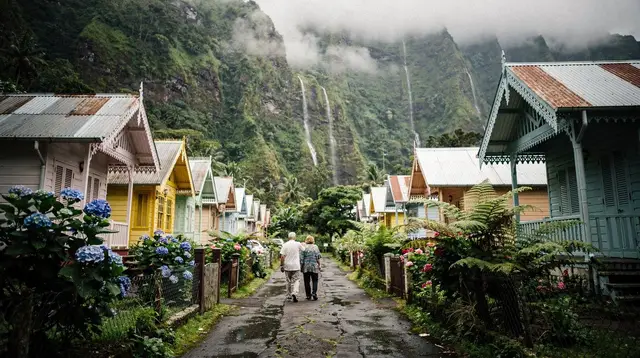
Start on the rue de Paris, the city’s oldest street, lined with 18th- and 19th-century Creole houses: wide verandas, wooden lace trim, shutters painted in the faded blues and ochres typical of colonial-era Réunion. A few minutes’ walk away stands the Grande Mosquée Noor-e-Islam, on rue Maréchal Leclerc — the oldest mosque in France, built by and for the Gujarati Muslim community that settled in Saint-Denis from the early 1900s and still worships there today. It is not preserved as a monument; it functions as a mosque, with the calls to prayer and the daily rhythm that implies, so visitors are welcome to view the courtyard respectfully but should treat it as an active place of worship rather than a photo stop.
Tamil temples sit within the same few blocks, recognisable by their brightly coloured gopuram-style gateways and the deities carved across them — a visual language closer to southern India than to metropolitan France. Chinese temples, smaller and often tucked into narrow streets, serve the descendants of Cantonese and Hakka traders who built a substantial share of Saint-Denis’s historic shopfronts. Walk the Barachois, the seafront promenade at the western edge of the old town, and you pass war memorials, colonial cannons and Creole café terraces within sight of all of it. No single itinerary explains Réunion’s religious geography better than an unhurried loop through this part of Saint-Denis, on foot, ideally starting mid-morning before the heat sets in.
This density of coexisting communities is not folklore laid on for tourists. It is how the city has worked for well over a century, and it still shapes daily life: shop hours around religious calendars, shared public holidays that cover Catholic, Hindu and Muslim observances, and a Creole language that borrows vocabulary from French, Malagasy, Tamil and African languages in roughly equal measure.
The three main communities and where to see them
| Community / faith | Visible presence in Saint-Denis | Wider island presence |
|---|---|---|
| Catholic (majority) | Cathédrale Saint-Denis, roadside chapels, church-centred village festivals | Chapels across every commune; strongest visible presence in the Hauts |
| Hindu (Tamil and North Indian) | Temples near rue de Paris; Dipavali (Diwali) lighting and ceremonies | Temples in Saint-André and Saint-Pierre |
| Muslim (largely Gujarati descent) | Grande Mosquée Noor-e-Islam | Smaller mosques in Saint-Pierre and Le Port |
| Chinese Buddhist-Taoist | Temples on side streets off rue de Paris | Family associations and shops island-wide |
None of these groups lives in isolation. Intermarriage across the categories above is common enough that many Réunionnais families hold more than one faith or ancestry within a single household, which is part of why the island resists the label “melting pot” that travel writing tends to reach for — it is less a blend than several traditions kept distinct and visible side by side, in the same streets, on the same calendar.
Maloya: a 2009 Unesco listing, not the 2010 one
Réunion appears twice in Unesco’s records, for two different reasons, and the two are worth separating clearly.
Maloya is the island’s foundational Creole music: slow, percussive, built on call-and-response vocals, the kayamb seed-rattle, the roulèr drum and the bobre musical bow. It developed among enslaved and later indentured plantation workers as a form of expression that colonial authorities actively suppressed for much of the 19th and 20th centuries — maloya gatherings were policed and, at points, banned outright, which is part of why the music carries weight beyond entertainment. Unesco inscribed maloya on the Representative List of the Intangible Cultural Heritage of Humanity in 2009. It sits in Unesco’s cultural category, alongside things like oral traditions and performing arts elsewhere in the world — a recognition of a living practice, not a physical place.
The island’s other Unesco listing, “Pitons, cirques et remparts,” was inscribed in 2010 as a natural World Heritage Site: the volcanic peaks, the three cirques of Cilaos, Salazie and Mafate, and the cliff-lined interior protected since 2007 by the Parc national de La Réunion. It recognises geology and biodiversity, not music or religion. The two listings get conflated often enough — same island, one year apart, both “Unesco” — that it is worth stating plainly: 2009 is maloya (culture), 2010 is the Pitons, cirques and remparts (nature). They have nothing else in common.
Hearing maloya live usually means timing a visit around a festival rather than expecting a nightly show. The Sakifo Musik Festival in Saint-Pierre and smaller community events tied to Fête Kaf, the 20 December commemoration of the abolition of slavery on the island, are the most reliable settings. Outside festival dates, some Saint-Denis bars and cultural centres schedule maloya evenings irregularly; asking at the tourist office on arrival is more reliable than searching for a fixed weekly slot, because there generally isn’t one.
Everyday social customs worth knowing before you land
Réunion runs on French administrative norms layered onto Creole social habits, which produces a few points worth knowing in advance rather than working out on the fly.
Tipping. Service is included in restaurant, bar and taxi prices by law, as in mainland France. No tip is expected, and Réunionnais servers won’t read its absence as rudeness. Rounding up a café bill or leaving small change after a good meal is appreciated but genuinely optional — treat it as a gesture, not an obligation, and don’t feel pressure to calculate a percentage the way some other destinations train travellers to.
Greetings. A handshake or, among people who know each other, la bise (a cheek kiss, usually one on each side) is standard, following French rather than English-speaking conventions. In more formal or first-meeting contexts, a simple handshake covers it.
Modesty at religious sites. Covered shoulders and knees are expected when viewing temples and the mosque from outside; entering any of them as a non-worshipper generally isn’t offered, and isn’t something to request. Viewing courtyards and exteriors respectfully, without loud conversation or intrusive photography of people praying, is the standard visitors are expected to meet.
Phones and connectivity. Because Réunion is a French overseas department inside the European Union, EU roaming rules apply: a European mobile plan works here exactly as it would in Marseille or Lyon, with no separate roaming charge for EU-based plans. That said, Réunion sits outside the Schengen area for border and immigration purposes — a detail that affects entry requirements, not phone bills. See our entry requirements guide for what that means for your passport or ID card.
Language. French is the official language and the one used in shops, signage and administration. Creole (Kréol Rényoné) is the everyday spoken language at home and among friends, with its own grammar rather than being “broken French.” Learning a handful of Creole greetings is noticed and appreciated, though French alone is entirely sufficient for getting around.
Festivals that put the culture on the street
Réunion’s calendar mixes Catholic, Hindu, Chinese and Creole observances, several of which are public holidays.
- 20 December (Fête Kaf): commemorates the 1848 abolition of slavery on Réunion, marked island-wide with maloya performances, markets and community gatherings — the single most significant date on the cultural calendar.
- Dipavali (Diwali): the Hindu festival of lights, celebrated by Réunion’s Tamil community with temple ceremonies and illuminated storefronts, most visible in Saint-Denis and Saint-André.
- Chinese New Year: marked with lion dances and family gatherings, particularly around Saint-Denis’s Chinese-owned businesses.
- Cavadee: a Tamil Hindu festival involving processions and, for some participants, body piercing as an act of devotion — visible mainly around temples in Saint-André and Saint-Pierre in January or February.
- Sakifo Musik Festival: a multi-day music festival in Saint-Pierre, usually in the austral winter, that programmes maloya and séga alongside international acts.
None of these are staged for visitors. Turning up respectfully, as an observer rather than a participant, is the right posture at all of them.
Building this into a visit
Saint-Denis rewards a half-day on foot more than a drive-through. Pair the rue de Paris and Grande Mosquée walk with the Barachois seafront and, if timing allows, the Jardin de l’État. Several operators run half-day and full-day Saint-Denis tours that add context a self-guided walk can miss, and the city’s own things-to-do guide breaks the neighbourhood down further.
Because this guide focuses on communities and public life rather than food, the island’s Creole cuisine and rum-distilling heritage — itself shaped by the same immigration history — gets its own treatment in our rum distilleries and Creole food guide. For travellers who want the island’s natural landmarks alongside its cultural ones, a scenic helicopter tour of the island departing from Saint-Gilles covers the cirques and the volcano from above in under an hour, useful for travellers short on time who still want to see Mafate’s terrain without the multi-day trek.
Closer to the coast, a guided snorkelling session with turtles in Saint-Gilles-les-Bains makes an easy half-day addition after a morning in Saint-Denis, in the protected lagoon rather than open water, and inland, a quad biking and buggy outing above Saint-Gilles-les-Hauts passes through the agricultural villages of the Hauts where Creole farming life continues largely unchanged.
For planning the rest of a trip around this cultural core, our first-time visitors guide, how many days to plan and a sample one-week itinerary all slot naturally around a Saint-Denis morning. If dates matter, check festivals and events and when to visit before booking flights, since several of the dates above move from year to year on the Hindu and Chinese lunar calendars. Travellers still deciding between islands should also see Réunion versus Mauritius: the two are close by air but culturally distinct, and this street-level multiculturalism is one of the clearest differences.
Frequently asked questions about culture and religion in Réunion Island
Is Réunion Island multicultural?
Yes. Malagasy, African, Indian (Tamil and Gujarati), Chinese and European ancestries mix in the Creole population, and Catholic, Hindu, Muslim, Chinese Buddhist-Taoist and Protestant communities each keep active places of worship, most visibly in Saint-Denis.
What is maloya music?
Maloya is a Creole musical form rooted in the songs of enslaved and indentured workers, built around percussion, call-and-response vocals and the kayamb rattle. Unesco added it to the Intangible Cultural Heritage list in 2009.
Is maloya the same as the Unesco World Heritage listing on Réunion?
No. Maloya’s 2009 Unesco recognition covers intangible cultural heritage, a living tradition. The island’s 2010 Unesco World Heritage listing, Pitons, cirques et remparts, covers a separate natural site: the volcanic peaks, cirques and cliffs protected by the Parc national de La Réunion. The two dates and the two categories are easy to mix up, but they recognise different things.
What is the Grande Mosquée Noor-e-Islam in Saint-Denis?
It is the oldest mosque in France, standing on the rue Maréchal Leclerc a short walk from the rue de Paris. It has served Saint-Denis’s Muslim community, largely of Gujarati Indian descent, since the 1900s and remains an active place of worship, not a museum.
Do people tip in Réunion?
No tip is expected. Service is included in restaurant and bar prices, and rounding up or leaving small change is a gesture, not a norm, unlike in some other travel destinations.
Can EU travellers use their phone plans normally in Réunion?
Yes. Réunion is a French overseas department inside the European Union, so EU roaming rules apply and European mobile plans work as they would in mainland France, even though the island sits outside the Schengen area for border checks.
Where is the best place to see Réunion’s religious diversity in one walk?
The rue de Paris and the streets around it in Saint-Denis, where Creole houses, the Grande Mosquée Noor-e-Islam, Tamil temples and Chinese temples sit within a few hundred metres of each other and of the Barachois seafront.
Is Diwali (Dipavali) celebrated in Réunion?
Yes, by the island’s Tamil and broader Hindu community, with temple ceremonies and lit storefronts in Saint-Denis and Saint-André among the more visible public celebrations of the Hindu calendar on the island.
Rum distillery and culinary tours on GetYourGuide
Verified deep-linked GetYourGuide tours. Book through these links and we earn a small commission at no cost to you.
GetYourGuide does not provide a product photo for this activity — the image shows the meeting point, photographed by us.