One week in Réunion Island: cirques, volcano and the wild south
A week is the point where Réunion Island stops forcing choices. Four or five days push most visitors to pick one cirque over the other, or the volcano over the wild south. Seven days, looped from Saint-Denis, fit both Salazie and Cilaos, a proper volcano day, and a full run down the wild south to Saint-Pierre — then a slower finish on the lagon at Saint-Gilles-les-Bains. What it buys over a shorter trip isn’t more stops, it’s nights placed where the mountain roads actually need them, so you’re not driving the route to Cilaos or the volcano road twice in the same day.
One name is deliberately absent from the day list: Mafate. It has no road in or out — only footpaths from the Maïdo, the Col des Boeufs or the Rivière des Galets — so it needs its own multi-day trek, not a stop on a driving loop. If that’s the draw, see our Mafate planning guide separately.
Why seven days changes the shape of the trip
Shorter formats — see how many days in Réunion Island — typically route through Saint-Pierre as a single wild-south stop, glancing at the coast on the way past. A week lets you treat the wild south as its own day: the Grand Brûlé lava flows, Cap Méchant, the Langevin waterfall, at a pace that isn’t squeezed against an evening in Saint-Pierre. It also means the two inhabited cirques — Cilaos and Hell-Bourg in Salazie — each get a night rather than a rushed there-and-back from the coast. And there’s slack: one day carries less fixed plan than the rest, because at this scale a spell of fog on the Maïdo, a closed volcano enclosure, or a heavy-rain day in the east is likely, not hypothetical.
Trip overview
| Day | Base | Focus |
|---|---|---|
| 1 | Saint-Denis | Arrival, Barachois, rue de Paris |
| 2 | Salazie / Hell-Bourg | Cirque roads, waterfalls, Trou de Fer viewpoint |
| 3 | Cilaos | The road with its bends, canyoning or thermal baths |
| 4 | Bourg-Murat / Plaine des Cafres | Piton de la Fournaise volcano day |
| 5 | Saint-Pierre | Wild south: Grand Brûlé, Cap Méchant |
| 6 | Saint-Gilles-les-Bains | Lagon, transfer west, margin day |
| 7 | Saint-Denis | Lagon morning, return to the airport |
Day 1: Saint-Denis
Land at Roland-Garros (RUN) and pick up your rental car — nearly indispensable for this loop; see driving in Réunion Island. Spend the afternoon in Saint-Denis: the Barachois seafront, the creole houses on the rue de Paris, and the Grande Mosquée Noor-e-Islam if it’s open to visitors. Save any ocean tour or city walking tour for here if you’d rather not drive on arrival day — see things to do in Saint-Denis for pace-setting options, including a sensory solo ceramic workshop for a slow first evening, or a local food walk through Saint-Denis to get oriented on creole cooking before the trip properly starts.
Day 2: Salazie and Hell-Bourg
Drive from Saint-Denis toward Salazie, reckoned in driving time rather than kilometres — allow the better part of a morning with stops. The cirque is the greenest and most accessible of the three, with waterfalls along the road including the Voile de la Mariée, and Hell-Bourg, one of France’s officially listed most beautiful villages. From Bélouve, a forest walk gives a distant view over the Trou de Fer gorge; a full descent into it is a guided day out on its own — see the small-group hike to the Trou de Fer or the weekly Bélouve forest walk run in French. Overnight in or near Hell-Bourg.
Day 3: Cilaos
The road into Cilaos is the trip’s best-known drive: roughly 400 bends from Saint-Louis, about an hour of steady, low-speed driving with no shortcuts — plan the whole morning around it rather than a fixed arrival time. Cilaos is the island’s canyoning base; a half-day out on Fleur Jaune canyon covers rappels through the mineral gorge with panoramic stretches between. Prefer a slower afternoon and the thermal baths are a fair trade, especially after two driving-heavy days. This is also the trailhead for the Piton des Neiges for those adding a night hike to the summit — not part of this loop’s default pace, but worth flagging if you’re tempted.
Day 4: Piton de la Fournaise
Drive out via Bourg-Murat to the Plaine des Cafres, then up the volcano road across the Plaine des Sables to Pas de Bellecombe (2,311 m). Start early: cloud typically builds over the crater rim by late morning, and it’s cold before sunrise even in the austral summer. Whether the hike into the Enclos Fouque toward Dolomieu crater is open depends on current volcanic alert status, checked at the Cité du Volcan or with the OVPF — never assume it in advance. A guided walk removes the guesswork on route and access: the Piton de la Fournaise volcano hike covers the crater trail with a local guide, or take the helicopter flight over the volcano as a weather-proof alternative if the enclosure is closed or the forecast turns. Base near Bourg-Murat or push on to Saint-Pierre that evening if the day finishes early.
Day 5: The wild south
This is the day that a shorter trip through Saint-Pierre alone doesn’t have room for. East from Saint-Pierre, past Saint-Joseph and Saint-Philippe, the wild south is basalt coastline and lava fields rather than beaches: the Grand Brûlé flows that reached the sea, the Cap Méchant cliffs, and the Notre-Dame-des-Laves chapel spared by the 1977 eruption further north at Sainte-Rose. A guided minibus route covers the coast road efficiently — the wild south waterfalls and lava route tour — or, for something more active, an SSV buggy route through the wild south. Overnight back in Saint-Pierre; the Saga du Rhum distillery or the Saturday market are worth timing around if your dates allow.
Day 6: Saint-Gilles-les-Bains and the lagon
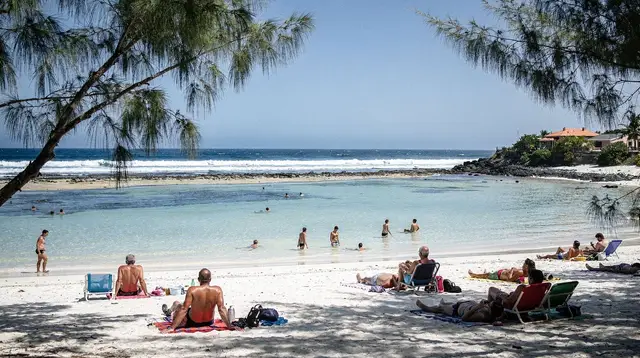
Drive the west coast to Saint-Gilles-les-Bains, where the reef-protected lagon is one of the few places on the island where swimming beyond marked, surveilled zones is not restricted by prefectural order — elsewhere the shark risk keeps open-water swimming off limits. Use this as the loop’s margin day: if fog delayed the volcano or rain pushed the wild south back, this is where a spare afternoon gets absorbed without reshuffling everything else. Otherwise, snorkel the Hermitage lagoon, or book a whale or dolphin watching trip if travelling between roughly June and October, sightings never guaranteed.
Day 7: Return via Saint-Denis
A short lagon morning, then the drive back north to Saint-Denis and on to Roland-Garros for the flight out. Traffic on the coastal road into Saint-Denis backs up at peak hours, so build in margin rather than cutting it close to a departure time.
What this itinerary leaves out
No stop covers Mafate, since it has no road and needs a dedicated multi-day trek rather than a loop stop — see the Mafate planning guide if that’s a priority. The east coast beyond Salazie’s approach (Sainte-Rose’s Anse des Cascades, the vanilla plantations around Saint-André) is also skipped; folding it in usually means trading a wild-south day or adding an eighth day. If cyclone-season timing (November to April) puts pressure on the volcano or hiking days, read the cyclone season guide before booking flights.
FAQ: planning a one-week Réunion Island loop
Is seven days enough for both cirques and the volcano?
Yes — this is the shortest loop that comfortably fits Salazie, Cilaos, the volcano and the wild south with a night in each area, rather than long there-and-back drives from a single base.
Do I need a 4x4 for this itinerary?
No. The roads to Cilaos, Salazie and the volcano are paved and manageable in a standard rental car, though narrow and slow in places. A 4x4 only matters if you’re adding off-road detours, which this loop doesn’t need.
Can I do the Piton de la Fournaise crater hike on day 4 no matter what?
No. Access to the Enclos Fouque and the Dolomieu crater trail depends on the current volcanic alert level and can be closed with little notice during unrest or an eruption. Check status locally before the day, and treat the helicopter flight as a backup that doesn’t depend on ground access.
Why isn’t Mafate part of this itinerary?
Mafate has no road; it’s reached only on foot from trailheads like the Maïdo or the Col des Boeufs. Folding it into a driving loop isn’t possible — it needs its own multi-day trek with gîte bookings made well in advance.
Is the road to Cilaos really that difficult?
It’s slow rather than dangerous: around 400 bends and roughly an hour of steady low-speed driving from Saint-Louis with no real place to make up time. Treat it as part of the day’s plan, not a quick transfer.
What’s the best time of year for this loop?
The austral winter, roughly May to October, is drier and better for the volcano and cirque roads, and it’s whale season on the west coast from around June. The austral summer (November–April) is hotter, wetter, and includes cyclone season, which can disrupt mountain-road days with little warning.
Should I book the wild south as a guided tour or self-drive?
Either works. Self-driving gives more stop flexibility along the coast road; a guided minibus or buggy tour removes the need to plan stops and works well if day 5 follows a demanding volcano day.
Is one margin day really necessary on a trip this length?
At this scale, yes — across seven days touching mountain roads, a cirque and an active volcano, at least one day of fog, rain or closure is a reasonable expectation, not a worst case. Building it into day 6 avoids reshuffling the whole loop if it happens.
tours.7 days
Verified deep-linked GetYourGuide tours. Book through these links and we earn a small commission at no cost to you.
GetYourGuide does not provide a product photo for this activity — the image shows the meeting point, photographed by us.