Réunion Island for first-time visitors
What do I need to know before visiting Réunion Island for the first time?
Réunion is a French island in the Indian Ocean, not Mauritius: it uses the euro, is in the EU but outside Schengen, and French (plus Réunion Creole) is spoken. Driving is on the right, a rental car is close to essential, and seasons run opposite to Europe, with a dry austral winter from May to October best for hiking.
Réunion or Mauritius? Two different islands
The first thing to sort out, before any packing list or flight search, is which island you are actually going to. Réunion and Mauritius sit around 40 minutes apart by plane, share a similar volcanic origin, and get mixed up constantly in casual conversation and even in some travel searches — but they are two separate countries with almost nothing administrative in common.
Mauritius is an independent state with its own government and its own currency, the Mauritian rupee. Réunion is a French overseas department and region (a full part of France, not a colony or a dependency), and it uses the euro (€). Prices, entry formalities, driving rules, and even the political status of each island differ. If your search history has both islands open in tabs, decide now which one this trip is — the practical advice in this guide, and everywhere else on this site, applies specifically to Réunion. A full side-by-side comparison, with what actually differs for a traveller, sits in Réunion vs Mauritius.
Where Réunion Island actually sits
Réunion is in the Indian Ocean, east of Madagascar and roughly 200 km southwest of Mauritius. It belongs to the Mascarene Islands group. The island is small — about 63 km across at its widest — but almost entirely mountainous, built around two volcanic massifs: the extinct Piton des Neiges (3,070 m, the highest point in the Indian Ocean) and the active Piton de la Fournaise (2,632 m) in the southeast. That volcanic geology is why distances on a map are misleading here: a 40 km drive into the interior can take two hours on switchback mountain roads.
Flights connect Réunion to mainland France (around 11 hours to Paris), to Mauritius, Madagascar, and Mayotte, landing at one of two airports: Roland-Garros (RUN) near Saint-Denis in the north, or Pierrefonds (ZSE) near Saint-Pierre in the south. Which one you fly into shapes your first night’s drive, so it’s worth checking before booking accommodation.
French, European, but not Schengen
Réunion is French territory and part of the European Union as an outermost region — but it sits outside the Schengen area. That distinction trips up a lot of first-time visitors who assume a Schengen visa or a Schengen-zone mindset covers the island automatically. It doesn’t. EU and EEA citizens travel with a valid national identity card or passport; visitors from elsewhere need to check the entry rules that apply specifically to Réunion, not to mainland France or the wider Schengen zone, via france-visas.gouv.fr. This guide stays at the level of orientation; the full breakdown of documents, formalities, and exceptions is covered separately in entry requirements for Réunion Island.
Because the island is part of France, the currency is the euro, and EU mobile roaming rules apply as they would in mainland France — a European data plan works here the same way it would in Lyon or Lisbon.
Language: French, with Réunion Creole everywhere
French is the official language and the one used for signage, menus, and official information. Réunion Creole is spoken widely in daily life, in markets, and among locals — you’ll hear it more than you’ll need to speak it, but a friendly “bonzour” goes further than English does. Outside hotels, tour desks, and the more touristy stretches of the west coast, English is genuinely limited, so it’s worth having a translation app or a few French basics ready, especially in the Hauts and the cirques.
Driving on the right, and why a car matters
Réunion drives on the right, in line with mainland France. A rental car is close to essential for most itineraries: the coastal towns are linked by a decent road network and the Car Jaune bus system, but the interior — the cirques, the volcano road, the Maido viewpoint — is really only practical to reach by car (or, for Mafate, on foot only, since no road goes there at all). Mountain roads here are slow by nature: narrow, winding, and occasionally closed after heavy rain, so plan trips by driving time rather than by kilometres on a map. The details of licences, road rules, and where car hire desks are located are covered in driving in Réunion Island and renting a car in Réunion Island; if you’d rather not drive at all, getting around by Car Jaune lays out what’s realistic without a car.
Seasons run opposite to Europe
Because Réunion sits in the southern hemisphere, its seasons are the reverse of what a European visitor expects. The austral summer runs from November to April — hot, humid, and the island’s cyclone season, with risk peaking between January and March. The austral winter, from May to October, is drier, cooler at altitude, and the season most people choose for hiking, for clearer skies over the volcano, and for the best chance of seeing humpback whales offshore. Don’t assume “summer” means July here — it means the opposite. A month-by-month breakdown lives in Réunion Island weather by month, and if you’re travelling during the November–April window, the cyclone season guide explains what that actually means for a trip without overstating the risk.
The island as a mental map: six zones
Once the basics are settled, the most useful thing for a first-time visitor is a simple mental map of the island’s zones, because almost every itinerary here is built around moving between them rather than staying in one base.
| Zone | What defines it | Good for |
|---|---|---|
| North — Saint-Denis | The capital, Creole townhouses, the Barachois seafront | Arrival, city culture, Roland-Garros airport |
| West coast | Dry, sunny, the island’s lagoon and beach base | Swimming, snorkelling, sunsets, paragliding at Saint-Leu |
| South | Saint-Pierre’s markets and nightlife, the wild south’s lava coast | A second coastal base, black-sand beaches, lava fields |
| East coast | Wet, green, vanilla and sugarcane country | Waterfalls, a quieter, rural side of the island |
| The cirques | Cilaos, Salazie, and roadless Mafate | Hiking, mountain villages, canyoning |
| The volcano | Piton de la Fournaise and its approach roads | Hiking to the crater rim, lunar landscapes |
The north, around Saint-Denis, is where most visitors land and where the island’s administrative and commercial life is concentrated — worth a walk through its Creole townhouses and along the Barachois seafront even if you’re not basing yourself there. The west coast is the island’s driest, sunniest side, home to the lagoon beaches most people picture when they imagine Réunion, and a natural first base. The south splits into Saint-Pierre’s markets and nightlife and the more remote “wild south,” where lava fields meet the ocean. The east coast is the wettest and greenest part of the island, shaped by trade winds and worth a detour rather than a base. The cirques — Cilaos, Salazie, and Mafate — are the mountain heart of the island, each reached differently and each explored primarily on foot. And the volcano, Piton de la Fournaise, is its own destination entirely, approached via a dedicated road from the Plaine des Cafres.
None of these six zones needs to be fully understood before you land — that’s what the dedicated destination pages are for — but knowing they exist, and roughly how they relate to each other, is what turns a first Réunion itinerary from a guess into a plan. Start with Saint-Denis, Saint-Gilles on the west coast, the south, the east coast, the cirques, and the volcano once you’re ready to go deeper on any one of them.
What this island is actually like on the ground
Réunion rewards travellers who come for the outdoors rather than a beach-only holiday, though the lagoon beaches are real and worth their reputation. Hiking is the island’s defining activity, with trails through the cirques and up to the volcano rim graded from easy afternoon walks to multi-day treks into Mafate. The lagoon along the west coast, protected by a coral reef, is where swimming, snorkelling, and diving happen safely — swimming outside the lagoon or unsupervised areas is restricted by local authority order because of shark risk, a rule that’s taken seriously here rather than treated as a formality.
Whale watching is seasonal, roughly June to October, when humpback whales pass close to the west coast; sightings are never guaranteed but boat operators follow an approach charter that keeps a respectful distance. Food leans firmly Creole — carri (a Réunion-style curry), rougail saucisse, samoussas — built around markets and small family-run tables rather than resort buffets. And the island’s cultural mix, visible in temples, mosques, and pagodas standing within a few streets of each other in Saint-Denis, is as much a part of a first visit as any landscape.
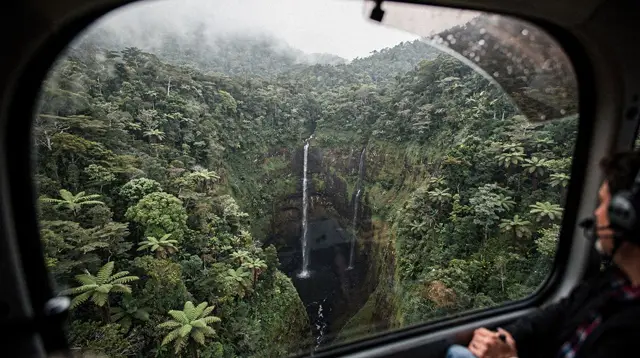
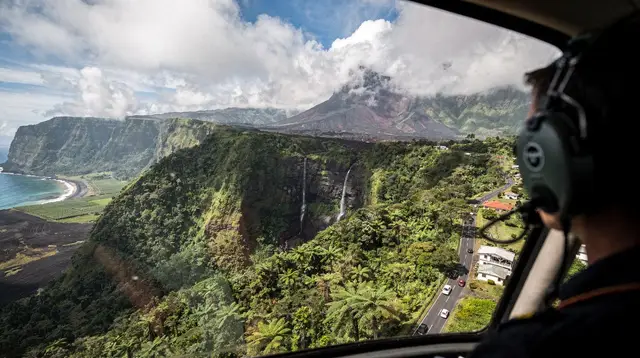
A short lagoon session is an easy way to get a first feel for the coast: a half-day snorkelling trip with turtles off Saint-Gilles-les-Bains works well on day one or two, before heading inland. For a first overview of the whole island from above, before you’ve decided which zones to prioritise on the ground, a helicopter tour over the cirques and the volcano departing from Saint-Gilles puts the six-zone map into visible perspective in under an hour, though it depends entirely on clear weather and should be booked with flexible dates in mind.
What to plan next, and what to leave for its own page
This page is deliberately a starting point, not a full itinerary. A few things are worth flagging now so you look them up properly rather than guessing:
- How long to stay and how to split time between the coast and the interior is its own question, answered in how many days in Réunion Island.
- Where to base yourself — the west coast for a beach-first trip, Saint-Pierre or Saint-Denis for something more urban, a cirque town if hiking is the priority — is covered in where to stay in Réunion Island.
- Safety questions, from swimming restrictions to volcano access during activity, get a dedicated, honest answer in is Réunion Island safe for tourists.
- Which beaches are worth the drive, and which are for looking rather than swimming, are laid out in best beaches in Réunion Island.
- If a rough itinerary shape would help before you dive into planning tools, one week in Réunion Island is a reasonable first template to adapt, and the best time to visit tool and budget tool are built to make those decisions concrete rather than theoretical.
For the outdoor activities that define most Réunion trips, browse hiking, volcano tours, and lagoon trips by zone from the things to do hub, or compare planning angles side by side, including a guided boat trip to swim near whales and dolphins in season for travellers visiting between June and October, and a full-day guided tour covering the island’s 13 essential stops for a fast, structured first overview if your trip is short.
Getting oriented: frequently asked questions about visiting Réunion Island
Is Réunion Island the same as Mauritius?
No. They are two separate islands about 40 minutes apart by plane. Réunion is a French overseas department using the euro; Mauritius is an independent country using the Mauritian rupee. Currency, entry rules, and planning logistics are entirely different between the two.
Where is Réunion Island located?
Réunion sits in the Indian Ocean, east of Madagascar and about 200 km southwest of Mauritius. It’s a French region and an outermost region of the European Union, though it is not part of the Schengen area.
Do I need a Schengen visa for Réunion Island?
A Schengen visa doesn’t automatically cover Réunion. EU and EEA citizens enter with a valid national identity card or passport; other nationalities should check the rules specific to Réunion on france-visas.gouv.fr before booking, since they can differ from mainland France’s Schengen rules.
What language do people speak in Réunion?
French is the official language, and Réunion Creole is spoken widely in daily life. English coverage is limited outside hotels and tour operators, so a few French phrases help, especially away from the coast.
Do I need a car to get around Réunion Island?
Yes, in practice. The Car Jaune bus network links coastal towns, but it’s slow into the Hauts and the cirques, so a rental car is close to essential for reaching the volcano road, Cilaos, and the Maido viewpoint.
What is the best time to visit Réunion Island?
The austral winter, from May to October, is dry and cooler and considered the best season for hiking and whale watching. The austral summer, November to April, is hot, humid, and the cyclone season, with the highest risk between January and March.
What are the main regions to plan a Réunion Island trip around?
Six broad zones work as a starting map: the north around Saint-Denis, the sunny west coast and lagoon, the south and wild south, the wet green east coast, the three cirques (Cilaos, Salazie, Mafate), and the Piton de la Fournaise volcano area.
Can I see everything in Réunion Island in one trip?
Not really, given how much of the island is mountainous and slow to cross by road. Most first-time visitors pick a coastal base, add one or two cirques, and treat the volcano as a separate day trip rather than trying to cover all six zones in depth on a single visit.
Trip planning tours and activities on GetYourGuide
Verified deep-linked GetYourGuide tours. Book through these links and we earn a small commission at no cost to you.
GetYourGuide does not provide a product photo for this activity — the image shows the meeting point, photographed by us.