Réunion vs Mauritius: what actually sets them apart
Are Réunion and Mauritius the same place?
No. Réunion is a French overseas department in the EU, using the euro, with mountainous cirques and an active volcano. Mauritius is an independent country using the Mauritian rupee, generally flatter and more beach-resort focused. They are about 40 minutes apart by plane.
Two islands, two countries, one common mix-up
“Réunion or Mauritius?” gets asked as if they were neighbourhoods of the same resort area. They aren’t. They are two separate islands belonging to two separate countries, sitting about 40 minutes apart by direct flight in the western Indian Ocean, east of Madagascar. Both get grouped informally with Rodrigues under the geographic label “Mascarene Islands,” and that shared geology is real — both were built by volcanic hotspots — but geology is where the overlap mostly ends.
Réunion is a French overseas department and region, meaning it is legally part of France and the European Union, with the same administrative status (broadly) as a department in mainland France. Mauritius is an independent republic, a sovereign state with its own government, currency and immigration rules that have nothing to do with the EU. If you book a trip assuming the two islands share a visa policy, a currency or even a general travel style, you will plan the wrong trip. This page exists to stop that confusion before it costs you a wasted booking or a border-desk surprise.
We are not comparing Réunion’s own regions here — the cirques of Cilaos against Mafate, or Saint-Gilles against Saint-Leu for where to stay. Those comparisons live on their own pages. This one is specifically about Réunion versus Mauritius: two different countries that happen to sit close together on a map.
Nationality, sovereignty and what that changes for you
Réunion has been French territory since the 17th century and became a full French department in 1946, later gaining regional status as well. Practically, that means Réunion runs on French administrative law, French public services, and — critically for travel planning — the European Union’s regulatory framework, even though the island sits roughly 9,000 km from Paris.
Mauritius gained independence from the United Kingdom in 1968 and became a republic in 1992. It sets its own immigration policy, its own currency, and its own tax and business rules, entirely independent of any EU or UK oversight.
The practical result: Réunion feels French in ways that go beyond language — supermarkets stock French brands, pharmacies follow French regulation, the postal system is La Poste, and prices are quoted in euros with EU consumer protections applying. Mauritius feels more like its own hybrid: British-inherited institutions (driving on the left, English-medium schooling for parts of the system), a strong Indian Ocean Creole culture, and its own currency and banking system tied to its own central bank.
The one everyone gets wrong: Schengen visas
This is the mistake worth repeating clearly, because it is the one that can actually strand someone at a check-in desk: a Schengen visa does not automatically cover Réunion. Réunion is an EU outermost region, but it sits outside the Schengen area. The Schengen agreement governs passport-free movement within a specific zone of mainland Europe; Réunion, despite being French and European, was never folded into that zone.
What this means in practice:
- EU and EEA citizens enter Réunion with a valid national identity card or passport — no visa required, the same as travelling to any other part of France.
- Everyone else needs to check Réunion’s own entry requirements, separate from any Schengen visa they may hold. The authoritative source is france-visas.gouv.fr, and it is worth checking well before booking flights, not after.
Mauritius runs its own, completely separate visa policy, unrelated to Réunion’s and unrelated to Schengen. Many nationalities get visa-free entry for tourism up to a set number of days, but the list of eligible countries and the exact duration are set by Mauritian immigration authorities, not by anything to do with the EU. If you are combining both islands on one trip, treat the entry requirements as two separate research tasks, not one.
For the full picture on Réunion’s side, see entry requirements for Réunion Island.
Currency: euros versus Mauritian rupees
Réunion uses the euro (EUR), exactly as mainland France does. Cards are widely accepted along the coast; cash matters more once you head into the Hauts (highlands) or stay in a Mafate gîte, where card terminals are unreliable or absent. There is no separate “Réunion currency” and no favourable exchange rate to chase — it is the same euro you’d spend in Paris or Lyon, generally at somewhat higher prices because of import costs to an island territory.
Mauritius uses the Mauritian rupee (MUR), its own national currency with its own exchange rate against the euro, US dollar and British pound. Many tourist-facing businesses on Mauritius also quote or accept euros or US dollars informally, but the underlying economy runs on rupees, and ATMs dispense rupees.
| Réunion | Mauritius | |
|---|---|---|
| Currency | Euro (EUR) | Mauritian rupee (MUR) |
| Political status | French department, EU outermost region | Independent republic |
| Schengen zone | No (despite being EU territory) | Not applicable — separate visa system |
| Official language(s) | French (+ Réunion Creole) | English (official), French and Mauritian Creole widely spoken |
| Driving side | Right | Left |
| Typical terrain | Mountainous, volcanic, three cirques | Flatter, coral-fringed, lagoon-dominated |
| Flight between islands | — | About 40 minutes direct |
More detail on the money side of a Réunion trip specifically: money and payments in Réunion Island.
Terrain and what kind of trip each island suits
This is the difference that actually shapes your itinerary, more than the paperwork does.
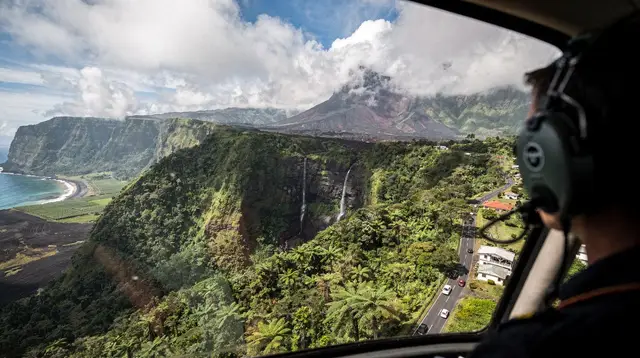
Réunion is built vertically. The island centres on a dormant volcano, Piton des Neiges (3,070 m, the highest point in the Indian Ocean), collapsed into three deep cirques — Cilaos, Salazie and Mafate — plus a separate, still-active volcano, Piton de la Fournaise (2,632 m), in the southeast. Mafate has no road at all; it’s reached on foot only, via trails from the Maido, the Col des Bœufs or a handful of other trailheads. A trip to Réunion built around beach time alone would miss most of what the island actually offers: the lagoon at Saint-Gilles and l’Hermitage is real and worth a day or two, but the island’s identity is in the Hauts (highlands), the cirques and the volcano.
Mauritius is built around the coast. It is a smaller, generally flatter island (with some notable peaks like Le Pouce and Pieter Both, but nothing on the scale of Réunion’s cirques) ringed by lagoon and beach, and its tourism economy leans heavily on resort stays, water sports and day excursions to smaller islets. It suits travellers who want a more classic tropical-beach holiday with a lower logistical load — fewer mountain roads, less need for a rental car if you’re based at one resort.
Neither is “better” in the abstract. If your trip is about hiking, volcano landscapes and a French-Creole cultural mix, Réunion fits. If it’s about beach-resort time with minimal driving, Mauritius fits. Many travellers do both, precisely because the ~40-minute hop makes it easy to get contrasting terrain in one trip.
For Réunion’s own hiking landscape in more depth: best hikes in Réunion Island and Piton de la Fournaise volcano tours.
Language on the ground
Réunion’s sole official language is French; Réunion Creole is spoken widely in daily life but French is what you’ll need for signage, menus and most interactions outside of a few tourism-facing businesses. English is not a given outside major hotels.
Mauritius runs officially in English for government, courts and much of the school system, though French is also widely spoken and Mauritian Creole dominates everyday conversation. In practice, an English-speaking visitor will generally get further with English alone on Mauritius than on Réunion, where at least basic French phrases go a long way.
Cost of a trip: not a simple “one is cheaper” answer
Réunion carries EU/French price levels for many goods, pushed higher again by the cost of shipping to an island territory — expect mainland-France-plus pricing for groceries, car rental and restaurant meals, with genuinely reasonable options if you self-cater or eat at small créole “cases.”
Mauritius spans a wider range, from backpacker guesthouses to five-star all-inclusive resorts, so its cost profile depends heavily on which end of that range you book into. An all-inclusive luxury stay on Mauritius can cost considerably more per day than a mid-range self-drive trip around Réunion; a modest Mauritius guesthouse stay can undercut it.
Neither island should be assumed cheap. Budgeting each leg separately, in its own currency, avoids surprises — see Réunion Island trip cost for Réunion-specific numbers, or plan a tighter budget with Réunion Island on a budget.
Wildlife and marine encounters: similar sea, different framing
Both islands sit in humpback whale migration waters, with sightings roughly from June/July through October on Réunion’s west coast. On Réunion, whale-watching trips leave from Saint-Gilles under an approach charter that sets minimum distances — sightings are common in season but never guaranteed. A dedicated option from the marina:
a half-day boat trip from Saint-Gilles watching for dolphins and, in season, humpback whalesSwimming matters differently on the two islands, too. On Réunion, swimming and water sports outside the lagoon and designated, monitored zones are restricted by prefectural order because of shark risk — you swim in the lagoon (Saint-Gilles, l’Hermitage, La Saline, Saint-Leu, l’Étang-Salé, Saint-Pierre) or in supervised areas, not freely offshore. Mauritius has its own, separately managed lagoon and reef system with its own local guidance; don’t assume Réunion’s rules apply there, or the reverse.
Getting between the two, if you’re doing both
The Réunion–Mauritius route is a short regional hop, generally under an hour in the air, flown by a handful of regional carriers. It is straightforward to combine both islands in a single trip, most commonly starting or ending in Réunion’s Roland-Garros (RUN) or Mauritius’s main airport near Port Louis. If you’re building a longer Réunion-only itinerary first, how many days in Réunion Island is a useful starting point before you decide how much time, if any, to split off for Mauritius.
For a broader first-timer’s orientation to Réunion specifically — separate from any Mauritius comparison — start with Réunion Island for first-time visitors.
Practical snapshot: if you only remember five things
- They are two different countries. Réunion is French/EU; Mauritius is independent. Not one archipelago under one flag.
- A Schengen visa does not cover Réunion automatically. Check france-visas.gouv.fr for your nationality before you book, and don’t assume a Schengen stamp does the job.
- Different currencies. Euro on Réunion, Mauritian rupee on Mauritius — budget each leg separately.
- Different terrain, different trip. Réunion is mountains, cirques and an active volcano; Mauritius is flatter and beach-resort led.
- About 40 minutes apart by air, which is why combining both is common and generally easy to arrange.
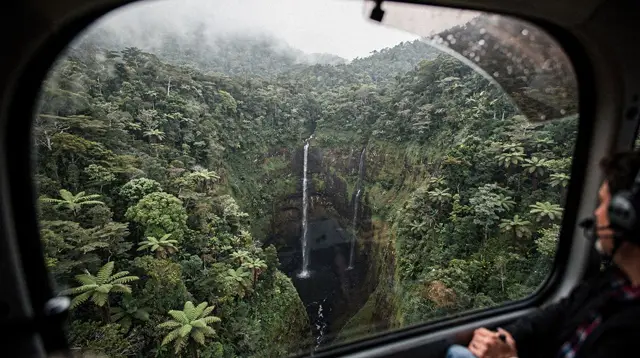
If your interest in Réunion runs toward the volcano and the cirques rather than lagoon time, a wider island overview is a reasonable next stop: a full-day guided tour covering the island’s main landscapes in one trip — or, for an aerial sense of how compact and vertical Réunion actually is compared with a flatter island like Mauritius:
a helicopter flight over the cirques and volcano departing from Saint-GillesRéunion vs Mauritius: frequently confused points, answered
Is Réunion part of Mauritius, or the other way around?
Neither. Réunion and Mauritius are separate islands and separate countries, roughly 40 minutes apart by direct flight. Réunion is French territory; Mauritius is an independent republic. They are sometimes grouped together as the Mascarene Islands, along with Rodrigues, but that is a geographic label, not a political one.
Do I need a Schengen visa for Réunion?
A Schengen visa alone does not automatically cover Réunion, because the island sits outside the Schengen area even though it is part of France and the EU. EU and EEA citizens enter with a valid national ID card or passport. Other nationalities should check the entry regime specific to Réunion on france-visas.gouv.fr before booking.
What currency do I need for Réunion and for Mauritius?
Réunion uses the euro (EUR), the same currency as mainland France. Mauritius uses the Mauritian rupee (MUR), its own currency. If you are visiting both islands on one trip, budget for two different currencies and two different card-fee structures.
Which island is better for hiking, and which for beach resorts?
Réunion is the stronger choice for hiking: three mountainous cirques, a 3,070 m summit at Piton des Neiges, and an active volcano at Piton de la Fournaise. Mauritius has some walking trails but is built primarily around beach resorts, lagoon activities and a flatter, more classic tropical-island layout.
Can I visit both Réunion and Mauritius on the same trip?
Yes, this is a common combination given the roughly 40-minute flight between them. Most visitors split their time, spending a few days on Réunion’s cirques and volcano, then a few days on Mauritius’s beaches, or the reverse. Check baggage allowances separately for each leg, since the connecting flight is often on a smaller aircraft.
Is one island more expensive than the other?
Both islands run higher than mainland prices for imported goods, but for different reasons: Réunion carries French/EU price levels plus overseas-territory import costs, while Mauritius prices vary more by resort category, from budget guesthouses to high-end all-inclusive properties. Neither island is a reliably cheap destination.
Do Réunion and Mauritius share a language?
French is spoken on both, but for different reasons. On Réunion, French is the sole official language, alongside Réunion Creole. Mauritius has English as its official language for government and law, with French and Mauritian Creole widely spoken day to day — so English gets you further on Mauritius than it does on Réunion.
Planning the Réunion side of the trip in more depth: is Réunion Island safe for tourists, best time to visit Réunion Island, Réunion Island cyclone season guide, and a full one week in Réunion Island itinerary if you’re deciding how to split your days once you land.
Compare top-rated excursions on GetYourGuide
Verified deep-linked GetYourGuide tours. Book through these links and we earn a small commission at no cost to you.
GetYourGuide does not provide a product photo for this activity — the image shows the meeting point, photographed by us.