Réunion Island weather by month: when to go and what to expect
What's the weather like in Réunion Island by month?
Réunion Island runs on inverted seasons: a hot, humid austral summer from November to April, and a drier, cooler austral winter from May to October that's the better season for hiking and for whale sightings off the west coast. The east coast is markedly wetter than the west all year, and it can turn cold at altitude near the summit of Piton de la Fournaise and Piton des Neiges in winter.
Réunion’s seasons run backwards from Europe’s
The single fact that trips up most first-time visitors: Réunion Island sits in the southern hemisphere, so its seasons are the mirror image of Europe’s. There is no “summer holidays in July” here in the sense a European visitor might expect — July falls in the middle of the island’s driest, coolest season. Get this the wrong way round and a trip planned for “summer” can land squarely in the hottest, most humid, most unpredictable months instead.
Two broad seasons matter for planning: the austral summer, hot and humid, from November to April, and the austral winter, drier and cooler, from May to October. Everything else — when to hike, when whales pass offshore, when the east coast turns into a rainforest and the west coast stays dry — sits inside that basic split. For a full framework on choosing dates, see best time to visit Réunion Island.
Austral summer: November to April
This is the island’s hot, humid stretch, with the heaviest rain generally falling from January through March. Days are long, the lagoon at Saint-Gilles-les-Bains warms up nicely, and the interior turns intensely green — but this is also the period when tropical weather systems form in the region. This guide is about the ordinary rhythm of heat and rain; how to plan around cyclone risk specifically, including the alert system and what a red alert means for movement on the island, belongs in the cyclone season guide, not here.
Hiking in the Hauts and in the cirques is still possible in austral summer, but afternoon downpours are common and trails can close with little warning after heavy rain — check conditions before setting out rather than assuming a route will be open. Coastal and lagoon activities generally hold up better than mountain routes during these months.
Austral winter: May to October
This is the season most independent guides quietly point toward, and for good reason. Rainfall drops, skies clear more often, and daytime temperatures on the coast stay comfortable without the humidity of the wet season. It’s the best window for multi-day treks, for the ascent of Piton des Neiges, and for exploring Mafate on foot over several days.
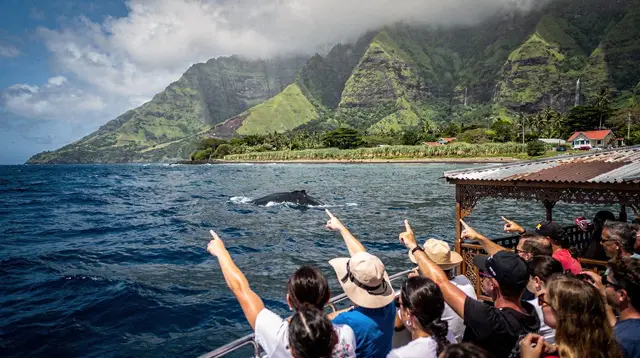
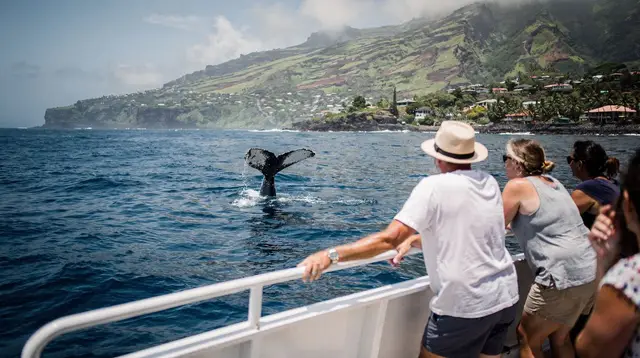
It’s also whale season. Humpback whales are typically present off the west coast from roughly June-July through October, which is why boat trips out of Saint-Gilles-les-Bains cluster in this window. A morning on the water looking for them works well paired with the season:
a boat trip from Saint-Gilles-les-Bains that combines snorkelling with dolphin and, in season, whale sightings, or, for a more focused outing, a cruise built specifically around finding cetaceans offshore.
Sightings are never guaranteed on any single outing — see whale season in Réunion, when to see humpbacks for more on realistic expectations, and the four-day whale season itinerary for how to build a trip around this window.
Microclimates: the east and west coasts don’t share a forecast
Réunion is small enough to drive across in a few hours, yet its coasts can be having completely different weather at the same moment. The trade winds arrive from the southeast, drop most of their moisture on the east coast — Saint-Benoît, Sainte-Rose, Saint-André — and leave the west coast in a rain shadow that stays noticeably drier and sunnier, which is exactly why the beach resorts cluster around Saint-Gilles-les-Bains, l’Hermitage and Saint-Leu rather than around the east.
The same split shows up vertically, not just geographically. It’s entirely normal to leave the coast under full sun and find cloud building over the Hauts within half an hour — cloud tends to form over the interior and the volcano from mid-morning onward, which is the practical reason guides for Piton de la Fournaise and for the Maido viewpoint all say the same thing: start early. A short drive up from Saint-Gilles-les-Bains toward Cilaos or the volcan can move you from beach weather to overcast in well under an hour.
| Region | General character | Typical rainfall pattern |
|---|---|---|
| West coast (Saint-Gilles, Saint-Leu, l’Étang-Salé) | Dry, sunny, in the rain shadow | Lowest rainfall on the island |
| East coast (Saint-Benoît, Sainte-Rose, Saint-André) | Humid, lush, exposed to trade winds | Highest rainfall, green year-round |
| South and Sud sauvage | Mixed, more exposed to swell and wind | Moderate, variable |
| Cirques and Hauts (Cilaos, Salazie, Mafate) | Cooler, cloud builds through the day | Can be wet even when the coast is dry |
| Volcano and high peaks | Coolest, exposed to wind | Fog common from late morning |
Altitude changes the temperature more than the calendar does
Coastal temperatures stay fairly mild year-round, but altitude is a bigger swing factor than the season itself. Near the summit of Piton de la Fournaise and on the final stretch up to Piton des Neiges, mornings in austral winter can feel close to freezing before sunrise — a real contrast to a coastline that may still be pleasantly warm the same morning. This isn’t a reason to avoid either summit, but it is a reason to pack a genuine warm layer and a windproof shell even on what looks, from the coast, like a hot day. The what to pack guide covers this in more detail for anyone building a packing list around a summit attempt.
Time zone: UTC+4, no daylight saving
Réunion Island runs on UTC+4 all year, with no seasonal clock change. Practically, that means the time difference with Paris isn’t fixed: the island is 2 hours ahead of Paris during European summer time and 3 hours ahead during European winter time. Worth checking before booking early activities, calling home, or scheduling a pickup with a driver or guide.
A rough month-by-month picture
Treat this as a general pattern, not a forecast — conditions vary year to year, and the east/west and altitude differences described above apply within every month on this table.
| Months | Season | General pattern | Good for |
|---|---|---|---|
| November-December | Early austral summer | Warming up, humidity building, rain increasing | Lagoon, early-season hikes before the wettest weeks |
| January-March | Peak austral summer | Hottest, most humid, heaviest rain, tropical systems possible | Coastal and lagoon activities; check trail status before mountain hikes |
| April | Transition | Rain easing, still warm | Shoulder-season visit, fewer crowds |
| May-June | Early austral winter | Drying out, cooling, seas calming | Start of hiking season, early whale sightings |
| July-September | Peak austral winter | Driest, clearest, coolest at altitude | Multi-day treks, Piton des Neiges, whale watching |
| October | Late austral winter | Still mostly dry, warming again | Good hiking window before the wet season returns |
Choosing a season by activity
Rather than picking a single “best month,” it often works better to start from what you actually want to do and let the season follow. Hikers chasing multi-day routes through Mafate or the climb to Piton des Neiges get the most out of austral winter, when trails are driest and visibility on the ridgelines is best; the best hikes guide is built around that same window. Canyoning in the cirques is less season-dependent day to day, since it runs on the water level in a specific ravine rather than the general forecast, but operators are more likely to run trips consistently when the island as a whole is drier, which again points toward austral winter.
Beach and lagoon time is more forgiving. The lagoon at Saint-Gilles-les-Bains and l’Hermitage stays swimmable in both seasons, and the best beaches guide doesn’t lean hard on one season over the other — austral summer even has the advantage of warmer water, if you’re willing to accept a higher chance of an afternoon downpour. Whale watching is the one activity that’s genuinely tied to a narrow window: outside roughly June to October, the boat trips still run, but the odds of a sighting drop sharply.
Getting around changes with the weather
How you get around the island shifts a little with the season, even if the road network itself doesn’t. In austral summer, heavy rain can slow traffic on the mountain roads and, in the worst cases, trigger temporary closures after a landslide — something to build slack into a plan for, especially on the road to Cilaos with its long run of hairpin bends up from the coast. The driving in Réunion Island guide and the notes on renting a car cover the practical side of this in more detail, and both are worth a look before a trip that leans heavily on independent driving.
Travellers without a car still have options in either season. The Car Jaune bus guide covers the island’s public network, and the Réunion without a car itinerary lays out a full trip built around it — though bus frequency and mountain access both tend to be more reliable in the drier months, simply because there’s less weather-related disruption to work around.
Cyclone season in practical terms
The November-to-April window is also the Indian Ocean’s cyclone season, and it’s worth being clear about what that does and doesn’t mean for a trip. Most days within that window pass with nothing more than the ordinary heat and rain described above; an actual direct hit on Réunion in any given year is the exception, not the rule. But when a system does approach, the island’s alert system can restrict movement, close schools, ground boat trips, and in a red-alert scenario ask everyone to stay indoors until it passes. The cyclone season guide explains how the colour-coded alert levels work, and what happens if a cyclone hits during your trip walks through what that looks like day to day if the timing lines up with a visit.
None of this is a reason to avoid the window outright — plenty of trips happen every austral summer without incident — but it’s a reason to build a little flexibility into flights and bookings if travelling between November and April, rather than assuming the schedule will run exactly as planned.
Building it into a first trip
None of this needs to be memorised in detail before landing — it mostly boils down to picking a season that matches what you want to do. Anyone planning their first visit can start with the broader first-time visitor guide, and the common travel mistakes page covers a few season-related planning errors worth avoiding, on top of the seasonal picture here.
For travellers who want the island’s scale from above regardless of season, a clear-morning flight works in both austral summer and austral winter, weather permitting on the day:
a helicopter tour over the island departing from Saint-Gilles-les-Bains. For a lower-key, land-based half-day when the coast is dry and sunny, a quad and buggy outing above Saint-Gilles-les-Bains is a straightforward way to fill an austral-winter afternoon.
Whichever season you land in, the west coast around Saint-Gilles-les-Bains stays the most weather-reliable base, with the festivals and events guide worth a separate look if specific dates matter to your trip.
FAQ: Réunion Island’s weather and seasons
What’s the best month to visit Réunion Island for hiking?
Austral winter, roughly May to October, gives the driest trails and the clearest mountain views. July to September is usually the most reliable stretch, though the Cirque de Mafate and the summit routes can still close after rain.
Is Réunion Island’s summer the same as Europe’s summer?
No. Réunion is in the southern hemisphere, so its austral summer runs from November to April, opposite the European calendar. A trip booked for “summer” by European habit can land in the island’s hottest, wettest months instead.
Why is the east coast so much wetter than the west coast?
The trade winds hit the east coast (Saint-Benoît, Sainte-Rose, Saint-André) first and drop most of their moisture there, which is why the region is so green. By the time the air reaches the west coast (Saint-Gilles-les-Bains, Saint-Leu, l’Étang-Salé) it has dried out, giving that side far more sun.
Does it get cold at the top of the volcano?
Yes. Near Pas de Bellecombe and on the ascent of Piton des Neiges, austral winter mornings can feel close to freezing before sunrise, even though the coast is still mild. Pack a warm layer and a windproof shell for either summit.
What time zone is Réunion Island in?
Réunion is UTC+4 all year, with no daylight-saving change. That means it’s 2 hours ahead of Paris during European summer time and 3 hours ahead during European winter time.
Can the weather change during a single day trip?
Yes, especially between the coast and the Hauts. It’s common to leave Saint-Gilles-les-Bains under full sun and find cloud or light rain 30 minutes later on the Maido or the road to Cilaos, particularly from mid-morning onward.
When is whale season in Réunion Island?
Humpback whales are typically seen from around June-July to October, overlapping with austral winter, when calm, drier conditions also make boat trips more comfortable.
Should I worry about cyclones when picking a month?
Cyclone risk is a real part of the November-to-April window, but it’s a separate planning question from weather timing. See the dedicated cyclone season guide for how the alert system works and how to plan around it.
Seasonal Réunion Island activities on GetYourGuide
Verified deep-linked GetYourGuide tours. Book through these links and we earn a small commission at no cost to you.
GetYourGuide does not provide a product photo for this activity — the image shows the meeting point, photographed by us.