Best viewpoints in Réunion Island
What are the best viewpoints in Réunion Island that don't require a hike?
Maïdo over Mafate, Pas de Bellecombe on the volcano's enclos, the Fenêtre des Makes above Cilaos, the Trou de Fer overlook from Belouve, and Cap Méchant in the wild south are all reached by car plus at most a 10 to 20-minute walk. Arrive before mid-morning: cloud usually rolls in by 10-11am at altitude.
Five belvederes you reach without a backpack
Réunion Island has no shortage of hikes that reward hours of walking with a view. This page is not about those. It’s about the handful of spots where you park the car, walk five to twenty minutes at most, and get a view that would otherwise cost a full day on a trail. That matters if you’re short on time, travelling with people who don’t hike, or just want a big view before breakfast without committing to the island’s best hikes.
The five below cover four very different landscapes: the wall of Mafate from above, the volcano’s mineral enclos, the cirque of Cilaos from the far side, a waterfall gorge you look into rather than climb down, and a black lava coastline in the wild south. None of them require technical gear. All of them are weather-dependent, and that’s the part most guides skip.
| Viewpoint | Nearest base | Drive time | Walk from car park | Best window |
|---|---|---|---|---|
| Maïdo | Saint-Paul / Saint-Gilles | about 1h from the coast | 2-5 min to the main platform | before 9-10am |
| Pas de Bellecombe | Bourg-Murat | about 1h15 from Saint-Pierre | 5-10 min to the belvedere | before 10-11am |
| Fenêtre des Makes | Les Makes | about 45 min from Saint-Leu | 5 min | before 11am, clearest in winter |
| Trou de Fer (from Belouve) | Bébour-Belouve forest | about 1h from Saint-Benoît | 15-20 min forest path | before 10am, avoid heavy rain |
| Cap Méchant | Saint-Philippe | about 1h30 from Saint-Pierre | 5 min | any time, less fog-dependent |
Every drive time above is a driving estimate, not a straight-line distance — on Réunion’s mountain roads, the two rarely match.
Maïdo — the wide shot over Mafate
The Maïdo belvedere sits at roughly 2,200m on the western rim of the island, reached by a paved road that climbs out of Saint-Paul through the Hauts de l’Ouest. From the car park, a short paved path leads to a platform looking straight down into the cirque of Mafate — the ilets, the ridgelines, and on a clear day, the ocean beyond. It’s the single most efficient way to see Mafate’s scale without walking into it, since Mafate itself has no road in and can only be reached on foot.
The catch is timing. Cloud tends to form over the cirque from mid-morning, and by 10 or 11am the view can be reduced to white. Locals leave the coast by 6 or 7am specifically for this reason; arriving at noon “to see the sunrise spot” is a common and avoidable disappointment. If you want the fuller picture of what a Maïdo morning actually looks like, weather included, this is worth reading before you set an alarm.
Pas de Bellecombe — the volcano’s enclos, not the crater
Pas de Bellecombe, at about 2,311m, is reached by the Route du Volcan from Bourg-Murat, crossing the Plaine des Sables’ mineral plateau before the road ends at a car park. A few minutes’ walk brings you to a belvedere over the enclos Fouque, the vast bowl containing Piton de la Fournaise and the Formica Leo cone below.
Be clear with yourself about what this viewpoint gives you: a wide view over the enclos, not a look into an active crater and not a guarantee of lava. Reaching the Dolomieu crater itself is a roughly five-hour round trip on foot, and only when the préfecture has the enclos open. During an eruption or an alert, access is closed outright — check current access before you build a day around it. Fournaise is one of the most active volcanoes on the planet, but “active” means frequent and unpredictable, not visible on demand. If eruptions and the mechanics of the enclos interest you beyond the view itself, the volcano tours guide covers what a guided visit adds.
As with Maïdo, fog builds through the morning here too. Arrive early, bring a layer — it sits close to 0°C at dawn in the austral winter — and treat any lava sighting as a bonus, not the plan.
Fenêtre des Makes — Cilaos from the other side
Most visitors see the cirque of Cilaos from inside it, after the drive up from Saint-Louis on the road with its roughly 400 bends. The Fenêtre des Makes offers the reverse: a lookout in the Hauts de l’Ouest, near the village of Les Makes, that looks down into the cirque from outside its rim. It’s a five-minute walk from a small car park, with an observatory nearby (Les Makes is also known for stargazing).
It’s a genuinely different perspective from standing in Cilaos itself, and a useful stop if you’re staying on the west coast and want a sense of the cirque’s geography without driving the 400 bends. It doesn’t replace a visit to Cilaos village, its thermal baths or its canyoning routes — for that, the Cilaos day-trip guide is the better starting point.
Trou de Fer from Belouve — a waterfall you don’t hike to
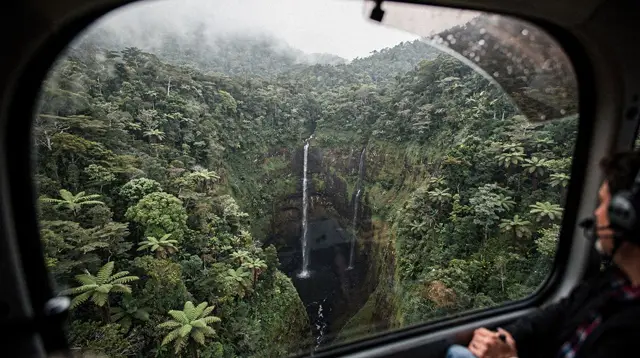
The Trou de Fer is a deep, forested gorge on the east side of the island where several waterfalls drop from a natural amphitheatre. There’s no safe, marked trail down into it for casual visitors — most people who describe “hiking to the Trou de Fer” are describing the walk through the Bébour-Belouve forest to a marked overlook, not a descent into the gorge.
From the Belouve forest car park, a forest path of 15 to 20 minutes leads to the viewing platform. It’s an easy walk by Réunion standards but uneven underfoot, so it needs a bit more care than the paved platforms at Maïdo or Cap Méchant, particularly after rain. The other common way to see the full amphitheatre is by helicopter, which reaches angles the ground overlook can’t — more on how the two compare. Note that the east side of the island gets considerably more rain than the west, so check conditions before driving out.
Cap Méchant — where lava met the sea
In the wild south, past Saint-Philippe, Cap Méchant is a stretch of black basalt cliff shaped by centuries of lava flows meeting the ocean. Unlike the other four viewpoints, it’s at sea level, and it’s the one on this list least dependent on morning cloud — the fog problem here is more about rain squalls blowing in off the ocean than upslope mist.
A short walk from the car park brings you to the cliff edge, with waves breaking against dark rock and, depending on swell, sea spray reaching several metres up the basalt. There’s no barrier at the edge in most spots, and the rock is uneven and can be slippery when wet, so this isn’t a place to let children run ahead. It sits within reach of the Grand Brûlé’s more recent lava flows and the puits arabe further along the coast, making it a natural stop on a wild south day trip.
Timing is the whole game
If there’s one rule across all five viewpoints, it’s this: mountain and volcano views in Réunion are a morning activity, full stop. Warm, moisture-laden air rises from the coast through the day and condenses into cloud over the Hauts by mid-to-late morning, most reliably at Maïdo and around the volcano, less predictably at the Fenêtre des Makes and Belouve, and least of all at sea-level Cap Méchant.
In practical terms: leave before sunrise or shortly after for Maïdo and Pas de Bellecombe if you want a real chance at a clear view, and don’t schedule them for early afternoon “on the way back” from somewhere else. The month-by-month weather guide and the best time to visit page both go into more detail if you’re planning several viewpoint mornings across a longer trip — winter (May-October) generally gives more stable, drier mornings than the summer wet season.
What these viewpoints are not
It’s worth being direct about what this page deliberately leaves out. These are lookout points, not summits, not waterfalls you swim in, and not substitutes for the destinations they overlook. Maïdo is not a Mafate trek — for that, see planning a hike into Mafate. Pas de Bellecombe is not the Piton des Neiges summit, a separate mountain entirely on the other side of the island, reached from Cilaos. And none of these five should be confused with the island’s swimmable waterfalls and natural pools, which are a different list altogether.
If what draws you to a viewpoint is really the appeal of a broader trip through the cirques, three cirques in four days links several of these places into one route rather than treating them as isolated stops.
Getting there: car, tour, or air
A rental car is the practical way to reach all five viewpoints on your own schedule, particularly for an early Maïdo departure that a tour bus won’t match. If you’d rather not drive the mountain roads yourself, guided minibus day trips cover Cilaos, the volcano and the wild south with local drivers who know the road conditions — worth comparing against renting a car if the switchbacks aren’t for you.
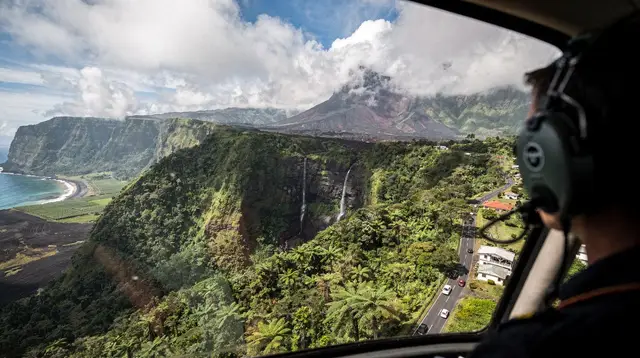
For a genuinely different angle on the same landscapes, a scenic flight crosses Mafate, the cirques and the volcano’s enclos in under an hour, reaching perspectives — like the full bowl of the Trou de Fer — that no ground viewpoint offers. A helicopter tour of the island departing from Saint-Gilles covers most of these landmarks in one flight, weather permitting, while a microlight flight over Réunion gives a slower, more open-air version of the same idea for those who want the wind rather than a cabin.
If you’re building a longer road trip around Réunion’s viewpoints and want the coastal and inland stops linked into a single day, a guided complete tour of the island in 13 steps strings together many of the road-accessible highlights, including several of the belvederes above, without you having to plan the driving order yourself. And for the Hauts de l’Ouest around Les Makes and the western slopes below Maïdo, a quad biking or buggy ride out of Saint-Gilles-les-Hauts is a way to cover some of that terrain actively rather than purely by car, for travellers who want more than a parking-lot view.
Whichever way you reach them, treat all five as morning plans first and everything-else second: the drive up Maïdo or the Route du Volcan on a clear 7am is a different experience from the same road at noon under cloud, and no amount of planning the rest of the day changes that.
FAQ: viewpoints and belvederes in Réunion Island
Which Réunion Island viewpoint is easiest to reach without a car?
None of the five are realistically doable without a car or a booked tour. Car Jaune buses run along the coast, not up to Maïdo, the Fenêtre des Makes or Belouve. A guided minibus or helicopter tour is the fallback if you’re not driving.
Can I see lava from Pas de Bellecombe?
Not reliably. Pas de Bellecombe looks over the enclos Fouque and the Formica Leo, not into an active flow. Piton de la Fournaise erupts often but unpredictably, and the préfecture closes the enclos and the trail to Dolomieu crater during eruptions or alerts. Check OVPF-IPGP updates and the préfecture’s status before you plan around seeing lava.
Do I need to hike to see the Trou de Fer?
No trail reaches the floor of the Trou de Fer safely for casual visitors. The standard view is from a marked platform near the Belouve forest, a short walk from the car park, looking across the gorge at the waterfalls. It’s a viewpoint, not a descent.
What time should I leave for Maïdo to see Mafate clearly?
Leave Saint-Paul or Saint-Gilles by 6-7am. Cloud typically builds over Mafate and the western slopes from mid-to-late morning, and by 10-11am the view can be gone for the rest of the day.
Is the Fenêtre des Makes the same view as Cilaos itself?
No. The Fenêtre des Makes looks down into the cirque of Cilaos from the Hauts de l’Ouest, on the opposite side from the road that climbs up from Saint-Louis. It’s a lookout, not a substitute for visiting Cilaos village.
Is Cap Méchant worth visiting if I’ve already seen the Grand Brûlé lava fields?
Yes, they show different things. The Grand Brûlé road crosses flat lava flows that reached the sea; Cap Méchant is a black basalt cliff further south where the ocean has carved the older coastline, with a rougher, more exposed feel.
Are these viewpoints suitable for young children or people with limited mobility?
Maïdo, Pas de Bellecombe, the Fenêtre des Makes and Cap Méchant have car parks close to the viewing point, with paved or short gravel paths. Belouve for the Trou de Fer involves a longer, uneven forest path, so it needs more caution with small children or limited mobility.
Can a helicopter flight replace visiting these viewpoints on the ground?
It shows them from a different angle rather than replacing them. A scenic flight crosses Mafate, the cirques and the volcano in under an hour and reaches places like the Trou de Fer’s full amphitheatre that no road view captures, but it depends entirely on clear weather and doesn’t replace standing at Pas de Bellecombe or the Fenêtre des Makes at your own pace.
Trip planning tours and activities on GetYourGuide
Verified deep-linked GetYourGuide tours. Book through these links and we earn a small commission at no cost to you.
GetYourGuide does not provide a product photo for this activity — the image shows the meeting point, photographed by us.