Réunion Island travel mistakes to avoid
What are the most common mistakes travellers make about Réunion Island?
Confusing Réunion with Mauritius, assuming a Schengen visa covers Réunion, swimming outside the lagoon, thinking Mafate is reachable by car, and expecting to see lava on every volcano trip. Mountain drive times and the November-to-April cyclone season also catch people out.
Most trip-planning guides for Réunion Island list beaches and hikes. This one lists what goes wrong before people even land, because the mistakes on this island are rarely about picking the wrong restaurant. They are about assuming Réunion works like its famous neighbour, or like the rest of France, when in several practical ways it does not. Fix these six confusions before you book, and the rest of the trip gets much easier to plan honestly.
Mistake 1: thinking Réunion is Mauritius
This is the single most common mix-up, and it is an easy one to make: both islands sit in the same stretch of the Indian Ocean, both are marketed with lagoon photos, and both get lumped together in “Indian Ocean islands” lists. But Réunion and Mauritius are two separate islands and two separate countries, about 40 minutes apart by plane.
Réunion is a French overseas department and region, part of the European Union, using the euro. Mauritius is an independent state with its own currency, the Mauritian rupee, its own visa rules, and its own government. The two islands share some cultural DNA — Indian Ocean Creole culture, sugar cane history, tropical volcanic terrain — but booking a hotel, a rental car, or an excursion on one island does not get you anywhere near the other. If your itinerary casually says “then fly to Mauritius for the day,” check the actual flight time and cost; it is a genuine international trip, not a short transfer. For a side-by-side comparison of what each island actually offers, see Réunion vs Mauritius.
Practically, this confusion shows up most often in searches for entry requirements, currency, and language, which brings us to the next mistake.
Mistake 2: assuming a Schengen visa covers you
Réunion’s status is genuinely unusual, and it is worth stating plainly: Réunion is part of France and part of the European Union as an outermost region, but it is outside the Schengen area. A Schengen visa, or Schengen-free travel rights for some nationalities, does not automatically extend to Réunion.
In practice this means:
| Traveller type | What covers entry to Réunion |
|---|---|
| EU/EEA citizens | Valid national ID card or passport |
| Non-EU nationalities | Réunion-specific entry rules, not a Schengen visa alone |
| French citizens | Valid ID, as for any French department |
If you already hold a Schengen visa for a trip to Paris or elsewhere in mainland Europe, do not assume it lets you add on Réunion without checking. The rules differ by nationality and change over time, so the only reliable source is the official one: france-visas.gouv.fr. Our entry requirements guide walks through the practical side of this for common nationalities, but the government site is the one to verify against before you book flights.
One related point worth flagging honestly: because Réunion is in the EU, EU mobile roaming allowances apply as they would in mainland France, which is a genuine convenience once you have sorted out entry.
Mistake 3: swimming outside the lagoon
Réunion’s west coast lagoon, from Saint-Gilles-les-Bains and l’Hermitage down to La Saline-les-Bains, looks like classic postcard swimming water — calm, shallow, protected by a coral reef. It’s tempting to assume the whole coastline works the same way. It does not.
Because of a documented shark risk, swimming and water sports outside the lagoon and outside designated supervised or protected zones are banned by prefectural order on large stretches of Réunion’s coast. This is not a vague caution sign; it is an enforced restriction, and it exists because of real incidents over the past years that led local authorities to draw clear boundaries.
Where you can safely swim:
- Inside the lagoon at Saint-Gilles, l’Hermitage, and La Saline-les-Bains, protected by the reef
- At Saint-Leu and L’Étang-Salé, in the marked and supervised sections
- At Saint-Pierre and Grand Anse, where a supervised or enclosed pool area exists
- Anywhere with visible surveillance (a lifeguard post) or an explicit safe-swimming designation
Where not to freelance a swim: open coastline outside these zones, however inviting it looks from the road. Surfing and other water sports carry the same restriction outside the lagoon. If you are booking a snorkeling or scuba trip, that is exactly why operators run their activities inside the lagoon or in specifically cleared zones — see the Hermitage lagoon snorkeling and kayaking guide for what a supervised lagoon outing actually looks like. A short guided outing here beats freelancing on an unmarked beach, and it is one of the more pleasant ways to spend a warm afternoon: gliding over the reef with a guided snorkel among sea turtles in the Saint-Gilles-les-Bains lagoon, inside the protected water, rather than guessing where the boundary lines are on an unfamiliar stretch of coast.
Mistake 4: expecting to drive into Mafate
Of the island’s three cirques, Mafate is the one that catches people out hardest, because it looks close on a map and reachable on a road atlas. It is not. Mafate has no road at all. The only ways in are on foot, via trailheads at the Maïdo, Col des Boeufs, Rivière des Galets, or Dos d’Âne, or by helicopter, which is how supplies reach the ilets (Mafate’s scattered hamlets) rather than how visitors typically arrive.
If your itinerary includes “drive to Mafate for lunch,” the itinerary is wrong. What actually works:
- A guided day hike into one of the accessible ilets from the Maïdo or Col des Boeufs side, returning the same day
- A multi-day trek staying overnight in a gîte (a mountain lodge), such as La Nouvelle or Marla, which need booking well ahead
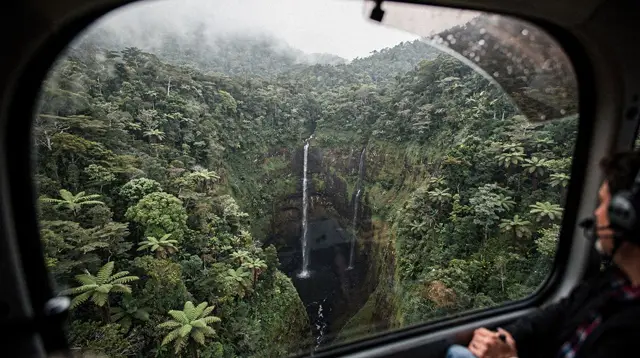
- A helicopter flight that circles over Mafate for aerial views without landing to explore on foot
The Maïdo belvédère itself, reached by car from Saint-Paul, gives a genuine and easy view down into Mafate without any hiking — that is the honest way to see the cirque if you don’t have a full day or more for the trek. Plan the viewpoint separately from the trek; they are different trips with different time budgets. For the full planning picture, see hiking in Mafate: a planning guide.
Mistake 5: assuming you’ll see lava
Piton de la Fournaise, at 2,632 m, is one of the most active volcanoes in the world, and Réunion’s volcano tourism understandably leans on that reputation. But active does not mean predictable, and it does not mean open. The prefecture, guided by monitoring from the OVPF-IPGP observatory, can close the enclos Fouque — the volcanic caldera containing the Pas de Bellecombe trail toward the Dolomieu crater — during an eruption or an elevated alert.
A few honest points worth knowing before you book a volcano tour:
- Eruptions happen fairly often, but the timing is not something any tour operator or blog can predict for your travel dates
- When the enclos is open, the hike from Pas de Bellecombe to the crater rim and back takes roughly 5 hours, with no guarantee of visible lava even during an active phase
- The Cité du Volcan museum in Bourg-Murat is a solid plan B on a closed-access day or in bad weather, and worth building into the itinerary regardless
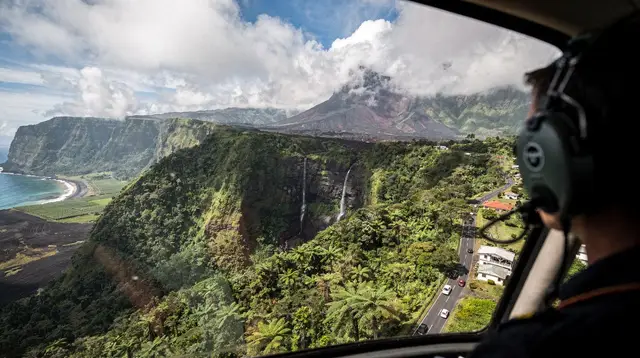
- A scenic helicopter flight over the volcano can sometimes show an active crater from the air even when ground access is restricted, though this too depends on conditions on the day
If your travel dates are fixed months in advance, build in flexibility rather than a fixed expectation. Compare the self-drive versus guided tour options for the volcano road before deciding how to approach the day. And if the ground trail is closed, a helicopter tour over the island departing from Saint-Gilles gives you a genuine shot at seeing the crater and the surrounding cirques from above, weather permitting, without depending on the enclos being open.
Mistake 6: underestimating mountain drive times
Réunion is a compact island — you can drive its coastal perimeter in well under a day — which makes it tempting to underestimate how long the interior roads take. This is a real and repeated trap, not just a minor inconvenience.
| Route | Distance (approx.) | Realistic drive time |
|---|---|---|
| Saint-Louis to Cilaos | ~35 km | ~1 hour, no stops, on a road with roughly 400 bends |
| Bourg-Murat to Pas de Bellecombe | ~25 km | 45–60 minutes, plus time for fog to close in |
| Saint-Paul to the Maïdo | ~35 km | ~1 hour, best done before mid-morning cloud buildup |
| Saint-André to Hell-Bourg (Salazie) | ~35 km | 45–60 minutes, more with traffic near Saint-André |
The road to Cilaos is the clearest example: the raw distance looks modest, but the road switches back on itself roughly 400 times, and driving it is genuinely tiring, not just long. The volcano road and the Maïdo road share the same problem in a different form — clouds tend to roll in from around mid-morning onward, so a viewpoint that’s clear at 7am can be socked in by 10am. Plan an early departure for any of these routes, not a “we’ll head up after breakfast” one.
The practical fix is simple: treat each of these zones — the cirques, the volcano, the west coast — as a separate half-day or full-day outing rather than trying to string several into one loop. A “tour of the island in a day” plan almost always underestimates these mountain segments. For a realistic multi-day structure, see three cirques in four days or, for a broader single loop, a guided 13-stop tour covering the island’s main regions, which at least puts the driving in someone else’s hands for the day.
A word on cyclone season
One more thing worth stating plainly rather than glossing over: Réunion’s seasons are reversed relative to Europe. The austral summer, hot and humid, runs roughly November to April, and this is also the island’s cyclone season, with the highest risk typically in January to March. The austral winter, from May to October, is drier, cooler at altitude, and the better season for hiking.
This is not a reason to avoid a November-to-April trip outright — plenty of travel happens in these months — but it is a reason to be realistic:
- No one can tell you months ahead whether a cyclone will affect your specific travel dates; treat any such claim with suspicion
- Flexible flight and accommodation bookings, and travel insurance that covers weather disruption, are sensible for this window
- The east coast gets meaningfully more rain than the west coast year-round, an effect that intensifies in the wet season
- A cyclone alert system exists locally (vigilance, orange alert, red alert with mandatory confinement); if you are on the island during an active alert, follow local instructions rather than trying to travel through it
For month-by-month detail, see Réunion Island weather by month and the dedicated cyclone season guide, which covers what an alert actually means for a visitor in more depth than fits here.
Getting the planning basics right
Once these six confusions are cleared up, the rest of Réunion planning is fairly straightforward: rent a car (driving is on the right), budget realistic drive times between regions, book any Mafate gîte or Cilaos summit hut well ahead, and check trail status with the ONF before a hike rather than assuming a route is open. If cetaceans are part of your plan, the whale and dolphin season runs roughly June/July to October, and sightings on any given outing are never guaranteed — a boat trip from the west coast searching for whales and dolphins gives a genuine chance during that window, run under an approach charter that keeps a respectful distance from the animals.
For a broader first-timer overview beyond this list of mistakes, see Réunion Island for first-time visitors and how many days to plan for Réunion Island.
Common questions about Réunion Island mistakes
Is Réunion Island the same as Mauritius?
No. Réunion and Mauritius are two separate islands and two separate countries roughly 40 minutes apart by plane. Réunion is a French overseas department using the euro; Mauritius is an independent state using the Mauritian rupee.
Does a Schengen visa let me visit Réunion Island?
No. Réunion is part of France and the European Union but sits outside the Schengen area, so a Schengen visa does not automatically cover it. EU and EEA citizens enter with a valid national ID card or passport; other nationalities should check the rules specific to Réunion at france-visas.gouv.fr.
Can you swim anywhere around Réunion Island?
No. Because of shark risk, swimming and water sports outside the lagoon and designated supervised or protected zones are banned by prefectural order. Safe swimming is in the lagoon along the west coast and in supervised or sheltered spots elsewhere.
Can you drive into the Cirque de Mafate?
No. Mafate has no road at all. It is reached only on foot, from trailheads such as the Maïdo, Col des Boeufs or Rivière des Galets, or by helicopter for supply drops. Any plan that assumes a car can reach a Mafate ilet is wrong.
Will I definitely see lava at Piton de la Fournaise?
Not necessarily. Eruptions are frequent but unpredictable, and the prefecture can close the enclos Fouque and the Pas de Bellecombe trail during an eruption or an alert. Treat any volcano tour as weather- and activity-dependent, never as a guaranteed lava sighting.
How long does it really take to drive to Cilaos or the volcano?
Longer than the kilometres suggest. The road to Cilaos climbs through roughly 400 bends and takes about an hour from Saint-Louis without stops; the volcano road and the Maïdo are similarly slow, winding routes. Always plan by driving time, not distance.
When is cyclone season in Réunion Island?
Roughly November to April, the austral summer, with the highest risk in January to March. It is a normal part of planning a trip in these months, not a reason to expect a cyclone on any given date, but flexible bookings and travel insurance are worth having.
Trip planning tours and activities on GetYourGuide
Verified deep-linked GetYourGuide tours. Book through these links and we earn a small commission at no cost to you.
GetYourGuide does not provide a product photo for this activity — the image shows the meeting point, photographed by us.