Things to do in Saint-Pierre, Réunion Island
What is there to do in Saint-Pierre, Réunion Island?
Saint-Pierre is the capital of the south: a covered market, a large Saturday street market, a lively seafront, restaurants and nightlife, plus the Saga du Rhum at the Isautier distillery. It also has its own airport (Pierrefonds), making it a practical base for exploring the wild south and the volcano without going back through Saint-Denis.
Saint-Pierre is not a beach town
Most first-time visitors land in the north or west and build their trip around the lagoon at Saint-Gilles and l’Hermitage. Saint-Pierre works differently. It is the administrative and commercial capital of the south, a real working town with a port, a market economy and a night-time buzz that the beach resorts further up the coast don’t really have. If you’re comparing Saint-Pierre with Saint-Gilles as a base, the honest answer is that they serve different trips: one is for lagoon days, the other for a town with its own rhythm and quick access to the wilder half of the island.
This guide covers what to do in Saint-Pierre itself and its immediate surroundings — the market, the seafront, the rum distillery, the airport, and a few short outings nearby. It deliberately stops short of the wild south proper (Saint-Joseph, Saint-Philippe, the Grand Brûlé lava fields) and the Piton de la Fournaise volcano area, both reachable from Saint-Pierre but covered in their own guides, since they deserve a full day each rather than a paragraph here.
For itinerary planning, Saint-Pierre works well as one stop within a longer loop of the island rather than a single-city stay. Travellers building a one-week itinerary or a road trip around the island often spend one or two nights here specifically to access the wild south and the volcano without the return drive from Saint-Gilles each day.
The covered market and the Saturday market
Saint-Pierre has two distinct markets, and it’s worth knowing which is which before you plan around them.
The covered market (marché couvert), near the town centre, runs daily except Monday and sells fruit, vegetables, spices, vanilla and local products in a permanent hall. It’s small, fast to walk through, and useful if you want vanilla pods or Bourbon coffee to take home without the crowds of a bigger event.
The Saturday market (marché forain) is the bigger draw: a long open-air market along the seafront every Saturday morning, roughly 6am to 1pm, with produce stalls, prepared food, clothing, crafts and household goods spread over several hundred metres. It’s one of the largest markets on the island and gets genuinely crowded by mid-morning in the southern hemisphere summer (November to April) heat. Go early — before 9am — for easier browsing and a cooler walk, and bring cash; card acceptance is patchy among the smaller stalls.
| Market | Days | Best time | What to expect |
|---|---|---|---|
| Covered market | Daily except Monday | Morning | Produce, spices, vanilla, compact |
| Saturday seafront market | Saturday only | 6am–9am | Large, food stalls, crafts, crowded by 10am |
The seafront and the town centre
Saint-Pierre’s front de mer is the town’s social spine: a long promenade along the waterfront with restaurants, bars and a small marina, busy from late afternoon through the evening. It doesn’t have the postcard lagoon of Saint-Gilles, but it’s the most pleasant place on the island to sit down for a drink at sunset and watch the town go about its evening rather than a resort routine.
The town centre behind the seafront mixes creole houses with ordinary shops and administrative buildings — this is a real town people live and work in, not a tourist set piece. It’s worth a slow walk, particularly around the market days, but there’s no single must-see monument; the point of Saint-Pierre is its atmosphere rather than a checklist of sights.
For a fast overview without much walking, a guided Segway tour of the city covers the seafront and centre in under two hours — useful if you’re passing through for a single afternoon.
a guided Segway tour through Saint-Pierre’s seafront and town centreSaga du Rhum at the Isautier distillery
The Saga du Rhum is the visitor circuit at the historic Isautier rum distillery in Saint-Pierre, tracing the island’s rum-making history from sugar cane through to bottling, with a tasting at the end. It takes roughly an hour and is one of the better indoor options if the weather turns, or as a midday break between the market and the seafront. It pairs naturally with a broader look at Réunion’s rum distilleries and creole food if you want to compare it with other producers on the island.
Prices are modest — expect a small entry fee that usually includes the tasting — but check the current rate locally or on the official site rather than relying on a fixed figure here, since these change year to year.
Nightlife
Saint-Pierre has the most active nightlife on the island after dark, concentrated along the seafront and in a handful of streets just behind it. It’s still modest by mainland French standards — this is a small town, not a city — but bars stay open later here than almost anywhere else in Réunion, especially on weekend evenings during the southern hemisphere summer (November to April). If an evening out matters to your trip, Saint-Pierre is a stronger choice than Saint-Gilles or Saint-Denis, both of which quiet down earlier.
Restaurants along the seafront tend to fill from around 7pm, and the bars nearby stay open later into the evening than anywhere else on the island, particularly around the Saturday market weekend when the town already has a crowd in for the morning market.
Pierrefonds airport and getting to Saint-Pierre
Pierrefonds airport (ZSE) sits a few kilometres west of Saint-Pierre and handles a smaller schedule than Roland-Garros in the north, mostly regional and inter-island connections. If your trip is centred on the south — the wild south, the volcano, Cilaos — flying into or out of Pierrefonds can save a long drive across the island. Check current routes before booking, as the schedule is thinner and more seasonal than the northern airport’s.
By road, Saint-Pierre sits on the coastal route linking the west coast to the wild south, roughly 45 minutes to an hour from Saint-Gilles depending on traffic, and about 30 to 50 minutes from the Saint-Joseph and Grand Brûlé area further southeast. A rental car is close to essential; Réunion drives on the right, and renting a car is the practical way to combine Saint-Pierre with day trips into the south.
Day trips and flights from Saint-Pierre
Saint-Pierre’s real strength as a base is what it puts within easy reach. From here, without changing accommodation, you can reasonably plan:
- The wild south — Saint-Joseph, the Cap Méchant coastline and the Grand Brûlé lava fields — as a half-day or full-day outing; see the dedicated wild south day trip guide for route and timing, adjusted for Saint-Pierre’s shorter starting distance.
- Canyoning on the Langevin river, in the hills above Saint-Joseph, a common half-day activity booked from the south coast.
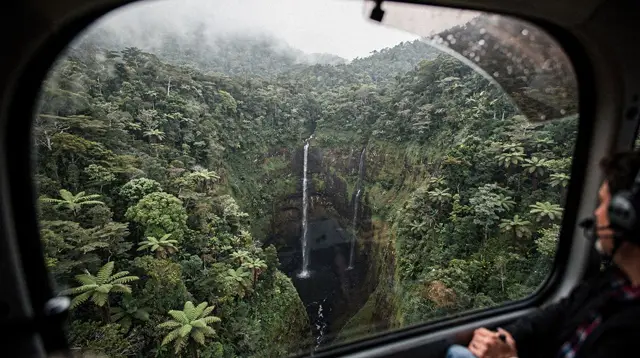
- Helicopter flights departing directly from Saint-Pierre over the volcano, the cirques or the wild south coastline — a practical option if you’re based here and don’t want to backtrack to Saint-Gilles for a scenic flight.
- The Piton de la Fournaise volcano access road via Bourg-Murat, roughly an hour’s drive from Saint-Pierre; see the dedicated volcano guide for what the hike actually involves and when the crater enclosure is open.
If you’d rather combine culture and food into one outing, a guided cultural and gourmet tour run from the south touches on temples, markets and local produce in a single half-day.
a guided cultural and food tour covering markets, temples and local producePrices and tipping
As across the island, prices in Saint-Pierre’s restaurants, shops and activity operators tend to run a little higher than equivalent mainland French prices, since much is imported. Meals at a seafront restaurant typically run higher than an equivalent inland spot; the Saturday market is the cheapest way to eat well, with prepared food stalls offering good value. No tip is expected anywhere — service is included in the bill — though rounding up for good service is appreciated and not unusual.
Where to stay in Saint-Pierre
Accommodation in Saint-Pierre is more urban than the beach hotels of Saint-Gilles: expect small hotels and apartments near the seafront or town centre rather than resort complexes. Staying here suits travellers whose priority is the wild south, the volcano or the nightlife rather than lagoon swimming, since the nearest proper lagoon is a drive further up the west coast. For a broader comparison of where different parts of the island suit different trips, see the general where to stay in Réunion Island guide, or the more specific Saint-Gilles versus Saint-Leu comparison if you’re deciding between the west coast bases instead.
Saint-Pierre as a gateway to Cilaos
Saint-Pierre also sits within reach of Cilaos, the cirque best known for its winding mountain road of roughly 400 bends, thermal spring history and canyoning. The drive up is slower than the distance on a map suggests, since the road climbs steadily through switchbacks, so treat it as at least a half-day round trip rather than a quick detour from the coast. Cilaos rewards travellers who also want a taste of the island’s mountain interior alongside Saint-Pierre’s coastal, market-town character. If you’re deciding between Réunion’s two most accessible cirques, the Cilaos versus Salazie comparison lays out which suits hikers, which suits canyoning, and which is the easier drive from the south.
Saint-Pierre versus Saint-Gilles: which to base yourself in
This comparison comes up often enough to spell out directly, since the two towns suit different trips.
| Saint-Pierre | Saint-Gilles | |
|---|---|---|
| Character | Working town, market, nightlife | Beach resort, lagoon |
| Swimming | Limited; nearest lagoon further up west coast | Lagoon on the doorstep |
| Nightlife | Liveliest on the island | Quieter, more resort-paced |
| Best for | Wild south, volcano access, south-based trips | Lagoon days, snorkelling, whale watching |
| Airport | Pierrefonds (ZSE), regional/seasonal | None; nearest is Roland-Garros (north) |
Neither is objectively better — it depends on whether your priority is lagoon time or a base for the south and the volcano. Many visitors who plan a full loop of the island simply spend a night or two in each.
Practical notes
- Currency: euro (€); cards are widely accepted in town, but carry cash for the Saturday market.
- Language: French is the working language; Réunion Creole is widely spoken informally.
- Getting around: a rental car is the practical option; the Car Jaune interurban bus network connects Saint-Pierre to other coastal towns but runs on a limited schedule.
- When to visit: the southern hemisphere winter (May to October) is drier and more comfortable for walking the seafront and market; the summer (November to April) is hot, humid and includes cyclone season.
Frequently asked questions about things to do in Saint-Pierre
Is Saint-Pierre worth staying in over Saint-Gilles?
It depends what you want. Saint-Gilles has the lagoon and beach life; Saint-Pierre is urban, with a working port, a market culture and more nightlife, and it puts you closer to the wild south and the volcano access road. Couples wanting beach days lean west; travellers prioritising the south and southeast often prefer Saint-Pierre.
What is the Saint-Pierre market like?
There is a small covered market open daily for produce, spices and local products, and a much larger open-air market along the seafront every Saturday morning, with food stalls, crafts and clothing. Arrive before 9am for the best choice and before the heat builds.
Can you swim in Saint-Pierre?
Swimming and water sports outside the lagoon and designated, supervised areas are banned by prefectural order because of shark risk. Saint-Pierre’s own beach options are limited compared with Saint-Gilles; most visitors who want to swim head to the lagoon further up the west coast or use Saint-Pierre’s small protected swimming area near the marina.
What is the Saga du Rhum?
It is the visitor circuit at the Isautier distillery in Saint-Pierre, covering the history of rum production on the island with a tasting at the end. It takes about an hour and works well as a midday or late-afternoon stop between other activities.
Is Saint-Pierre a good base for visiting the wild south?
Yes. Saint-Joseph, Saint-Philippe and the Grand Brûlé lava fields are roughly 30 to 50 minutes by car from Saint-Pierre, which is noticeably closer than from Saint-Gilles. This guide covers the town itself; use the dedicated wild south guide for the coast beyond Saint-Joseph.
Does Saint-Pierre have its own airport?
Yes, Pierrefonds airport (ZSE) sits just outside Saint-Pierre and handles some inter-island and regional flights. It is a useful entry or exit point if your trip is focused on the south, avoiding the drive to or from Roland-Garros in the north.
Is Saint-Pierre expensive?
Prices in restaurants and shops are generally a little higher than in mainland France, as with the rest of Réunion, because many goods are imported. No tip is expected in restaurants or bars; service is included in the bill.
What is Saint-Pierre’s nightlife like?
It is the liveliest town on the island after dark, with bars and restaurants along the seafront staying busy on weekend evenings, especially in the southern hemisphere summer (November to April). It is quieter and more low-key than a mainland French coastal town, but noticeably more active than Saint-Gilles or Saint-Denis at night.
How many days should you spend in Saint-Pierre?
Saint-Pierre itself can be covered in a single day — the markets, seafront and Saga du Rhum — but most travellers use it as a base for one or two nights to also reach the wild south, the volcano and Cilaos without a long return drive to Saint-Gilles each time.
Is Saint-Pierre a good first stop in Réunion Island?
It can be, especially if you’re flying into Pierrefonds rather than Roland-Garros, but most first-time visitors still start in the north or west near the lagoon and treat Saint-Pierre as a later stage of the trip focused on the south.
Trip planning tours and activities on GetYourGuide
Verified deep-linked GetYourGuide tours. Book through these links and we earn a small commission at no cost to you.
GetYourGuide does not provide a product photo for this activity — the image shows the meeting point, photographed by us.