Helicopter or microlight: how to see Réunion Island from above
Should I fly over Réunion Island by helicopter or by microlight (ULM)?
A helicopter goes further into Cilaos, Salazie, Mafate, the Trou de Fer and the volcano in one flight and suits a short stay. A microlight (ULM) flies lower and slower along the west coast and the cirques' edges, at a lighter price, and suits travellers who want the sensation of flying more than maximum ground covered. Both depart early morning and both can be grounded by cloud.
Two ways to see the same island
Réunion is a small island with an outsized interior: three cirques, an active volcano and ridgelines that a road can’t reach. From the ground, Cilaos, Salazie and Mafate each take a separate day, and Mafate takes a multi-day walk because it has no road at all. From the air, all three can appear in a single morning. That’s the appeal of flying over the island, and it’s also where the two options — helicopter and microlight (ULM) — start to differ enough to matter for planning. This page is about that choice. If you’re weighing whether to drive or hike up Piton de la Fournaise itself, that’s a separate decision covered on its own page; here we’re strictly comparing the two ways to see the island from above.
Neither option is guaranteed. Cloud builds over the cirques and the volcano through the morning, both types of flight depend on visibility and calm wind, and an operator will reschedule rather than fly you into cloud. Treat either booking as weather-dependent and build a spare morning into your itinerary before committing to a fixed date.
The core of what either flight passes over — the cirques, the high ridgelines and the summit area of the volcano — is protected as the Parc national de La Réunion and forms part of the site inscribed on the UNESCO World Heritage list in 2010 under the name “Pitons, cirques et remparts.” That status doesn’t change how a flight is booked, but it’s part of why both helicopter and microlight operators fly established corridors over that terrain rather than improvising a route: the interior below is a managed landscape, not open airspace.
What a helicopter flight covers
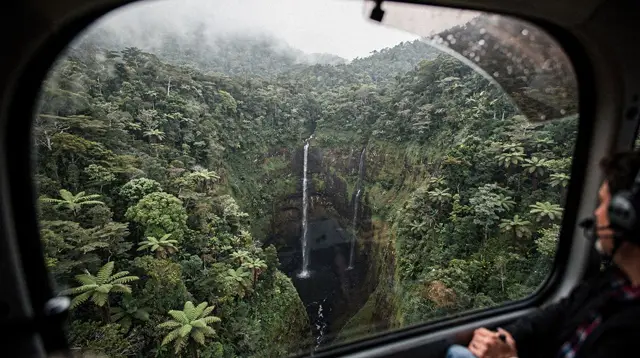
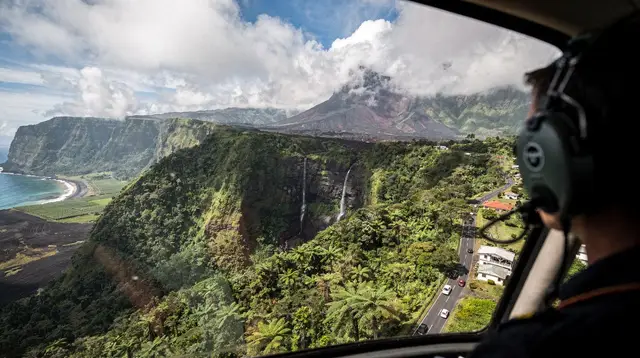
Helicopter flights over Réunion depart from Saint-Gilles or from Saint-Pierre, and their main advantage is range. In one flight, a helicopter can pass over Cilaos, Salazie, the ilets of Mafate, the Trou de Fer waterfall, and the crater area of the volcano, linking places that would otherwise take four separate days of driving and hiking to see from the ground. That makes a helicopter the more efficient option if your stay is short and you’d rather see the interior of the island once, from above, than piece it together over several days on winding mountain roads.
The cabin is enclosed, the ride is smoother than a microlight, and the pilot narrates the route over headsets, which matters if you want to actually identify what you’re looking at rather than simply feel the sensation of flying. It’s also the more practical way to see Mafate without walking in: the cirque has no road, so a flyover is one of the only ways to take in its ridgelines and isolated ilets without committing to an overnight trek.
The trade-off is price and predictability. Helicopter flights cost more than microlight flights, generally in line with how much distance and how many landmarks the route covers, and departures are tied more tightly to clear-sky mornings over the whole interior — a single pocket of cloud over one cirque can be enough to redraw or delay the route. Check the current duration and price on the listing itself rather than assume a fixed figure, since both vary by operator, season and exact route.
a 45-minute flight tracing the cirques, the coastal islets and the lagoon gives a sense of how a shorter aerial route is packaged, even though that particular flight is a microlight rather than a helicopter — useful for comparing what 45 minutes actually buys you in each format.
A helicopter flight over the cirques depends on clear mornings, so a short stay leaves little room if cloud sits over Mafate on your first try. Arrive with a spare day or two in the schedule and keep the flight for the middle of the trip, not the last morning, so a delay does not cost you the view. For the journey to the island itself, you can check dates and fares through flight options to Réunion on Aviasales.
What a microlight (ULM) flight covers
A microlight, called an ULM locally, is a different kind of flying altogether. It’s lighter, slower, flies lower, and in most configurations the cabin is more open to the air — closer to the sensation of flying itself than to a scenic tour with commentary. Where a helicopter is built to cover distance efficiently, an ULM is built for the feeling of it: wind, altitude changes, and a closer view of the terrain directly below.
ULM routes over Réunion tend to stay closer to the west coast, the lagoon, the coastal islets and the edges of the cirques rather than penetrating as deep into the interior as a helicopter does. Some routes pass near the volcano; many don’t, and the exact route depends on the operator and the day’s conditions, so check the specific listing rather than assume volcano access is included. What an ULM does reliably deliver is the west coast from an angle you don’t get any other way: the reef line, Saint-Leu and Saint-Gilles from above, and a lighter price than a helicopter for a shorter, more sensation-driven flight.
a longer microlight route built to cover more of the island in one flight and a more standard introductory microlight flight over Réunion sit at different lengths within the same format — worth comparing against each other before comparing either one to a helicopter.
Departing from the west coast or the south
Most helicopter operators fly out of Saint-Gilles on the west coast or from Saint-Pierre in the south, and the choice of departure point shapes the flight more than the price alone suggests. From Saint-Gilles, the airfield already sits close to Mafate, the Maido side of the cirques and the west coast lagoon, so a flight from there reaches that terrain quickly. From Saint-Pierre, a flight starts closer to the Sud sauvage, the volcano’s lower flanks and Cilaos, simply because of where the south coast sits relative to those landmarks.
If your stay is based around Saint-Pierre rather than the west coast, booking a flight that departs locally saves a transfer back to Saint-Gilles for the same activity. Microlight airfields follow a similar west-and-south split, though which landmarks a given ULM route actually covers still depends more on the specific listing than on which coast it takes off from.
Flying versus driving the same ground
It’s worth being honest about what a flight replaces and what it doesn’t. Seeing Cilaos from the air shows the shape of the cirque and the scale of its walls in a way no photo from the valley floor does, but it skips the town itself, the winding drive up, and the chance to actually walk any of its trails. The same applies to Mafate: a flyover takes in the ilets and ridgelines that have no road, but it isn’t a substitute for hiking into Mafate if the multi-day walk itself is part of why you came to Réunion. Treat either flight as a way to see terrain you won’t otherwise reach in the time available, or as a complement to time spent on the ground, rather than a replacement for standing in Cilaos or Hell-Bourg in person. For travellers building a longer trip around the cirques on foot, the three cirques in four days itinerary covers much of the same geography from below.
Side by side
| Helicopter | Microlight (ULM) | |
|---|---|---|
| Typical departure | Saint-Gilles or Saint-Pierre | West and south coast airfields |
| Ground covered | Cirques, Mafate, Trou de Fer, volcano area possible in one flight | West coast, lagoon, islets, cirque edges; volcano not always included |
| Cabin | Enclosed, smoother, pilot commentary via headset | Lighter, more open, closer sensation of flying |
| Best for | Short stays wanting the interior in one go; seeing Mafate without hiking | Travellers who want the feel of flying and a West Coast view, at a lighter price |
| Price and duration | Higher, scales with route length — check the listing | Lighter, priced by flight time — check the listing |
| Weather dependency | High — cloud over any part of the route can change or delay it | High — same morning cloud pattern applies |
Neither figure in this table is a fixed number worth memorising: prices and durations on both change with operator and season, and the accurate figure is the one on the tour page on the day you book.
Timing: fly before the cloud does
Both types of flight are a morning activity, and the reason is the same one that governs hiking and driving in the interior: cloud builds through the morning and tends to sit over the cirques and the volcano by late morning. Operators schedule early departures — often before or shortly after sunrise — specifically to get above clear terrain before that happens. Booking a mid-morning or afternoon slot, where offered, trades away most of the reliability that makes either flight worth doing. If you’re also planning a drive up to the volcano or a morning at the Maido viewpoint on the same trip, the same early-departure logic applies there too, and it’s worth reading how the weather changes by month before fixing dates, especially if your trip falls in cyclone season from November to April, when both flights and driving plans are more likely to be disrupted.
Choosing between them
There’s no universally right answer, but three questions narrow it down quickly.
How much time do you have? If your stay in Réunion is short — a long weekend or a stopover — and you want the interior of the island in one go, a helicopter compresses four days of driving and hiking into one flight. If you have a full week and plan to actually visit Cilaos, Salazie or the Maido viewpoint over Mafate on the ground as well, a microlight becomes a lighter add-on rather than a substitute for those visits.
What’s the budget? A helicopter costs more, in line with the ground it covers. A microlight is the lighter option for travellers who want an aerial view without it becoming the most expensive activity of the trip. Neither figure is worth fixing in your head months out — check the listing close to your travel date.
What sensation are you after? If you want to understand the geography of the island — how the cirques connect, how far Mafate really is from a road, how the coastline curves from Saint-Gilles down toward Saint-Leu — the smoother, commentated helicopter ride serves that better. If you want the physical sensation of flying, wind and altitude included, a microlight delivers that more directly, even over a shorter route.
Which coast are you staying on? If your accommodation is around Saint-Gilles, Saint-Leu or the west coast lagoon generally, a West Coast departure keeps the whole morning close to base and cuts out a transfer. If you’re staying near Saint-Pierre in the south, a departure from there avoids the drive back up to Saint-Gilles and puts you closer to the volcano side of the route.
If you’d rather stay closer to the water
Not every trip needs an aerial view, and both of these are weather-dependent activities worth having a fallback for. A morning on the water covers some of the same instinct — seeing the coastline and the reef from a different angle — without the cloud risk that grounds flights. a boat trip out of Saint-Gilles looking for dolphins, and humpback whales in season runs from June to October and gives a similar sense of the island’s scale from offshore, on a morning when cloud has closed off the flying option.
Practical notes before booking
Both activities involve a pre-flight safety briefing and a weight or age minimum that varies by operator — read the listing’s requirements rather than assume. Wear closed shoes and bring a light layer; even on a warm coastal morning, altitude and wind chill the air inside a microlight noticeably. Cameras and phones are usually fine to bring, but ask about loose items before boarding, since an open-cabin microlight handles them differently from a helicopter. If you’re prone to motion sickness, mention it when booking: a microlight’s more direct exposure to wind and altitude change affects some passengers more than a helicopter’s smoother ride.
Book a few days ahead rather than on the morning itself, particularly in the Réunion whale season from June to October and around school holidays, when the limited number of morning slots fills first. If your dates are flexible, choosing a departure early in your stay — rather than on your last morning — leaves room to shift to the next clear day if the first one is clouded out.
For a broader sense of how a flight fits into a wider trip budget, see the Réunion Island trip cost guide; for how these flights compare against driving the interior yourself, the page on the road to Cilaos and its roughly 400 bends is a useful counterpoint, and the piece asking whether a helicopter flight over Réunion is worth it goes further into that specific trade-off. For a ground-based plan built around the volcano itself rather than a flight, the volcano weekend itinerary and the wider list of best viewpoints across the island are the next pages to read, alongside the general roundup of adventure activities in Réunion if canyoning or paragliding out of Saint-Leu are also on your list.
a sea cruise along the coast is another weather-independent option worth keeping in your back pocket for the same reason as the whale-watching trip above: it doesn’t depend on a clear sky over the interior, only calm water.
Compare top-rated excursions on GetYourGuide
Verified deep-linked GetYourGuide tours. Book through these links and we earn a small commission at no cost to you.
GetYourGuide does not provide a product photo for this activity — the image shows the meeting point, photographed by us.