Where to stay in Réunion Island: choosing your base
Where should you stay in Réunion Island?
Base yourself on the west coast (Saint-Gilles-les-Bains, l'Hermitage, La Saline-les-Bains) for the lagon, paragliding and nightlife. Choose Saint-Pierre in the south for the market, urban energy and Pierrefonds airport. Sleep in the cirques (Cilaos, Salazie) if hiking is the main goal, and book Mafate gîtes well ahead since no road reaches them.
Base your stay on what you’ll actually do
Réunion Island doesn’t have one obvious place to sleep. The island is compact on a map, but a car and mountain roads change what “close” means, so the right base depends on whether the trip is built around the lagon, a town with some life after dark, or hiking trailheads. This guide sets out what each area gives you and what it costs you in driving time — not a ranking of hotels, and not a verdict on how many days to stay or how safe any given spot is, both covered elsewhere.
One rule holds everywhere on the island: a rental car is close to essential, whichever base you pick. There’s no coastal train, and while the Car Jaune bus network links towns along the coast, it isn’t built for day trips into the Hauts (the highland areas) or the cirques. Plan around drive times, not kilometres on the map — the road to Cilaos alone takes about an hour of continuous switchbacks for roughly 35 km.
The west coast: lagon, paragliding, and evenings out
The west coast — Saint-Gilles-les-Bains, l’Hermitage, La Saline-les-Bains and Saint-Leu — is the default base for most first-time visitors, and for good reason: it’s the driest, sunniest stretch of the island, and it’s where the swimmable lagon actually is.
Saint-Gilles-les-Bains has the highest concentration of restaurants, bars and boat-trip operators, plus the Aquarium de La Réunion and a small marina. It’s the liveliest base after dark among the coastal towns, without being a big city. L’Hermitage, just south, is quieter and sits directly on the lagon, with white sand and calmer water — a better pick if evenings out matter less than a short walk to the water. La Saline-les-Bains, further south again, is similar in character to l’Hermitage but a touch more residential.
Saint-Leu, about 20-25 minutes south of Saint-Gilles by car, is worth considering as a base in its own right if paragliding is a priority: tandem flights launch from the cliffs above town, landing near the lagon, and it’s regularly ranked among the best tandem paragliding spots in Europe. Saint-Leu also has its own patch of lagon, the Kélonia sea turtle observatory, and a quieter pace than Saint-Gilles.
From any west coast base, the Maido viewpoint over Mafate is roughly 45 minutes to an hour of driving, mostly uphill switchbacks — leave before mid-morning, since clouds typically roll in by around 10am and erase the view. The volcano side of the island (Pas de Bellecombe) is a 2 to 2.5-hour drive from Saint-Gilles, which is long enough that many visitors treat it as an overnight rather than a day trip from the coast.
| From Saint-Gilles-les-Bains to… | Approx. drive time |
|---|---|
| Saint-Leu | 20-25 min |
| Maido viewpoint | 45 min-1 h |
| Saint-Denis | 30-40 min |
| Cilaos | 1.5-2 h |
| Saint-Pierre | 1-1.5 h |
| Pas de Bellecombe (volcano) | 2-2.5 h |
Swimming on the west coast means staying inside the lagon or in areas explicitly authorised for swimming — bathing outside the lagon and supervised zones is restricted by prefectural order because of shark risk, so “beachfront” doesn’t automatically mean open-water swimming.
Saint-Pierre and the south: a working town, not a resort strip
Saint-Pierre is the capital of the south, and it reads differently from the west coast towns: a real market (daily, with a larger version on Saturdays), a genuine nightlife scene around the marina, and a working-town feel rather than a holiday strip. It also sits close to Pierrefonds airport (ZSE), which matters if your flights route through the south rather than Roland-Garros in the north.
Staying in Saint-Pierre puts you within easy reach of the Sud sauvage (wild south) — the black-sand coastline toward Saint-Joseph and Saint-Philippe, the Grand Brûlé lava fields, and Cap Méchant — without the longer drive that a west coast base would require. It also shortens the run to the volcano side: Pas de Bellecombe is about 1.5 hours from Saint-Pierre via Plaine des Cafres, noticeably less than from Saint-Gilles.
What Saint-Pierre gives up compared with the west coast is the lagon on the doorstep — the nearest good swimming spots (Grand Anse, l’Étang-Salé) are a short drive rather than a walk. For a trip weighted toward the wild south, the volcano, and a town with some real texture rather than a resort feel, Saint-Pierre works better as a base than the west coast does.
Saint-Denis and the north: convenient, not a holiday base
Saint-Denis, the island’s chef-lieu, sits in the north near Roland-Garros airport in Sainte-Marie, and it’s worth naming even though it rarely works as a main base. The Barachois seafront and the creole houses along the rue de Paris make it worth an afternoon on foot, but Saint-Denis has no lagon beach and little of the resort infrastructure that makes the west coast easy for a first visit. Where it does make sense is as a one-night stopover either side of a flight — arriving late or leaving early from Roland-Garros — rather than as the base for the trip itself. From Saint-Denis, the west coast is a manageable 30-40 minute drive, so a night there before heading to Saint-Gilles costs little.
The east coast: green, wet, and quiet
The east coast — Saint-André, Saint-Benoît, and Sainte-Rose further south — sees far more rain than the west, since it faces the trade winds while the west coast sits in their rain shadow. That difference in climate is exactly why most visitors don’t base themselves here: fewer sunny days, and no equivalent to the west coast’s lagon. What the east does offer is vanilla and sugarcane country, the Anse des Cascades near Sainte-Rose, and the volcanic ruins of Notre-Dame-des-Laves, a chapel partly swallowed by a 1977 lava flow.
It suits travellers building a full loop of the island who want a quieter, greener night away from the coastal towns, or anyone timing a Sainte-Rose stop with the Sud sauvage and the Grand Brûlé lava fields just south. As a sole base for a short trip, though, it adds driving time to almost everything else without the lagon payoff that makes the west coast the easier default.
Matching climate to your base
Because Réunion’s seasons run opposite to Europe’s, when you travel changes how much a given base’s weather actually matters. The austral summer (November-April) is hot, humid, and the cyclone season, and it hits the wetter east coast hardest — a strong reason to lean west or south rather than east if travelling in those months. The austral winter (May-October) is drier and cooler island-wide and is the better season for hiking, which is also when cirque bases like Cilaos and Salazie fill up fastest. Whichever season, the west coast’s lower rainfall makes it a safer default base if the itinerary is flexible and swimming matters; see the best time to visit guide and the weather-by-month breakdown for the detail behind that pattern.
The cirques: sleep where you hike
If hiking is the actual point of the trip rather than one activity among several, staying in a cirque instead of commuting from the coast changes the trip meaningfully. Cilaos, reached via the roughly 400-bend mountain road from Saint-Louis, has hotels and chambres d’hôtes and works as a multi-night base for canyoning (Fleurs Jaunes, Gobert, Bras Rouge) and as the standard starting point for the Piton des Neiges summit hike, which typically means a night at the Caverne Dufour gîte partway up before a pre-dawn final push.
Salazie, and its village of Hell-Bourg, is greener and generally considered the most accessible of the three cirques by road. Staying there puts waterfalls like the Voile de la Mariée and the Belouve viewpoint over the Trou de Fer within a short drive, and Hell-Bourg itself — ranked among the Plus Beaux Villages de France — is worth an evening on foot once the day-trip crowds leave.
The trade-off is straightforward: a cirque base cuts out the daily descent-and-reclimb that coastal visitors do for a single hiking day, but it also moves you further from the lagon and from Saint-Gilles’ restaurant scene. A common pattern is two or three coastal nights plus one or two nights in Cilaos or Salazie specifically for hiking, rather than choosing one base for the whole stay.
Mafate is a different case entirely: there’s no road in, so an overnight there means booking a gîte in one of the ilets — La Nouvelle, Marla, Roche Plate, Aurère — reached only on foot from trailheads like the Maido, Col des Boeufs or Rivière des Galets. Beds are limited and fill up well ahead during the winter austral hiking season (May-October), so this isn’t a spontaneous booking; treat it as a planned addition to a coastal or Cilaos base, not the base itself. See the Mafate hiking planning guide for logistics.
Matching a base to what you came for
| If your priority is… | Best base | What you trade off |
|---|---|---|
| Lagon swimming, snorkelling, boat trips | Saint-Gilles-les-Bains, l’Hermitage, La Saline-les-Bains | Longest drives to the volcano and Sud sauvage |
| Paragliding, a quieter coastal town | Saint-Leu | Fewer restaurants than Saint-Gilles |
| Market life, nightlife, Pierrefonds airport, Sud sauvage | Saint-Pierre | No lagon at the doorstep |
| Multi-day hiking without a daily coastal commute | Cilaos or Salazie | Farther from the lagon; long mountain access road |
| A trek with no return to a hotel each night | Mafate gîte | Book weeks to months ahead; carry what you need |
| A short stopover near the airport | Saint-Denis | No lagon; little resort infrastructure |
| A quiet, green loop stop, vanilla country | East coast (Sainte-Rose area) | Wettest part of the island; fewest amenities |
Getting between bases
Distances in kilometres are close to meaningless here; plan by drive time instead. The coastal road linking Saint-Denis to Saint-Paul is generally fast outside peak hours, but anything heading into the Hauts — Maido, Cilaos, the volcano — means sustained switchback driving where 30 km can take 45 minutes to over an hour. If a trip covers both the west coast and a cirque, or the west coast and Saint-Pierre, budget the transfer as a half-day with stops rather than a quick hop, and check current conditions with the ONF if a hike is planned around the move. For a first look at logistics island-wide, the guide to getting around Réunion Island and the driving guide cover car rental and road conditions in more detail; airport transfer specifics are in the Roland-Garros to Saint-Gilles guide.
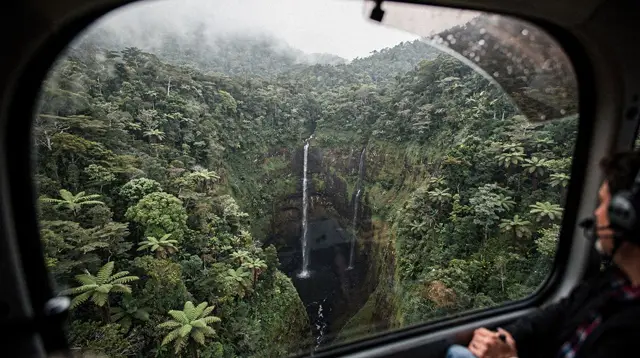
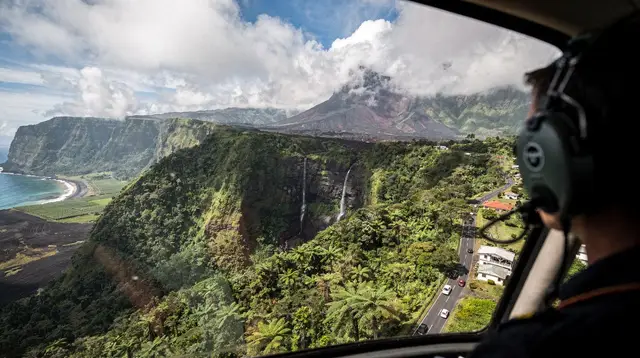
Whichever base you choose, a few bookable activities help make sense of the geography on day one: a snorkelling trip to see turtles in the Saint-Gilles-les-Bains lagon is an easy first outing from any west coast base, while a helicopter flight over the island departing from Saint-Gilles is the fastest way to see how the cirques, coast and volcano actually relate to each other before committing to a driving plan. Travellers weighing a west-versus-south base sometimes book a boat trip to spot dolphins and whales from Saint-Gilles (whales typically present from June-July to October) as a west-coast-specific draw, or a full-day guided tour covering 13 stops around the island to sample multiple areas before deciding where to spend the rest of a trip.
For destination pages covering each area in more depth, see Saint-Gilles, Saint-Leu, Saint-Pierre, Cilaos, Salazie and Hell-Bourg, and Mafate and the Maido. For what to do once you’ve chosen a base, the things to do in Saint-Gilles, things to do in Cilaos, and things to do in Saint-Pierre guides break down activities by area.
Where to stay in Réunion Island: frequently asked questions
Is it better to stay on the west coast or in the south of Réunion Island?
The west coast (Saint-Gilles-les-Bains, l’Hermitage) suits travellers who want lagon swimming, snorkelling and boat trips within walking distance. Saint-Pierre suits those who want a working town with a market and nightlife, and easier access to Pierrefonds airport and the wild south.
Can you stay in the cirques instead of the coast?
Yes. Cilaos and Salazie have hotels and chambres d’hôtes, and basing there saves the drive up and down each day if hiking is your priority. Distances on the map are short, but mountain roads mean 45 minutes to over an hour each way to the coast.
Do you need a car if you stay in Saint-Gilles-les-Bains?
Yes. Even from the west coast, reaching the Maido viewpoint, Saint-Leu or the volcano requires a car; Réunion Island has no coastal train and buses are slow for excursions into the Hauts.
How far in advance should you book a gîte in Mafate?
Several weeks to a few months ahead in the July-August and winter austral hiking season (May-October), since Mafate has no road and a limited number of beds in ilets like La Nouvelle, Marla and Roche Plate.
Is Saint-Leu a good base for paragliding?
Yes, Saint-Leu is one of Europe’s best tandem paragliding spots and sits between Saint-Gilles and the wilder south coast, so it works as a quieter alternative to Saint-Gilles-les-Bains with the same lagon access nearby.
Should you split your stay between several areas?
Most visitors do: a few nights on the west coast for the lagon, one or two in a cirque for hiking, and sometimes a night near Saint-Pierre or the volcano side to shorten the drive to Pas de Bellecombe.
Is Saint-Denis a good place to stay for a beach holiday?
Not really. Saint-Denis is the administrative capital with the Barachois and creole architecture, but it has no lagon beach; it suits a stopover near Roland-Garros airport more than a base for swimming.
Trip planning tours and activities on GetYourGuide
Verified deep-linked GetYourGuide tours. Book through these links and we earn a small commission at no cost to you.
GetYourGuide does not provide a product photo for this activity — the image shows the meeting point, photographed by us.