A five-day coastal road trip around Réunion Island
Why circle the coast instead of climbing into the cirques
There are two very different ways to spend five days on Réunion Island: drive up into the cirques and the Hauts, or stay on the coast and let the island’s climate do the storytelling. This itinerary is the second kind. It does not go to Cilaos, Salazie or the Piton de la Fournaise — if that’s what you’re after, look at a dedicated Three cirques in four days: Cilaos, Salazie and Mafate by road plan or a volcano weekend instead. What you get here is easier driving, a night in a new town almost every day, and a close look at how differently the east and west sides of a small volcanic island can behave.
That difficulty rating of easy is deliberate. There’s no version of the road to Cilaos or the Maido on this route — no hairpins, no fog rolling in by mid-morning, no white-knuckle descents. Instead, one grounded stop per region, coastal roads at a manageable pace, and enough slack each day to stop for a market, a viewpoint or a plate of rougail saucisse without the schedule falling apart. The trade-off is real: you won’t stand at 2,632 m or sleep in a Mafate gîte. What you will see is why the East Coast is a rainforest and the West Coast is a beach resort, on the same island, on the same day, an hour’s drive apart.
Renting a car is close to essential — see our notes on renting a car in Réunion Island and driving in Réunion Island before you land. Traffic can back up around Saint-Denis and the coast road at peak hours, so budget slack rather than trusting a GPS estimate at face value.
Day 1: Saint-Denis and the north
Start in Saint-Denis, the island’s administrative capital, whether you land at Roland-Garros airport in Sainte-Marie or pick up a car there. Saint-Denis doesn’t try to be a beach town — it’s a working Indian Ocean city with a genuinely mixed population, and it shows. Walk the Rue de Paris past the creole townhouses with their wrought-iron balconies, cross the Barachois waterfront, and look in on the Grande Mosquée Noor-e-Islam, the oldest mosque in France, a short walk from Tamil temples and Chinese pagodas. It’s worth an afternoon rather than a rushed morning; see our fuller list of things to do in Saint-Denis.
For dinner, book a table through a local food experience rather than guessing — a guided tasting tour through Saint-Denis’s everyday food scene is a good way to get oriented on creole cooking (carri, samoussas, bouchons) before you’re eating it solo for the rest of the trip. Sleep in Saint-Denis; there’s no reason to drive further on day one.
Day 2: the East Coast to Saint-Benoît
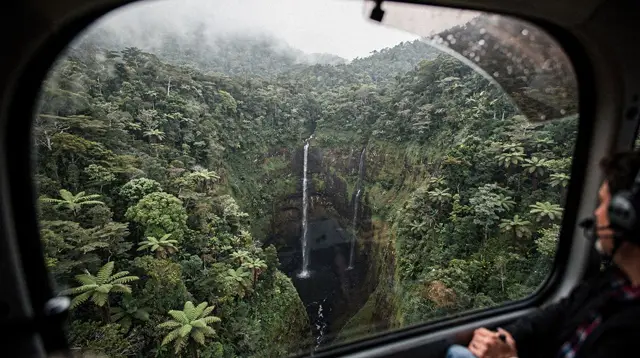
Head out of Saint-Denis on the coast road toward Saint-André and Saint-Benoît — figure on roughly an hour and a half with stops, longer if you pull off for the roadside vanilla stalls near Saint-André, where Bourbon vanilla is cured. This is where the island’s climate flips: the East Coast catches the trade winds head-on and stays green and wet almost year-round, a sharp contrast to the dry west you’ll reach on day five. Expect showers even on a sunny forecast day, and pack accordingly.
Saint-Benoît sits on the Rivière des Marsouins, and it’s the base for the island’s rafting and canyoning scene — see the fuller picture in our guide to rafting and canyoning in Saint-Benoît. If you want one active morning on this trip without heading into the mountains, a rafting descent on the Rivière des Marsouins fits well before lunch. In the afternoon, continue a little further to Sainte-Rose for the Anse des Cascades and the Notre-Dame-des-Laves church, spared by the 1977 lava flow that stopped at its door. Overnight in Saint-Benoît or push on to Sainte-Rose if you’d rather wake up closer to the lava fields you’ll cross tomorrow.
Day 3: the Wild South
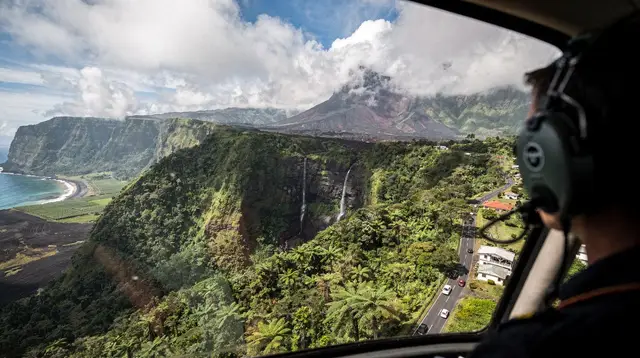
This is the day the coast road earns the name Route des Laves. From Sainte-Rose or Saint-Benoît, drive south through Saint-Philippe into the Wild South — roughly an hour to ninety minutes depending on where you stop, and you will want to stop often. The Grand Brûlé is a stretch of solidified lava flows that reached the sea as recently as 2007, black rock running straight into blue water with almost nothing built on it. Cap Méchant delivers basalt cliffs and heavy surf; walk out to the viewpoint but do not go near the water’s edge, the swell here is unpredictable and the coastline is rocky, not a beach. Swimming anywhere along the Wild South is not an option — there’s no lagoon protection here, and the whole exposed coastline of Réunion falls under the same prefectural swimming restriction that keeps bathing to the lagoon and surveyed zones only.
A guided half-day covering the highlights, a Wild South tour taking in the waterfalls, lava fields and the Route des Laves, is worth considering if you’d rather not navigate the stops yourself, since some of the best viewpoints are easy to drive past without local knowledge. For the full regional picture, see the Wild South’s things-to-do page and our notes on a Wild South day trip. Continue west toward Saint-Pierre for the night, about 40 minutes to an hour from the southern tip of the Wild South.
Day 4: Saint-Pierre
Saint-Pierre is the unofficial capital of the south, and it’s worth a full day rather than a drive-through. The covered market runs daily and the Saturday forain market spills through the streets, one of the better places on the island to buy spices, vanilla and fresh produce directly from growers. The waterfront has a genuine evening buzz that Saint-Denis doesn’t quite match, and Pierrefonds airport sits just outside town if you’re flying in or out from the south instead.
If the weather’s cooperating, this is also a strong base for a scenic flight — the same Wild South tour can be swapped for a helicopter view of the coastline you drove the day before, giving a very different sense of scale over the lava fields. Otherwise, spend the afternoon around town; see things to do in Saint-Pierre for the fuller list, including the Saga du Rhum distillery museum if you want an indoor option should it rain. Stay the night in Saint-Pierre.
Day 5: Saint-Leu, l’Étang-Salé and back to Saint-Gilles
The last leg runs northwest along the dry, sunny side of the island — a clear contrast to the East Coast two days ago, and the reason this loop works as a climate story as much as a road trip. From Saint-Pierre, it’s a short drive, under an hour, to l’Étang-Salé and its black-sand beach, then on to Saint-Leu, one of Europe’s better tandem paragliding spots thanks to the reliable thermals rising off the coast. If flying isn’t your thing, Kelonia’s sea turtle observatory is a calmer alternative in the same town. For a slower morning, a tandem paragliding flight over the Bay of Saint-Leu gives a last aerial view of the lagoon you’re about to reach by road. More detail at things to do in Saint-Leu.
Finish in Saint-Gilles-les-Bains, 20 to 30 minutes further north, where the lagoon at l’Hermitage and La Saline-les-Bains is the one stretch of coast on this whole route where open swimming is actually appropriate, protected by the reef and marked out by the marine nature reserve. It’s a fitting place to close a loop that started in a working city and spent five days tracking how much weather, coastline and pace can change over roughly 200 km of Réunion Island.
Distances and pacing, day by day
| Day | Route | Typical drive time | Overnight |
|---|---|---|---|
| 1 | Airport / Saint-Denis | Local only | Saint-Denis |
| 2 | Saint-Denis → Saint-Benoît (East Coast) | 1.5–2 h with stops | Saint-Benoît or Sainte-Rose |
| 3 | East Coast → Wild South → Saint-Pierre | 2–2.5 h with stops | Saint-Pierre |
| 4 | Saint-Pierre (base day) | Local only | Saint-Pierre |
| 5 | Saint-Pierre → Saint-Leu → Saint-Gilles | 1.5–2 h with stops | Saint-Gilles-les-Bains |
These are drive times, not distances — on a coast road that runs through town centres and roundabouts rather than in a straight line, kilometres are a poor guide to how long a leg actually takes.
Planning notes for this loop
- Season: austral winter (May–October) is drier and generally more comfortable for the Wild South’s exposed sections; austral summer (November–April) brings heavier rain, especially on the East Coast, and overlaps with cyclone season — check our cyclone season guide before booking non-refundable stays.
- Car: any compact rental works; this loop never needs the mountain roads that justify a bigger or higher-clearance vehicle.
- Swimming: lagoon and surveyed zones only, concentrated in Saint-Gilles, l’Hermitage, La Saline-les-Bains, Saint-Leu and l’Étang-Salé’s bassin — never along the Wild South’s open coastline. See best beaches in Réunion Island for the full rundown.
- Budget: mid-range, with the main variables being accommodation choice in Saint-Pierre and Saint-Gilles and how many activities you add on top of the driving.
- What this trip skips on purpose: Cilaos, Salazie, Mafate and the volcano. Building those in means adding mountain-road days, not stretching this itinerary — the Réunion Island road trip works better as two separate trips than one overloaded week.
Pick-up and drop-off for the coastal loop
Your five days start in Saint-Denis and end back in Saint-Gilles, so the car stays with you the whole way and you never need to leave it anywhere else. That makes the pick-up point the main choice: decide whether you collect it on arrival or only on the morning you leave the north, since the days you spend in town need no vehicle.
Check that the rental covers every day of the loop, including the final evening in Saint-Gilles, and look at how the fuel and mileage terms are written before you pay. The East Coast can be wet outside the austral winter, so a flexible cancellation option is useful if your dates may shift, and you can look at pick-up options on Localrent for this loop.
FAQ: planning a coastal loop around Réunion Island
Does this itinerary include Cilaos, Salazie or the volcano?
No. Those need mountain roads and a full day each in their own right. This is a coastal loop; pair it with a separate cirques itinerary or a volcano day trip if you have more time.
How many kilometres do you actually drive each day?
Less than the map suggests matters — what matters is time. Coastal legs run 1 to 2.5 hours including stops, since the road hugs the shoreline through towns and roundabouts rather than running straight.
Can you swim anywhere along this route?
Only in the lagoon on the west coast (Saint-Gilles, l’Hermitage, La Saline-les-Bains, Saint-Leu) or at surveyed, protected spots. The Wild South’s coastline is rocky and swimming there is prohibited by prefectural order because of shark risk.
Is a small rental car enough for this trip?
Yes. The whole route stays on the coastal ring road and secondary roads, no 4x4 or high clearance needed. A compact car is the norm and easiest to park in Saint-Denis and Saint-Pierre.
What’s the best time of year for a coastal loop like this?
The austral winter, from May to October, is drier and cooler, which suits the Wild South’s exposed lava fields best. November to April is hotter and wetter, especially on the East Coast, and falls within cyclone season.
Do you need to book anything in advance?
Accommodation in Saint-Pierre and Saint-Gilles books up in the austral winter high season. Activities like helicopter flights, paragliding or rafting depend on weather and should be reserved a few days ahead with flexible cancellation.
Trip planning tours and activities on GetYourGuide
Verified deep-linked GetYourGuide tours. Book through these links and we earn a small commission at no cost to you.
GetYourGuide does not provide a product photo for this activity — the image shows the meeting point, photographed by us.