What to pack for Réunion Island
What should you pack for Réunion Island?
Pack in layers: light clothes and a swimsuit for the lagoon coast, a warm fleece and windbreaker for the volcano or Piton des Neiges where temperatures can drop near 0°C in the austral winter, and rain protection for the wetter East coast. Add insect repellent, a 230V type E/F adapter, cash for the Hauts and Mafate gîtes, and proper hiking shoes.
The one fact that changes your suitcase
Most packing mistakes for Réunion Island come from a single wrong assumption: that July and August are summer. They are not. Réunion is in the southern hemisphere, so its seasons run opposite to Europe’s. The austral winter runs roughly May to October: dry, sunny on the coast, and noticeably cool in altitude. The austral summer runs November to April: hot, humid, and the cyclone season. A visitor packing for “summer in July” ends up shivering at Pas de Bellecombe at dawn, or overdressed and sweating through a March afternoon in Saint-Denis. Check the month you’re travelling against the Réunion Island weather by month guide before you pack, then build your bag in layers around it, not around a generic tropical-island list.
This page sticks to what goes in the suitcase. For visa rules and safe-swimming zones, see entry requirements and where can you swim in Réunion Island. For day-by-day planning, see the itineraries section instead.
Layer 1: lagon and coastal clothing
The coast, especially the West coast around Saint-Gilles-les-Bains, l’Hermitage and La Saline-les-Bains, stays warm and dry most of the year, with daytime temperatures typically between 24°C and 32°C even in the austral winter. Pack for this the way you would for any beach destination:
- Swimsuit, quick-dry clothing, sandals or flip-flops.
- Reef-safe sunscreen (the Réserve naturelle marine de La Réunion protects the coral in front of Saint-Gilles and l’Hermitage; some conventional sunscreens damage reef systems).
- A light cover-up or shirt for the strong tropical sun, even on cloudy days.
- A rash guard if you plan several snorkelling sessions; it saves on sunscreen reapplication in the water.
If your trip includes a morning on the water, whether that’s a snorkelling outing to see turtles off Saint-Gilles-les-Bains or a boat trip looking for dolphins, a dry bag for your phone and a spare towel are worth the small extra weight. Between June and October, whale season along the West coast draws people onto boats early; see a cruise departure focused on spotting whales and dolphins if that’s on your list, and dress as if it will be breezier on open water than it feels on the beach.
Layer 2: the warm layer for altitude
This is the layer most visitors forget, and it’s the one built around Réunion’s real terrain. The island’s interior climbs fast: Piton de la Fournaise sits at 2,632 metres, the Plaine des Sables crossing on the way there is a windswept, treeless plateau, and the Piton des Neiges, at 3,070 metres the highest point in the Indian Ocean, is often climbed overnight from the Caverne Dufour gîte above Cilaos to catch sunrise at the summit.
At these altitudes, especially during the austral winter (May–October), temperatures regularly drop close to freezing before dawn, and frost is not unusual at the highest points. Pack:
- A warm fleece or insulated mid-layer.
- A windproof and water-resistant shell jacket, packable enough to carry on a day hike.
- A hat and light gloves if you’re attempting Piton des Neiges or an early-morning start at the volcano.
- Long trousers rather than shorts for the volcano route; the Plaine des Sables has little shelter from wind.
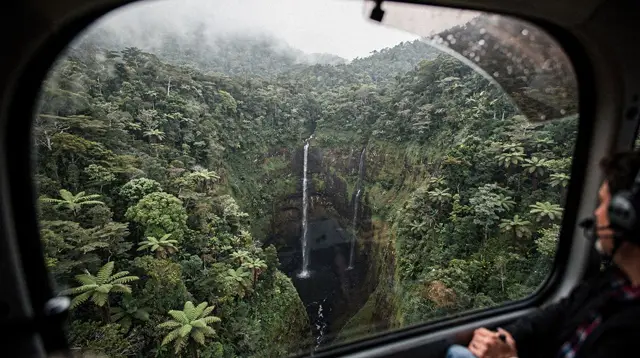
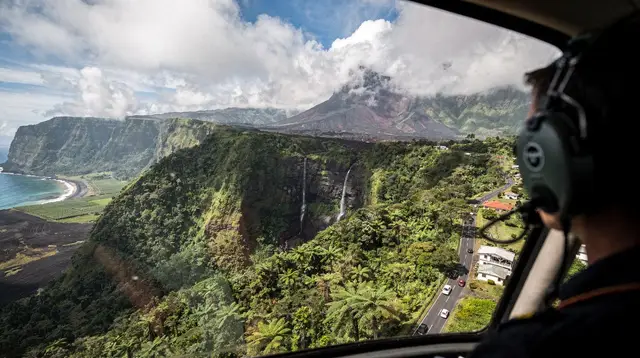
This layer earns its place in the bag even on a trip built mostly around beaches, because a volcano day trip or a Cilaos hike is on most itineraries. A helicopter flight over the island departing from Saint-Gilles is one way to see the volcano and the cirques without the early cold start on foot, but even inside the cabin, bring the same warm layer: doors-off or low-altitude passes over Mafate and the volcano crater rim can be genuinely cold, and ground temperatures at drop-off points are cooler than the coast.
Layer 3: rain protection for the East and the Hauts
Réunion’s East coast, from Saint-Benoît to Sainte-Rose, sits on the windward side and receives far more rainfall than the sheltered West. Even during the drier austral winter, a shower can appear with little warning, and the Hauts (the highland areas around Salazie, Cilaos and Mafate) see more rain than the coast at any time of year.
- A packable rain shell (not just an umbrella, which is impractical on trails).
- A dry bag or waterproof liner for a daypack if you’re hiking toward Salazie, the Voile de la Mariée waterfall near Hell-Bourg, or the Trou de Fer viewpoint.
- Quick-dry rather than cotton clothing for multi-day treks, since damp cotton doesn’t dry between days in humid conditions.
If a Salazie or Cilaos day trip is on the plan, check trail status with the ONF before setting out; heavy rain closes sections of path, and the rain gear above is about comfort, not a guarantee the trail will be open. For a broader sense of what rainfall to expect by season, the best time to visit Réunion Island guide breaks down the West-East contrast month by month.
Health and practical items
A few items aren’t about temperature at all, but come up constantly for visitors to Réunion:
Insect repellent. Dengue and chikungunya outbreaks, both mosquito-borne, have affected the island in recent years. Pack a repellent with DEET or an equivalent active ingredient, and consider light long sleeves for evenings, particularly in the humid East coast and in the Hauts after rain, where mosquitoes are more active.
Power adapter, type E/F, 230V. It’s an easy detail to overlook because Réunion is French territory, but “part of France” doesn’t mean “same plug as home” for most non-European visitors. Sockets are the same round two-pin type used in mainland France (types E and F, 230V), which differ from UK, US, Australian, and many Asian standards. If your devices use one of those, bring an adapter; it won’t be handed out at the airport.
Cash in euros. Cards work in most shops, restaurants and hotels along the coast. That coverage thins out fast once you head into the Hauts. Small créole restaurants, roadside stalls, and above all the gîtes in Mafate, which have no road access, often can’t process cards reliably or at all. Carry enough euro cash to cover a few days if your itinerary includes Mafate or remote parts of Cilaos and Salazie.
Hiking shoes. Réunion is a hiking island first. Trails into the cirques, whether a short walk near Hell-Bourg or a multi-day crossing of Mafate, involve steep, often muddy or loose-rock terrain, and river crossings after rain. Trainers are not enough for anything beyond a short, flat coastal walk. Bring proper hiking shoes, broken in before you arrive, and a second pair of shoes or sandals for evenings so your boots can dry out. See the best hikes in Réunion Island guide for what different trails actually demand underfoot.
A packing checklist by activity
| Planned activity | Pack |
|---|---|
| Lagon swimming, snorkelling (Saint-Gilles, l’Hermitage) | Swimsuit, reef-safe sunscreen, rash guard, sandals, dry bag |
| Volcano day trip (Pas de Bellecombe, Plaine des Sables) | Fleece, windbreaker, long trousers, hat, gloves, sturdy shoes |
| Piton des Neiges summit hike | All of the above plus headlamp, warm sleeping layer for the gîte, gloves |
| Salazie or East coast day trip | Rain shell, dry bag for electronics, quick-dry clothing |
| Mafate trek (multi-day) | Hiking shoes, rain shell, warm layer, cash, headlamp, blister care |
| Scuba or snorkelling excursion | Swimsuit, towel, reef-safe sunscreen, dry bag |
| Helicopter or microlight flight | Warm layer even in season, secure bag for phone/camera |
| Any road trip in the Hauts | Cash, light jacket for evenings, closed shoes |
A short note on gear you won’t need
Réunion Island isn’t a destination that rewards over-packing. You won’t need heavy waterproof boots for the coast, a full alpine kit for the volcano (it’s a strenuous day hike or overnight trek, not technical mountaineering), or formal clothing outside a handful of restaurants in Saint-Denis or Saint-Pierre. A soft duffel or daypack that compresses well works better than a hard suitcase if your trip includes any time in Cilaos or the Hauts, where roads are narrow and luggage sometimes gets carried on foot the last stretch to a gîte.
If diving is part of your trip, most operators around Saint-Leu, l’Étang-Salé or Le Port rent full equipment, so a mask and snorkel of your own is a convenience, not a requirement. For a first supervised dive, a supervised introduction to scuba diving departing from Le Port supplies the gear; you just need a swimsuit and a towel. The same goes for a quad biking and buggy excursion in the Saint-Gilles-les-Hauts area: closed shoes and clothes you don’t mind getting dusty are enough, helmets and gear are provided.
Building the bag around your trip length
A short coastal stay built around things to do in Saint-Gilles needs mostly Layer 1, plus repellent and an adapter. A trip that adds a Cilaos day trip or the volcano needs Layers 1 and 2 together, since coastal and mountain conditions can both show up in the same 48 hours. A longer stay that includes Mafate or the Piton des Neiges summit needs all three layers plus cash and proper footwear, because you’ll move between lagon heat and near-freezing altitude within a single week. Match the bag to the itinerary rather than packing one generic tropical kit; Réunion’s terrain changes faster over a short drive than most islands its size.
Packing questions for Réunion Island
Do I need warm clothes for Réunion Island if it’s a tropical island?
Yes, above roughly 2,000 metres. On the Piton de la Fournaise, the Plaine des Sables or the Piton des Neiges summit, temperatures can approach 0°C at dawn, especially from May to October. A fleece and windbreaker are not optional for these hikes.
When is the coolest time to visit and pack accordingly?
May to October is the austral winter: drier air, cooler nights, and the best hiking season. November to April is the austral summer, hot, humid and the cyclone season, with heavier rain especially on the East coast.
Do I need a plug adapter in Réunion Island if it’s part of France?
Yes. Réunion Island uses the same 230V, type E and F sockets as mainland France, which differ from UK, US, Australian and many Asian plugs. Bring an adapter if your devices use another plug standard.
Is cash necessary, or do cards work everywhere?
Cards are widely accepted on the coast, but keep euro cash on hand for the Hauts, small créole restaurants, and especially for Mafate gîtes, where there is no road access and card readers are unreliable or absent.
What footwear is best for the cirques?
Sturdy hiking shoes with good grip and ankle support, broken in before the trip. Trails in Cilaos, Salazie and Mafate involve steep, sometimes muddy or rocky sections, and river crossings after rain.
Do I need mosquito repellent in Réunion Island?
Yes. Dengue and chikungunya outbreaks have affected the island in recent years. Pack repellent and light long sleeves for evenings, particularly in the humid East and in the Hauts after rain.
What should I pack for a day at the lagon versus a day in the mountains?
For the lagon: swimsuit, reef-safe sunscreen, snorkel mask if you have one, sandals and a light cover-up. For the mountains: layers, a windbreaker, a hat, gloves in winter, and more water than you think you need.
Do I need a rain jacket even if I’m staying on the West coast?
A packable rain shell is still worth carrying. The West coast is the driest part of the island, but microclimates change fast, and any day trip toward the East, Salazie or the volcano can bring sudden showers.
Trip planning tours and activities on GetYourGuide
Verified deep-linked GetYourGuide tours. Book through these links and we earn a small commission at no cost to you.
GetYourGuide does not provide a product photo for this activity — the image shows the meeting point, photographed by us.