Is it safe to swim in Réunion? Sharks, the law, and the lagoon
The question I get asked before every trip here
The first time a friend told me they were booking a week in Réunion, the first thing they asked wasn’t about the volcano or the cirques. It was: “Is it actually dangerous to swim there?” They’d found a forum thread mentioning shark attacks and a ban on swimming outside the lagoon, and it had spooked them enough to nearly cancel the beach days from their itinerary.
I understand the reaction. “Shark risk” and “swimming ban” are not words you expect to read about a French department in the Indian Ocean. But the honest answer is more reassuring than the headlines suggest, and more restrictive than most visitors expect at the same time. Réunion is safe to swim in, provided you stay inside the areas where swimming is actually allowed. Outside those areas, it is not a grey zone you get to judge for yourself. It is against the law, and that distinction matters more than anything else in this article.
Why the ban exists
Since 2013, a prefectoral order (arrêté préfectoral) has prohibited swimming, surfing, bodyboarding, and other nautical activities along most of the west coast of Réunion outside the lagoon and a handful of supervised or protected zones. This followed a string of shark attacks, several of them fatal, concentrated on the west coast between Saint-Paul and Saint-Leu. The species involved are bull sharks and tiger sharks, both of which hunt close to shore in the channel of deeper water just beyond the reef, particularly where rivers or storm drains empty into the sea and around river mouths after rain.
The ban is not a blanket statement about the whole island’s coastline, and it is not permanent scaremongering left over from one bad year. It is a targeted, maintained restriction, reviewed and enforced by the prefecture, covering the stretch of coast where the risk is documented and real. It exists because the alternative, letting each swimmer judge the water in front of them, has already been tried, and it did not work.
What “outside the lagoon” actually means
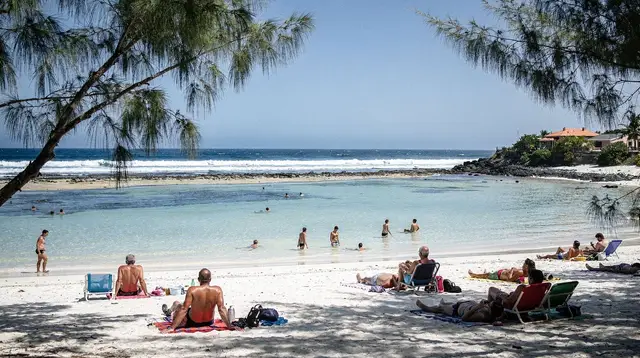
The lagoon along Réunion’s west coast, from around Saint-Gilles and l’Hermitage down to La Saline, is protected by a coral reef that creates a shallow, enclosed body of calmer water between the beach and the reef. This is where swimming is permitted, and where the vast majority of visitors spend their beach time without any issue. Beyond the reef, the seabed drops away and the open channel begins, and that channel is exactly where the ban applies.
The same logic extends past the lagoon itself. At Saint-Leu, Saint-Pierre, l’Etang-Salé, and other points along the coast, swimming is restricted to specific supervised or netted zones rather than the whole shoreline. A beach can look calm and inviting from the sand and still fall entirely outside the permitted zone. There is no visual cue that reliably tells you where the boundary is; the boundary is set by the order, not by how the water looks that day.
I am not going to list every safe beach and every restricted stretch here. That belongs in a dedicated guide, because it changes by exact location and it is the kind of detail you want confirmed on the ground, not skimmed from a blog post before you leave. What matters for this page is the principle: the areas are defined by the prefecture, they are marked with signage on-site, and they are not up for personal reinterpretation.
If you want to explore the lagoon itself rather than just lie on the sand next to it, snorkeling and kayaking inside the reef at l’Hermitage is a good way to spend a morning entirely within the permitted zone, and Saint-Leu has its own reef-protected patches worth checking locally. For visitors who’d rather go under the surface than float on it, guided scuba diving out of Saint-Gilles and diving around Saint-Leu and l’Etang-Salé operate with dive centres that know exactly where the permitted zones sit, which takes the guesswork out of it entirely.
Why “I’m a strong swimmer” doesn’t change anything
This is the part visitors from other coastlines struggle with most. Almost everywhere else, ocean safety is framed as a personal risk calculation: check the conditions, know your ability, decide for yourself. Réunion’s west coast doesn’t work that way, and treating it as if it did is the single most dangerous assumption a visitor can make here.
Bull sharks and tiger sharks in this channel are not deterred by calm water, clear visibility, or a swimmer’s confidence. Several of the people involved in past incidents were experienced surfers and swimmers, familiar with the ocean, who were in the water at spots that looked, and often were, unremarkable. The risk isn’t about individual skill or caution level. It’s about being present in a specific stretch of water where these species hunt close to shore. A confident swimmer outside the lagoon is not safer than a nervous one; they are both outside the zone where the restriction protects them, and inside the one it doesn’t.
So the honest advice is not “assess the water and decide.” It’s “the lagoon and the marked zones are where you swim, and the rest of the coast, however inviting it looks at 6pm with the light going gold over the water, is not open for negotiation.”
This is one of several details first-time visitors get wrong before they arrive, and it sits alongside a handful of other assumptions worth checking before you land; the common travel mistakes to avoid in Réunion page rounds up the rest. If you’re still deciding when to come, the best time to visit Réunion covers how the austral seasons affect beach and lagoon conditions in more detail.
What this means for your trip, practically
None of this should keep you off the beach. Réunion’s lagoon beaches, particularly around l’Hermitage and Saint-Gilles, are genuinely good: warm, calm, shallow enough for kids, and backed by a reef that keeps the swell out. You can spend entire days there without ever thinking about what’s happening in the channel beyond it. A separate page covers exactly which beaches and lagoon zones work best; the things to do in Saint-Gilles hub is a reasonable starting point once you’re planning the specifics.
If what drew you here was the idea of open water, sailing past the reef to look for marine life rather than swim in it, that’s still very much on the table, just from a boat rather than in the water. Boat trips out of Saint-Gilles harbour are a common and well-run way to see the coastline and its wildlife without crossing into restricted water, and I’ll point you to that option rather than the swimming question, since watching from a boat is a separate topic from where you’re allowed to swim. If you want to look further out to sea while staying entirely within the rules, a boat trip out of Saint-Gilles that watches for dolphins and whales or a seabed and wildlife boat excursion from the harbour gets you on the water without touching the question this page is about.
For a different kind of ocean view altogether, and one with zero overlap with the swimming restriction, a microlight flight over the island or a tandem paraglide above the bay of Saint-Leu shows you the lagoon, the reef line, and the channel beyond it from above, which is honestly one of the clearest ways to see why the boundary exists in the first place.
If your visit lines up with whale season in Réunion, roughly the cooler, drier months, the same boats that watch for dolphins also track humpback migrations offshore, and a dedicated whale-watching excursion out of Saint-Gilles is worth booking ahead rather than hoping for a sighting on a general boat trip. Some travellers also ask whether swimming with dolphins here is something to pursue; is swimming with dolphins in Réunion ethical is worth reading before you book anything that promises it.
The bottom line
Swimming in Réunion is safe inside the lagoon and the marked, supervised zones, and it is prohibited by law everywhere else on the affected coastline. That’s not personal caution dressed up as a rule; it’s an actual prefectoral order, enforced with real consequences, built on a documented pattern of incidents rather than general nervousness about sharks. Treat the boundary as fixed, not as a starting point for your own judgment call, and the beach days here are as relaxed as anywhere else you’ve swum. For where exactly those safe zones are on a map, best beaches in Réunion Island covers it beach by beach; for the wider safety picture beyond sharks, see is Réunion Island safe for tourists.
Réunion swimming safety: frequently asked questions
Is it illegal to swim outside the lagoon in Réunion?
Yes. A prefectoral order in force since 2013 bans swimming, surfing, and other nautical activities outside the lagoon and specific supervised or protected zones along much of the west coast, because of documented shark risk. It is enforced by local authorities, not a matter of personal choice.
Which sharks are the concern in Réunion?
Bull sharks and tiger sharks, both of which are known to hunt in the deeper channel water just beyond the reef, especially near river mouths and after rain. They are the species responsible for the incidents that led to the current restrictions.
Can experienced swimmers or surfers ignore the ban if conditions look calm?
No. Several past incidents involved experienced swimmers and surfers in calm, clear-looking water. The restriction isn’t based on individual skill or how the water appears; it applies to the location itself, regardless of who is in it.
Is the lagoon in Saint-Gilles safe to swim in?
Yes, the lagoon is the designated safe swimming area, protected by the coral reef, and it’s where the majority of visitors swim without incident. The risk the ban addresses is specifically in the open channel beyond the reef, not inside the lagoon itself.
How do I know where the swimming boundary actually is?
Restricted and permitted zones are marked with signage on-site, and they vary by beach and town rather than following one single line along the whole coast. Confirm locally rather than assuming a beach is safe just because it looks calm from the sand.
Does the swimming ban affect boat trips or whale and dolphin watching?
No, the restriction applies to swimming and nautical sports activities in the water, not to boat excursions. Boat trips out of Saint-Gilles harbour operate normally and are a common way to see the coastline and marine life without entering restricted water.
Is this rule unique to Réunion, or does it apply in Mauritius too?
The ban is specific to Réunion’s affected coastline and its documented shark incidents; it is not a general Indian Ocean rule, and swimming norms differ on other islands, including nearby Mauritius. Don’t assume the same restriction applies elsewhere in the region.
Should the shark risk stop me from visiting Réunion at all?
No. The lagoon and marked zones offer safe, well-used swimming, and the restriction exists precisely because it targets the specific area of risk rather than leaving visitors to guess. Respecting the boundary, not avoiding the island, is what keeps a beach day here uneventful.
tours.Practical
Verified deep-linked GetYourGuide tours. Book through these links and we earn a small commission at no cost to you.
GetYourGuide does not provide a product photo for this activity — the image shows the meeting point, photographed by us.