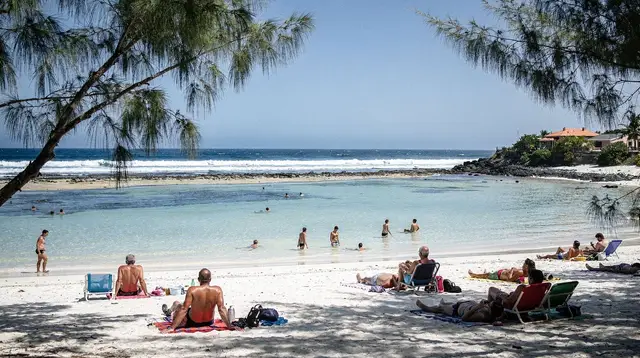
Saint-Gilles-les-Bains gets the crowds, the marina and the postcard lagoon. Twenty minutes south, Saint-Leu is the west coast’s more active sibling: a working town wrapped around a paragliding cliff, a turtle observatory and an old sugar factory, with a lagoon that’s narrower and quieter than Saint-Gilles’ but still swimmable. Push another twenty minutes south and the whole colour scheme flips at L’Étang-Salé, where the beach turns from white coral sand to black volcanic sand. This page covers both towns as one stretch of coast worth a full day, or two half-days if you’re basing yourself further north.
Why Saint-Leu isn’t just Saint-Gilles with fewer people
The comparison is inevitable because the two towns sit fifteen minutes apart on the same leeward coast, sharing the same dry, sunny microclimate and the same barrier-reef lagoon system. But the town centres serve different purposes. Saint-Gilles built itself around tourism: hotels along the beachfront, a marina with dolphin-watching and sunset-cruise boats, restaurants stacked three deep near L’Hermitage. Saint-Leu built itself around sugar first, then around a cliff.
That cliff — a launch site a few hundred metres above the coast road — is one of the more consistent tandem paragliding spots in the Indian Ocean, and one of the reasons pilots from Europe base themselves here for stretches of the austral winter. You don’t need to fly to feel the effect: on a clear morning it’s common to see a dozen canopies drifting over the bay from the beach or the coast road below, which is a different visual anchor for the town than Saint-Gilles’ marina ever offers.
If you’re choosing where to sleep, most visitors still pick Saint-Gilles for its wider choice of hotels and restaurants, using Saint-Leu as a day trip. That said, staying in Saint-Leu itself works well if paragliding, diving or a quieter pace matters more to you than nightlife.
Paragliding over the bay
Launch sites sit above the town, reached by a short drive up from the coast road; from there, tandem flights typically run 15 to 30 minutes depending on the package, gliding out over the bay with the reef and lagoon visible below and the Hauts de l’Ouest rising behind. Morning flights tend to have steadier air; by early afternoon, thermal activity can get bumpier, which some flyers enjoy and others don’t.
a tandem paragliding flight over the Bay of Saint-Leu is the single most-booked activity on this stretch of coast, and it’s worth checking weather flexibility when you book: flights get postponed on windy or overcast days, and operators reschedule rather than refund by default in most cases.
If flying isn’t your thing but the coastline still appeals from the water, Saint-Leu also has a reef break used for beginner lessons; a surfing lesson in Saint-Leu is a lower-key way to spend a morning on the same bay, with an instructor and board included.
Kélonia: the marine turtle observatory
Kélonia sits right on the coast at Saint-Leu, an easy stop before or after a flight. It’s a working rehabilitation and research centre for green and hawksbill turtles as much as a visitor attraction: outdoor pools hold turtles recovering from injury or entanglement, with information panels explaining the threats they face around the island, from fishing lines to plastic. Plan on one to two hours, more if you’re travelling with children who want to linger at each pool.
It’s not a swim-with-turtles operation — the animals here are in recovery, not on display for interaction — which is worth knowing if that’s what you’re expecting. For an in-water encounter with reef life instead, the lagoon just offshore is used for guided outings; see the snorkeling section below.
Stella Matutina: the old sugar factory
A short drive up from the coast at Piton Saint-Leu, Stella Matutina is a former sugar factory converted into a museum covering the industry that shaped this coast for over a century — cane cultivation, the mill machinery, the labour history behind it, and Réunion’s broader colonial-era economy. It’s a denser, more historical stop than the beach and turtle centre, and one that benefits from an hour of unhurried reading rather than a quick pass-through. Hours vary by day and season, so it’s worth checking before you drive up, since unlike Kélonia it isn’t visible from the coast road.
Diving and snorkeling around Saint-Leu
The reef off Saint-Leu is less crowded than the dive sites off Saint-Gilles and L’Hermitage, with drop-offs and coral formations that draw repeat divers rather than one-off resort visits. a guided snorkeling tour in the lagoon is the accessible version for non-divers, covering the shallower reef sections with a guide who knows where the fish life concentrates.
As everywhere on this coast, swimming and snorkeling stay inside the lagoon or supervised zones — a shark-risk prefectural order bans bathing and water sports outside the reef and unmonitored areas along the whole west coast, Saint-Leu and L’Étang-Salé included. This isn’t a Saint-Leu-specific rule; it’s the same restriction that applies from Saint-Gilles down to Saint-Pierre.
L’Étang-Salé: the black sand contrast
Drive twenty minutes south from Saint-Leu and the beach changes colour. L’Étang-Salé’s sand is dark, almost black, made of basalt rather than the coral-derived white sand at Saint-Gilles, L’Hermitage and La Saline-les-Bains further north. It’s the same coastline, the same leeward dry climate, but a different volcanic layer underfoot — worth naming explicitly if you’re coast-hopping in a single day, because the two beaches photograph nothing alike.
The black sand gets considerably hotter than white sand under the midday sun; sandals are more useful here than at Saint-Gilles. A filao (casuarina) forest runs behind part of the beach, giving shade that the more open Saint-Gilles beachfront lacks, and making L’Étang-Salé a reasonable picnic or walking stop even outside peak swimming hours.
Swimming again means staying inside the marked, supervised sections — L’Étang-Salé’s reef coverage is thinner than further north, so the safe swimming zone is smaller, and the same prefectural restriction on open-water swimming applies.
Whale and dolphin watching from L’Étang-Salé
From roughly June-July to October, humpback whales pass this stretch of coast, and L’Étang-Salé runs its own seasonal boat outings rather than relying solely on the Saint-Gilles marina further north. A supervised launch for whale and dolphin watching and snorkeling from Étang-Salé combines an in-water snorkel session with time on the water looking for cetaceans, under the approach-distance rules that apply to every operator on the island. Sightings are seasonal and never guaranteed on a given outing.
For an evening version of the same stretch of water, an L’Étang-Salé boat trip with snorkeling, sunset and a cocktail covers a shorter, sunset-timed outing rather than a dedicated wildlife search.
Getting there and around
Both towns sit on the coastal road (RN1/RN1a) linking Saint-Paul to Saint-Pierre. From Roland-Garros airport near Saint-Denis, figure on roughly an hour to Saint-Leu and just over an hour to L’Étang-Salé in normal traffic — longer during the morning and evening peaks around Saint-Denis and the Saint-Paul bypass. From Saint-Gilles, it’s about 20 minutes to Saint-Leu and another 20 to L’Étang-Salé.
A rental car is close to essential for combining both stops in one day; Car Jaune buses run the coast road but on a schedule that makes a same-day loop through paragliding, Kélonia, Stella Matutina and the black sand beach impractical.
| From | To Saint-Leu | To L’Étang-Salé |
|---|---|---|
| Roland-Garros airport | About 1h | About 1h15 |
| Saint-Gilles-les-Bains | About 20 min | About 40 min |
| Saint-Pierre | About 30 min | About 15 min |
| Pierrefonds airport | About 40 min | About 20 min |
Planning a day here
| Stop | Time needed | Notes |
|---|---|---|
| Paragliding flight | 2-3h including transfer and briefing | Morning flights usually steadier |
| Kélonia | 1-2h | Right on the coast road |
| Stella Matutina | 1-1.5h | Short drive uphill, check opening days |
| L’Étang-Salé beach and forest | 1-3h | Bring sandals for the hot sand |
| Snorkeling or boat outing | 2-3h | Seasonal for whale watching |
Fitting all of this into one day is tight; splitting it across a day trip from Saint-Gilles for the paragliding and Kélonia, then a separate half-day for L’Étang-Salé, is more realistic if you also want time to swim rather than just move between stops. Several day trips from Saint-Gilles cover other parts of the island, but the Saint-Leu–L’Étang-Salé stretch is compact enough to plan independently with a rental car.
Where this fits on a wider Réunion Island itinerary
If you’re working out how many days in Réunion Island you need, Saint-Leu and L’Étang-Salé are a natural add-on to a west coast base rather than a standalone destination: most visitors pair them with a stay in Saint-Gilles or Saint-Pierre, using the paragliding cliff, Kélonia and the black sand beach as day trips rather than reasons to relocate. For the wider region, see the west coast overview, and for where to stay on Réunion Island more broadly, weigh Saint-Leu’s quieter base against Saint-Gilles’ larger choice of hotels.
For budgeting the rest of the trip, see Réunion Island trip cost, and for what to pack given the sun exposure on the cliff and the beach, what to pack for Réunion Island covers sun protection and footwear for hot sand.
Saint-Leu and L’Étang-Salé: your questions answered
Is Saint-Leu better than Saint-Gilles for a first visit to Réunion?
Not better, different. Saint-Gilles has more hotels, restaurants and the widest lagoon beach, so most first-time visitors base themselves there. Saint-Leu suits people who already know they want to paraglide, dive or spend a quieter afternoon at Kélonia rather than lie on a beach all day. Many visitors do Saint-Gilles as a base and Saint-Leu as a day trip.
Do I need experience to paraglide in Saint-Leu?
No. Almost all flights sold to visitors are tandem, meaning you’re harnessed to a certified pilot who does the flying. You walk (or run a few steps) off the launch point and land on the beach or a field below. No licence or prior flight is required, though most operators set a minimum age and a maximum weight.
Can you swim at L’Étang-Salé’s black sand beach?
Yes, in the marked and supervised sections, the same rule as everywhere on this coast. The black sand gets notably hotter underfoot than white sand at midday, so sandals help, and the swimming area is smaller than Saint-Gilles’ lagoon since there’s no barrier reef directly in front of the beach.
What is Kélonia and is it worth the stop?
Kélonia is a marine turtle observatory and rehabilitation centre in Saint-Leu, with outdoor pools holding green and hawksbill turtles recovering from injury alongside research and conservation work. It’s a good one- to two-hour stop, especially with children, and works well combined with a paragliding flight or a walk through town.
Is Stella Matutina open every day?
Stella Matutina, the former sugar factory turned museum in Piton Saint-Leu, keeps set opening days and closes on some public holidays; hours shift with the season. Check the current schedule before driving out, since it’s a detour from the coast road rather than something you’ll pass by chance.
Why is the sand black at L’Étang-Salé but white further north?
L’Étang-Salé sits on a stretch of coast built from more recent volcanic material, so the beach is made of dark basalt sand rather than the coral-derived white sand that dominates Saint-Gilles, L’Hermitage and La Saline-les-Bains. It’s the same west coast, but a different geological layer at the surface.
Can you see whales or dolphins from Saint-Leu or L’Étang-Salé?
Humpback whales pass this stretch of coast roughly from June-July to October, the same season as further north at Saint-Gilles. Supervised launches and boat trips from L’Étang-Salé run seasonal snorkeling and watching outings, always at a legally required distance, with no guarantee of a sighting on any given day.
How do I get between Saint-Leu and L’Étang-Salé?
By car along the coastal road, about 20 minutes without traffic. There’s no reliable way to see both towns properly without a car or an organised tour, since the interesting stops (paragliding launch, Kélonia, Stella Matutina, the black sand beach) are spread along several kilometres of coast rather than clustered in one walkable centre.