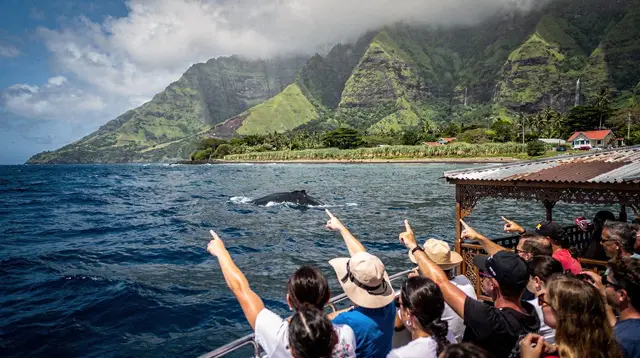
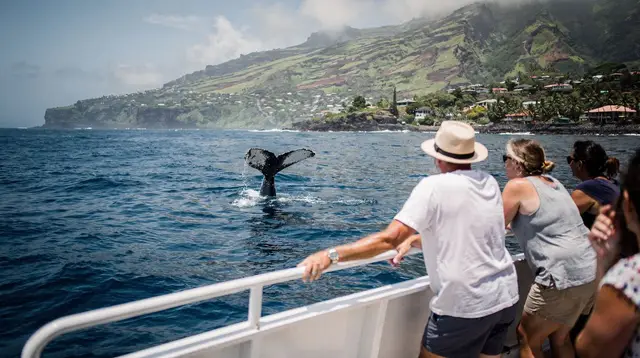
Whale season in Réunion: when to see humpbacks
The window I actually plan around
I get asked this more than almost anything else about Réunion: which week should I book to see a whale? I wish I had a tidier answer. What I have is a season, not a date, and the season lines up with something else I already tell people to plan for — the dry, cooler austral winter, from May to October, which is also the best stretch for hiking in the cirques and up the volcano.
Humpback whales show up off the west coast roughly from June or July through October, with August and September the most reliable months in most years. They’re migrating from Antarctic feeding grounds toward warmer water to breed and calve, and the lagoon side of the island — from Saint-Gilles down past Saint-Leu — sits close enough to deep water that boats don’t have to travel far to reach where the whales pass.
Outside that window, from November to May, you’re not going to see humpbacks here. Don’t let anyone sell you a “whale watching” trip in January; what you’ll get is dolphins, which are resident year-round and a different story altogether. That off-season window is also the cyclone season, so if you’re weighing a November-to-April date against a winter one, it’s worth reading about what happens if a cyclone hits during your trip before you commit to dates. For the bigger picture on when to come, our best time to visit Réunion guide and the weather by month breakdown both line up with the same austral-winter window I plan whale trips around.
No boat can promise you a whale
This is the part that matters more than the calendar. Whale watching around Réunion is regulated by an official approach charter, with minimum distances boats have to keep from any whale they encounter, and rules about how many boats can approach the same animal, how long they can stay, and how they’re allowed to move. Operators who hold the charter follow it; it’s a genuine constraint, not a marketing badge.
What that means in practice: even in peak season, a two-hour outing from the port at Saint-Gilles can come back having seen nothing. Whales aren’t on a schedule, and a good operator won’t chase one down to force a sighting — that’s the point of the distances. I’ve had trips where a mother and calf surfaced twenty metres from the boat for ten minutes, and I’ve had trips where we saw a distant blow and nothing else. Both are normal. If a company guarantees a sighting, that’s a reason to book somewhere else.
The same charter is part of why we think hard about the ethics of the dolphin trips that run the rest of the year — see is swimming with dolphins in Réunion ethical — and it’s a good reminder that the water here comes with its own rules generally, covered in is it safe to swim in Réunion: sharks and beaches.
a whale and dolphin watching outing from Saint-Gilles-les-Bains is the standard way to try, departing from the marina and working the coastline where sightings cluster in season.
Month by month, roughly
| Period | What to expect |
|---|---|
| November–April | No humpbacks. Cyclone season; dolphins still around. |
| May | Early arrivals possible, not reliable. |
| June–July | Season opens; sightings increase through July. |
| August–September | Peak months, best odds. |
| October | Tail end; numbers taper off. |
Treat this as a pattern, not a promise — some years the whales linger into November, other years the season feels short. Nobody, including the operators, controls that.
If whale season is the whole reason for your trip, it’s worth building the itinerary around it rather than squeezing it in. Our four-day whale season itinerary does exactly that, and it slots into a longer stay just as easily if you’re already looking at a one-week Réunion itinerary or a five-day trip.
Where the trips leave from
Almost every whale watching outing on the island departs from the port de Saint-Gilles-les-Bains, on the west coast where the lagoon meets open water. That’s also where I’d base myself if whale season is the main reason for the trip, since it puts you a short walk from the boats and close to Saint-Leu and l’Hermitage if you want to fill the rest of the day. A typical outing runs a couple of hours and often combines whale and dolphin watching with a look at the coastline from the water, since dolphins are the more dependable sighting of the two. For everything else worth doing around the port while you’re there, see things to do in Saint-Gilles and the wider Saint-Gilles destination guide; if you want the lagoon itself rather than a boat further out, Hermitage lagoon snorkelling and kayaking is the calmer option next door.
If you’d rather see the coast from the air than the sea — and it doesn’t compete with a boat trip, it’s a different vantage entirely — a microlight flight over the island sometimes turns up a whale shape in the water below, though that’s a bonus, not the point of the flight. We cover the other angles on that choice in helicopter and microlight flights from Saint-Gilles, helicopter vs. microlight flight over Réunion, and, if you’re wondering whether it’s worth the money at all, is a helicopter flight over Réunion worth it.
Boats also run from Le Port, just north of Saint-Gilles, and a whale watching excursion from Le Port covers similar ground with a slightly different departure point — useful if Saint-Gilles trips are booked out during peak weeks in August and September. A closely related trip, the Port de Saint-Gilles-les-Bains dolphin, whale and seabed boat trip, adds a look below the surface as well, which is worth it on days when the swell is calm enough to see the reef.
Booking around the odds
Because sightings aren’t guaranteed, I book whale season trips with slack built in rather than a single fixed slot. If your schedule allows it, doing the boat trip early in a multi-day stay on the west coast means you can try again if the first outing comes back empty-handed — some operators offer a second attempt at reduced cost, though that’s worth confirming when you book rather than assuming. Morning departures tend to have calmer water, which makes spotting easier and the ride more comfortable if you’re prone to seasickness.
Pair the boat trip with time on land rather than treating it as the whole day. Saint-Gilles itself has enough going on — the lagoon, the Aquarium de La Réunion, the port — that a whale trip fits naturally into a morning or afternoon rather than requiring you to structure the whole visit around it. If you’re still deciding where to stay for whale season, where to stay in Réunion Island and Saint-Gilles vs. Saint-Leu: where to stay both point toward the west coast for exactly this reason. On a calmer afternoon, a catamaran and sunset cruise from Saint-Gilles is a good lower-key way to be back on the water without the early start a whale trip usually needs.
Practical notes
Bring a hat, sunscreen, and something warmer than you’d expect for a tropical island — the wind picks up on open water even in August, which sits in the cooler austral winter. Binoculars help but aren’t essential; most sightings happen close enough to the boat that the naked eye does the job. Motion sickness tablets are worth having if you’re unsure how you’ll handle swell, since the boats do head out beyond the calm of the lagoon to reach whale territory. For the rest of what’s worth packing for a winter trip that might also take you up to the cirques or the volcano, our what to pack for Réunion Island guide covers it in full.
Building a trip around whale season
Winter, whale season, and the best hiking weather all overlap, which makes August and September a good stretch to plan a longer trip rather than just a single boat outing. A one-week Réunion itinerary or a weekend in Réunion Island can both be built around a West Coast base, with the boat trip slotted in early so there’s room to try again if the first one comes back without a sighting. If you’re driving the island yourself, a road trip around the island works well too, since it naturally starts or ends on the west coast where the boats leave from. Whichever shape the trip takes, the same austral-winter window that brings the whales is the one covered in our how many days do you need in Réunion Island guide, which is worth reading before you lock in dates.
FAQ: whale season in Réunion
When is whale season in Réunion Island?
Roughly June or July through October, with August and September the most reliable months. This falls within the dry austral winter (May–October).
Are humpback whale sightings guaranteed on a boat trip?
No. Operators follow an official approach charter with minimum distances, so trips work around the whales rather than chasing them, and a sighting is never certain on any single outing.
Where do whale watching boats leave from?
Mainly from the port at Saint-Gilles-les-Bains on the west coast, with some outings also departing from Le Port nearby.
Can you see whales outside June to October?
Not reliably. Outside the season window, boat trips typically focus on the dolphins that live in Réunion’s waters year-round.
How long does a whale watching trip last?
Most outings run around two hours, often combining whale watching with dolphin spotting and a view of the coastline from the water.
What’s the best month for the highest chance of seeing a whale?
August and September generally offer the best odds, though even peak-season trips can come back without a sighting.
Is whale watching in Réunion regulated?
Yes. An approach charter sets minimum distances and limits how boats behave around whales, which any credible operator follows.
Should I book more than one whale watching trip to improve my odds?
If your schedule allows it, yes — a second attempt raises the chance of a sighting, since no single outing can guarantee one.
Seasonal Réunion Island activities on GetYourGuide
Verified deep-linked GetYourGuide tours. Book through these links and we earn a small commission at no cost to you.
GetYourGuide does not provide a product photo for this activity — the image shows the meeting point, photographed by us.