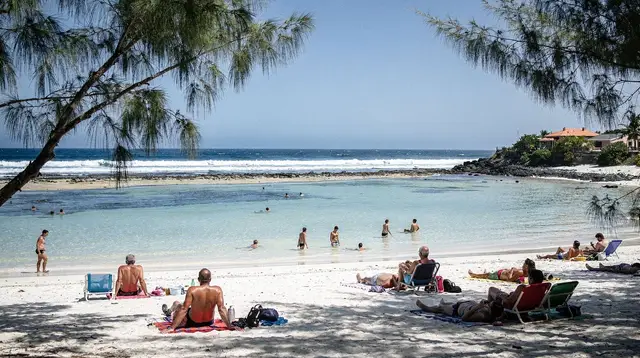
Two very different halves of the same coast
The north and east of Réunion Island are usually grouped together on a map, but they work as two separate trips. Saint-Denis is a real city: government buildings, the rue de Paris lined with creole houses, the Barachois seafront, and the Grande Mosquée Noor-e-Islam standing a few streets from Tamil temples and Chinese pagodas. It is the island’s political and commercial centre, not a resort town, and most visitors pass through it rather than stay for days.
East of Saint-Denis, past Sainte-Suzanne, the coast turns windward. This is the wet side of the island: Saint-Benoît, the Rivière des Marsouins, Grand Étang, the Plaine des Palmistes and the Anse des Cascades near Sainte-Rose. Rain falls here on days when the west coast is dry, and it falls more of the year, not just in the cyclone season. If your plan depends on sun, build in flexibility rather than fixed dates for this stretch.
This page is a wide-angle map, not a village-by-village guide. For street-level detail on the city — where to walk, what to see near the Barachois, how to use the airport — go to the dedicated Saint-Denis guide. For the rivers, waterfalls and villages further along the windward coast, the East Coast guide and North East guide hub link out to specific activities; the practical detail on Saint-Benoît itself lives on that region’s own pages rather than being repeated here.
Saint-Denis: the capital, not a beach base
Saint-Denis sits on the north coast, without a real beach of its own — the city looks toward administration, business and culture rather than the lagoon. The rue de Paris still has rows of 19th-century creole houses with wooden balconies, and the Barachois esplanade along the seafront is the place for an evening walk, with old cannons and a view toward the port. A few streets inland, the Grande Mosquée Noor-e-Islam — the oldest mosque in France — sits near Tamil temples, a reminder that Réunion’s population blends French, Indian, Chinese, Malagasy and African roots more visibly here than almost anywhere else on the island.
Most travellers give Saint-Denis half a day to a full day: enough for the old town, the Barachois and a market, before heading toward the beaches of the west or the volcano side. It works well as a first or last night if your flight lands or leaves from Roland-Garros, but it is not a place to plan a beach holiday around.
a guided city walk through Saint-Denis’s old town and markets is a reasonable way to get oriented in a few hours if you land in the morning and have the rest of the day free.
For a fuller list of what else the capital offers beyond a first afternoon — markets, museums, short excursions into the surrounding hills — see the things to do in Saint-Denis guide, which goes into more depth than this overview page can.
Roland-Garros: the island’s main gateway
Réunion’s main airport, Roland-Garros (RUN), sits at Sainte-Marie, about 20–30 minutes by car from central Saint-Denis depending on traffic. Most international and Paris flights (around 11 hours nonstop) land here, along with connections to Mauritius and Madagascar. If you’re renting a car, picking it up at the airport and driving straight to the west coast lagoon (roughly 45 minutes to 1 hour to Saint-Gilles-les-Bains) is more common than spending a first night in Saint-Denis — but doing the reverse, exploring the north and east first and finishing on the beach, avoids doubling back across the island.
The island’s second airport, Pierrefonds (ZSE) near Saint-Pierre, serves the south and some domestic and regional routes; it’s a useful detail if your itinerary is weighted toward the volcano or the south coast rather than the north.
A rental car is close to essential for this coast, since it lets you stop at Grand Étang, the Plaine des Palmistes or the Anse des Cascades on your own schedule rather than waiting on a bus timetable. The driving in Réunion Island guide covers the basics — right-hand driving, mountain-road habits, where fuel and services thin out — and renting a car in Réunion Island walks through picking one up at Roland-Garros. If you’d rather not drive, Car Jaune buses run along the coast road between Saint-Denis and Saint-Benoît; the Réunion Island by bus: Car Jaune guide explains routes, frequency and where the network stops being practical. The coastal road itself has also changed in recent years around Saint-Denis — the new coastal road explained covers what that means for driving times into and out of the capital.
The windward coast: wetter, greener, less crowded
Past Sainte-Suzanne, the road toward Saint-Benoît runs along a coastline shaped by rain. Sugar cane fields give way to denser vegetation, and the Rivière des Marsouins cuts down from the highlands toward the sea near Saint-Benoît — a river used for rafting and canyon-style activities rather than swimming laps. a guided tube descent down the Rivière des Marsouins is one of the more approachable ways to get onto the water here without technical canyoning experience, and a rafting descent near Saint-Benoît covers similar ground with a faster pace.
Inland from Saint-Benoît, Grand Étang is a crater lake reached by a short forest walk — quiet, humid, often shrouded in mist, and a fair example of what this side of the island looks like away from the coast road. Further up in altitude, the Plaine des Palmistes sits in a saddle between the windward coast and the volcano’s Plaine des Cafres side; it is noticeably cooler and wetter than the coast, with a slower, more rural feel. a guided half-day around the Plaine des Palmistes, lunch included is a practical way to see this area without driving it yourself in changeable weather.
Toward Sainte-Rose, the Anse des Cascades is a small cove where several waterfalls drop straight into the sea, framed by an old palm grove — one of the more photogenic stops on this coast, and a short, easy walk rather than a hike. Nearby, the church of Notre-Dame-des-Laves survived the 1977 lava flow that stopped a few metres from its walls, a concrete reminder of how active the Piton de la Fournaise remains on this side of the island. For the full story of the volcano and its lava fields further south, see the dedicated Piton de la Fournaise guide rather than this page.
Rain, and how it changes your plan
The windward coast — everything from Sainte-Suzanne to Sainte-Rose — faces the prevailing trade winds and catches far more rain than the leeward west coast, in every season, not only during the November–April cyclone season. A morning that starts sunny in Saint-Denis can turn to steady rain by the time you reach Saint-Benoît, and the reverse happens too. This isn’t a reason to skip the region — waterfalls, rivers and rainforest scenery depend on that rain — but it does mean building slack into a day here rather than a tight, sun-dependent schedule. Checking a short-range forecast the morning of, rather than trusting a plan made days earlier, is standard practice for anyone based on this coast.
For a broader picture of how rainfall and temperature shift month to month across the whole island, the Réunion Island weather by month guide sets this coast’s pattern against the drier west and south. If your trip falls between November and April, it’s also worth reading the Réunion Island cyclone season guide before you lock in a windward-coast itinerary, since a system tracking near the island can close roads and cancel river activities with little notice. For picking a window in the first place, the best time to visit Réunion Island guide weighs this coast’s rain pattern against the drier months elsewhere.
Culture and food along this coast
Sainte-Rose and the small towns further south along the wild coast keep a strong agricultural identity — vanilla, sugar cane, small farms selling direct. a farm visit and local brunch near Sainte-Rose is a straightforward way to see that side of the island’s economy up close, away from the tourist circuit around Saint-Gilles.
Back in Saint-Denis, the city’s food scene reflects its mixed population more than anywhere else on the island — Indian, Chinese and creole cooking side by side, often in unmarked family-run addresses rather than restaurant-row venues. If you’d rather be guided to those spots than search on your own, a local food tour through Saint-Denis’s lesser-known eating spots covers several stops in one outing.
Vanilla is one of the crops that ties this whole coast together economically, from small farms near Sainte-Rose back through Saint-Benoît and Saint-André; the bourbon vanilla in Réunion piece explains how it’s grown and cured, and what separates it from vanilla sold elsewhere. For a wider view of what’s actually on the plate around the island — not just this coast — the what to eat in Réunion Island guide is a useful companion. The mixed population here also shows up in music: sega and maloya, the island’s two signature styles, both have roots in this part of Réunion, and the séga and maloya piece is worth a read if you want context for what you might hear at a market or a family-run restaurant.
Practical basics for this coast
A few points are easy to overlook because Réunion is French territory: it’s part of the European Union, but outside the Schengen area, so a Schengen visa alone doesn’t cover entry here — see is Réunion Island part of the EU? and the entry requirements for Réunion Island guide before you book. The currency is the euro, and the money and payments in Réunion Island guide covers cards versus cash on this side of the island, where small family-run addresses don’t always take cards. The wetter climate here also means more mosquitoes than on the dry west coast; the mosquitoes, dengue and chikungunya in Réunion piece covers sensible precautions without overstating the risk.
How this fits into a wider itinerary
For most visitors, the north and east work best as a transit and day-trip zone rather than a full base: a night or two in Saint-Denis around your flights, a day or two out toward Saint-Benoît and the Plaine des Palmistes for rivers and rainforest, then on to the lagoon in the west or the volcano and cirques inland. Trying to combine Saint-Denis, the windward coast, and a West Coast beach stay in a single rushed day rarely works — the driving alone, given mountain roads and coastal traffic near Saint-Denis at peak hours, eats most of a morning.
If you’re building a full island route from scratch, the road trip around Réunion Island itinerary sequences this coast against the rest of the island, and the east coast day trip from Saint-Gilles guide is the practical option if you’re based on the west coast and want a single day here rather than a change of base.
Quick comparison: north and east at a glance
| Area | What it’s for | Typical time needed | Rain risk |
|---|---|---|---|
| Saint-Denis | City, culture, transit hub | Half day to 1 day | Moderate |
| Sainte-Suzanne to Saint-Benoît | Rivers, rafting, rainforest | 1 day | High |
| Plaine des Palmistes | Cool highland scenery, slower pace | Half day to 1 day | High |
| Sainte-Rose / Anse des Cascades | Waterfalls into the sea, volcano history | Half day | High |
FAQ: visiting Saint-Denis and the windward coast
Is Saint-Denis worth staying in overnight?
For most visitors, one night is enough — useful if your flight lands late or leaves early from Roland-Garros, or if you want a morning to see the old town and the Barachois before driving on. It is not a beach base, so a longer stay usually makes more sense on the lagoon side of the island.
How far is Saint-Denis from the airport?
Roland-Garros airport sits at Sainte-Marie, about 20–30 minutes by car from central Saint-Denis, depending on traffic. It’s also a similar distance in the other direction from parts of the windward coast toward Sainte-Suzanne.
Why does the east coast get so much more rain than the west?
The windward coast faces the prevailing trade winds head-on, which push moist air up against the island’s central mountains and drop rain on this side year-round. The west coast sits in the rain shadow, which is why it stays drier and sunnier on the same day.
Can I visit Saint-Benoît and the Plaine des Palmistes as a day trip from Saint-Gilles?
Yes, though it makes for a full day given the driving involved — figure on 1–1.5 hours each way from the west coast lagoon, more if you add stops. A guided day trip removes the need to navigate mountain roads and changeable weather yourself.
Is the Rivière des Marsouins safe for beginners?
Guided tube and rafting descents on the Rivière des Marsouins are run with safety equipment and instruction suitable for first-timers, but river levels change quickly after rain, and trips can be shortened or rescheduled for safety. Always book through an operator rather than attempting the river independently.
What’s the difference between Grand Étang and the Anse des Cascades?
Grand Étang is an inland crater lake reached by a forest walk, useful for a quiet, humid nature stop. The Anse des Cascades is a coastal cove near Sainte-Rose where waterfalls drop directly into the sea — a short, easy walk and one of the more photogenic points on this coast.
Do I need a car to see this region, or can I use Car Jaune?
A rental car gives far more flexibility, since Car Jaune buses connect the main coastal towns but run slowly and infrequently toward inland stops like the Plaine des Palmistes or Grand Étang. For a coast-only day (Saint-Denis to Saint-Benoît), the bus network is workable; for anything inland, driving is close to essential.
Is Sainte-Rose affected by the volcano?
Sainte-Rose has been touched by lava flows in the past, most notably in 1977, when a flow stopped just short of the Notre-Dame-des-Laves church. Current access to the Piton de la Fournaise’s crater area depends on ongoing volcanic activity and prefecture decisions — see the Piton de la Fournaise guide for up-to-date planning advice rather than assuming access here.