Getting around Réunion Island by bus: the Car Jaune guide
Can you get around Réunion Island by bus instead of renting a car?
Yes for the coastal towns: Car Jaune links Saint-Denis, Saint-Pierre, Saint-Gilles-les-Bains and other coastal points reasonably well. It is slow or impractical for the Hauts (Cilaos, Salazie, the volcano road, the Maido) and it does not reach Mafate at all, since Mafate has no road. Check the official Car Jaune website for current routes, timetables and fares before you plan a trip around it.
What Car Jaune actually covers
Réunion’s interurban bus network, Car Jaune, is a real option for travelling the island without a rental car, but it is a partial one, and it is worth being honest about that from the start. The network is built around the coastal ring: it links towns such as Saint-Denis, Saint-Pierre, Saint-Gilles-les-Bains and the other main coastal centres with regular-enough service to be genuinely useful for a visitor staying on the coast. If your plan is to base yourself in one coastal town and hop to a couple of others for a market, a beach or a restaurant, Car Jaune can do that job.
Where it gets harder is anywhere the road climbs. Réunion’s interior, the Hauts, and the three cirques of Cilaos, Salazie and Mafate sit at the end of long, winding mountain roads, and the bus network was not designed with the same frequency or directness for those routes as it was for the coast. Some connections toward the Hauts exist, but they typically involve transfers, longer journey times than driving the same distance, and schedules that thin out compared with the coastal lines. This page treats that honestly rather than presenting Car Jaune as a like-for-like substitute for a rental car everywhere on the island.
This guide is deliberately narrow. The overview guide on getting around Réunion Island mentions Car Jaune as one option among several; this page goes further into what the network is actually good for, where it falls short, and how to plan a car-free or car-light trip around those limits. If your plan centres on driving yourself, the driving in Réunion Island and renting a car in Réunion Island guides are the ones to read instead.
It also helps to keep in mind that Car Jaune is one network covering a whole French overseas department, not a shuttle laid on for visitors. Locals use it to get to work, school and appointments, which is part of why frequency drops sharply outside peak daytime hours and on Sundays, and why the timetable is built around the coastal ring where most of the island’s population actually lives, rather than around the trailheads and viewpoints that bring travellers to the Hauts.
Where Car Jaune makes sense
The clearest use case is coastal, point-to-point travel between towns that already sit close to the bus network’s main lines. Staying in Saint-Gilles-les-Bains and wanting a day in Saint-Denis for the Barachois and the rue de Paris, or a day in Saint-Pierre for its market and waterfront, is the kind of trip Car Jaune is built for. Both towns are past on the coastal road network the bus follows, and the journey stays on relatively flat, direct roads rather than climbing into the Hauts.
Car Jaune is also a reasonable choice if your holiday is genuinely coast-focused: lagoon time in Saint-Gilles-les-Bains or l’Hermitage, a day in the west’s beach towns, a look at the north’s Creole architecture, without an ambition to reach the volcano, the cirques or the high-altitude hikes. For that kind of trip, a car-free approach removes the cost and hassle of a rental, and the bus network’s coastal reach is enough.
It is worth naming the limits plainly rather than skating over them. Car Jaune is:
- Useful for town-to-town travel along the coastal ring.
- Slower than driving for the same distance, because buses stop and because routes are not always the most direct line between two points.
- Thinner in the evening and on Sundays, so plan return journeys for daytime and check the day’s actual timetable rather than assuming an even service.
- Not built for spontaneous stops. A rental car lets you pull over at a viewpoint or a roadside stall; a bus schedule does not.
None of this makes Car Jaune a bad option. It makes it a coastal-town option, and being clear about that from the outset saves a wasted afternoon waiting for a bus that was never going to get you up to Cilaos in reasonable time.
For travellers who want to experience the west coast’s lagoon without adding another leg to the bus timetable, a boat is worth considering alongside Car Jaune rather than instead of it: a sea cruise along the coast covers stretches of shoreline from the water that a bus route never touches, and it pairs naturally with a Car Jaune day spent based in Saint-Gilles-les-Bains or Saint-Leu.
The East coast and the Sud Sauvage: a similar story to the Hauts
Car Jaune’s coastal ring does technically extend around the East coast, through towns like Saint-André and Saint-Benoît toward Sainte-Rose, and around the south toward the Sud sauvage beyond Saint-Pierre. In practice, service on these stretches tends to be less frequent than on the busier Saint-Denis to Saint-Pierre corridor, and the East in particular sees far more rain than the West, which makes waiting at an open-air stop a less appealing prospect for much of the year. The East coast day trip and Sud sauvage day trip guides both cover these regions in more depth, including why a guided day trip or a rental car tends to suit them better than stitching together bus connections, especially since sights like the Grand Brûlé lava fields and the Anse des Cascades are spread out along a single long road with little to no service between stops.
Where it falls short: the Hauts and the cirques
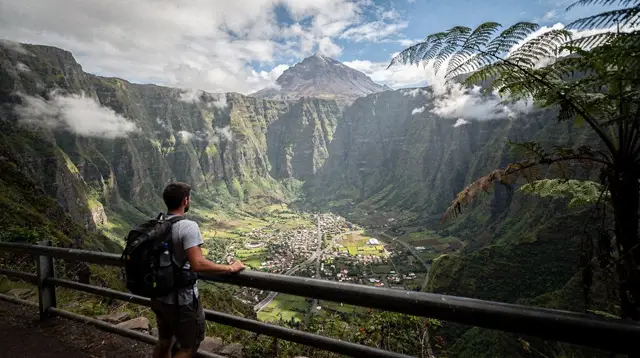
The honest limitation of Car Jaune is altitude. Réunion’s most striking landscapes, the cirques of Cilaos and Salazie, the Maido belvedere over Mafate, and the volcano road up to Pas de Bellecombe, sit well above the coast on roads that were carved into steep terrain long before public transport reached them. Car Jaune has some connections in this direction, but they are not built for the visitor who wants to reach Cilaos or Salazie for a day and be back by evening on a fixed schedule.
The road to Cilaos alone illustrates why. It winds up from Saint-Louis through several hundred bends and takes roughly an hour of steady driving without stops. That is already a demanding, engrossing drive behind a private wheel with the freedom to slow down; doing the same route on a bus that may involve a transfer and a longer overall journey time changes the calculation. The same applies to the volcano road from Bourg-Murat and to the climb to the Maido above Saint-Paul, both of which reward an early start that a fixed bus timetable is unlikely to match, especially since cloud and fog often roll in from mid-morning at altitude.
For these destinations, two car-free alternatives work better than trying to stretch Car Jaune to cover them:
- Organised day trips. Guided excursions from Saint-Gilles-les-Bains or Saint-Pierre to Cilaos, Salazie, the volcano or the wider island handle the driving, timing and route knowledge for you, and they are a realistic substitute for the flexibility a rental car gives you on those specific routes.
- A short car rental for the mountain days only. Some visitors keep the coast car-free with Car Jaune or taxis, then rent a car for two or three focused days to cover Cilaos, the volcano road and the Maido, returning the car once those routes are done. This hybrid approach is worth considering before assuming it has to be all bus or all car for the whole stay.
If a guided island tour by minibus with a driver appeals as the car-free way to see several regions in sequence, a full-day guided tour covering the island’s main sights in a single circuit removes the need to piece together bus connections for a one-off overview day. For the volcano, the cirques and the high viewpoints seen from above rather than reached by road at all, a scenic helicopter flight departing from Saint-Gilles-les-Bains over Cilaos, Salazie and the volcano is a different way to see the interior on a day when the bus network simply will not get you there and back in the time you have.
Mafate: on foot, not by bus
This point is worth stating without softening it: Mafate has no road, at all, anywhere inside the cirque. No bus route reaches it because none can. Car Jaune, taxis and rental cars all stop at the edge of the cirque, at trailheads such as the Maido, the col des Boeufs or the rivière des Galets, and from there the only way in is on foot, along marked hiking trails that lead down into the ilets.
This is not a gap in the bus network to work around with a transfer or a longer route; it is a structural fact about Mafate’s geography that shapes how every visitor, car or no car, reaches it. If Mafate is on your itinerary, the planning question is not which bus gets you there but which trailhead suits your fitness, how many days you want to spend walking between ilets, and whether you have booked a gîte in advance, since accommodation inside Mafate fills up and needs reserving ahead. The Mafate planning guide goes into trailhead choice, gîte booking and realistic walking times in detail; this page’s job is only to be clear that Car Jaune plays no role in reaching Mafate.
Helicopters do fly over and into Mafate, mainly for supplying the ilets and for scenic flights, but that is a different kind of transport from a bus network and a different kind of trip from a hike. If seeing Mafate’s ilets and ramparts from above, without the multi-day walk, appeals as a complement to time spent lower down the island, the same helicopter flight over the cirques and the volcano mentioned above is one way to see terrain that Car Jaune, by definition, cannot reach.
Planning a car-free trip around Car Jaune’s real shape
Given the pattern above, a workable car-free plan on Réunion tends to separate the island into two kinds of days rather than trying to force one transport mode to cover everything.
Coastal days, where Car Jaune does the work: moving between Saint-Gilles-les-Bains, Saint-Pierre and Saint-Denis, spending time in the lagoon, the markets and the coastal towns, and building in slack for a service that runs less often outside peak daytime hours.
Mountain and volcano days, where Car Jaune is the wrong tool: covered instead by a guided day trip, a short car rental, or a taxi for a specific point-to-point transfer such as reaching a trailhead early enough for a hike to matter.
Timing matters too, and not only for the reasons above. Réunion’s seasons run opposite to Europe’s: the hot, humid austral summer from November to April is also cyclone season, when a Car Jaune schedule can be suspended at short notice regardless of what a printed timetable says, while the drier, cooler austral winter from May to October is generally the steadier period for relying on any bus connection to run as planned. The best time to visit and cyclone season guides go into this in more detail; the practical takeaway here is to build slack into a car-free itinerary during the wetter months rather than assuming the coastal service runs exactly as advertised year-round.
A few practical points make this pattern easier to run in practice:
| Trip type | Car Jaune suitability | Better alternative |
|---|---|---|
| Coastal town to coastal town | Good, direct enough routes | — |
| Airport to Saint-Gilles-les-Bains | Limited, check current connection | Transfer, taxi, or rental car |
| Cilaos or Salazie day trip | Slow, indirect | Guided day trip or short rental |
| Volcano road (Pas de Bellecombe) | Not practical for an early start | Guided day trip or rental car |
| Maido viewpoint | Slow for a sunrise-timed visit | Rental car or taxi |
| Mafate | Not possible, no road exists | On foot from a trailhead |
For the airport leg specifically, the Roland-Garros airport to Saint-Gilles-les-Bains guide covers the realistic options for that first transfer, since it is the one journey almost every visitor has to make regardless of how the rest of the trip is planned.
Budget is often the reason travellers look at Car Jaune in the first place, and it is a fair one: a rental car, fuel and parking add up over a week, and cutting that cost for the coastal portion of a trip is reasonable. The Réunion Island trip cost guide and the budget guide both cover how transport choices affect an overall budget, including where a short rental for the mountain days is worth the expense against the time and flexibility it buys back.
A realistic verdict
Car Jaune is a legitimate, useful part of getting around Réunion Island without a rental car, and it deserves to be treated as one rather than dismissed. It is not, however, a full substitute for a car if the volcano, Cilaos, Salazie or the Maido are on the itinerary, and it plays no role at all in reaching Mafate, which has no road under any circumstances. The honest plan is to lean on Car Jaune for what it does well, coastal town-to-town travel, and to fill the gap it leaves in the Hauts with a guided day trip, a short car rental, or, for Mafate, a hike from a proper trailhead. Fares, routes and timetables change, so treat anything you read here as a framework and confirm the day’s actual schedule on the official Car Jaune website before you build a day around it.
Before finalising a car-free itinerary, it is worth reading the driving in Réunion Island guide even if you never intend to drive yourself, since it explains why the island’s road network behaves the way it does, and by extension why a bus network built on the same roads has the reach and the limits described here.
Getting around Réunion tours on GetYourGuide
Verified deep-linked GetYourGuide tours. Book through these links and we earn a small commission at no cost to you.
GetYourGuide does not provide a product photo for this activity — the image shows the meeting point, photographed by us.