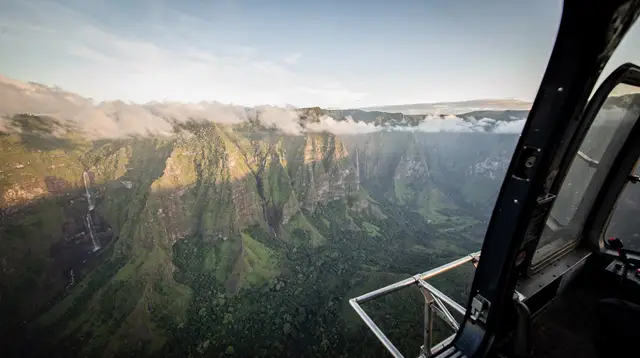
Helicopter flights from Saint-Pierre
What do helicopter flights from Saint-Pierre actually fly over?
Flights departing Saint-Pierre are built around the southern axis of Réunion Island: the Wild South coastline, the Grand Brûlé lava fields, Piton de la Fournaise, and often a pass over Cilaos. This is a different route from helicopter tours based in Saint-Gilles, which focus on the west coast and Mafate. Book through the operator's page for the current duration and price, since both change with fuel costs and demand.
Why Saint-Pierre is the base for the southern route
Réunion Island has two main helicopter departure hubs, and they cover different halves of the island. Flights from Saint-Gilles head out over the west coast, the lagoon and Mafate. Flights from Saint-Pierre, the capital of the south and home to Pierrefonds airport (ZSE), are built around a completely different axis: the Wild South coastline, the Grand Brûlé lava fields, Piton de la Fournaise, and often a swing toward Cilaos. If you’re comparing the two, this page is about the southern route only — for the western one, see the helicopter and microlight flights from Saint-Gilles guide.
That distinction matters because the two halves of Réunion look nothing alike from the air. The west is dry, sun-baked, ringed by a coral lagoon. The south is wilder: black basalt cliffs, lava deltas reaching into the ocean, and the raw cone of an active volcano. If your trip is centred on Saint-Pierre, the Wild South or the volcano itself, departing locally saves driving time and puts you directly over the landscape you came to see.
What the flight actually covers
A typical Saint-Pierre departure follows some version of this southern loop, though exact routing depends on the operator, the day’s weather and the flight length you book:
- The Wild South coast between Saint-Joseph and Saint-Philippe, with its black basalt cliffs and the Cap Méchant viewpoint from above.
- The Grand Brûlé, the lava field where past eruptions of Piton de la Fournaise have reached the sea, visible as dark tongues of solidified basalt cutting through green vegetation.
- Piton de la Fournaise itself: the Enclos Fouque caldera and, weather and volcanic activity permitting, the rim of the Dolomieu crater.
- On longer flights, a pass toward Cilaos, with its cirque walls and hairpin access road visible from above — a striking contrast to the flat lava fields you’ve just crossed.
This is not the same view a Saint-Gilles departure gives you. If you want the west coast lagoon, Maido and Mafate from the air, that’s a different flight and a different departure point. For the volcano, the Wild South and the southern cirques, Saint-Pierre is the logical base.
Booking the flight
Several operators run scenic flights from the Saint-Pierre area, with different durations, routes and price points. None of the figures below are fixed — check the operator’s page for the current duration and price on your travel dates.
| Option | What it emphasises | Typical length |
|---|---|---|
| Island tour by helicopter from Saint-Pierre | Broader island loop from the southern base | Longer flight |
| Full helicopter flight over Réunion from Saint-Pierre | Extended route covering more of the south and interior | Longest flight |
| Excellence helicopter tour from Saint-Pierre | Premium routing, often prioritising the volcano and Wild South | Varies by package |
Exact minutes in the air, cruising altitude and the precise route are set by the operator and can shift with weight, weather and volcanic activity on the day. Treat any duration or price you see elsewhere as a starting point, and confirm the current figure on the booking page before you commit to a date. If you’re unsure which package suits your trip, the shorter island-tour option is usually the easier add-on to an already busy day in the south, while the longer or premium routings suit travellers who want the volcano and the Wild South to be the day’s main event rather than a quick stop.
Because weather and volcanic activity can move a Saint-Pierre departure, avoid placing the helicopter on your last day on the island. Leave a spare day in the south so a postponed slot can be rebooked with the operator, and ask what happens to your reservation if the flight is cancelled. If you are still arranging the trip itself, you can search flights to Réunion on Aviasales with a little slack at the end of your stay.
Why the early morning slot matters
If there’s one piece of advice that separates a good flight from a disappointing one, it’s timing. Cloud typically builds over the interior of Réunion — the cirques and the volcano in particular — from mid-morning onward. It can go from a clear crater rim at 8 a.m. to a solid white ceiling by 10 or 11 a.m., especially in the austral summer (November to April) when humidity and convection are higher.
Operators know this, which is why the first rotation of the day is usually the one worth requesting. If you have flexibility in your schedule, ask for the earliest available departure rather than a mid-morning or afternoon slot. This single choice affects what you’ll actually see far more than which operator or package you pick.
Best time of year to fly
Réunion Island’s seasons run opposite to Europe’s, which catches some visitors off guard when planning a flight. The austral summer, from November to April, is hot and humid and also the island’s cyclone season: heavier cloud cover, more afternoon storms over the interior, and a higher chance that a flight gets postponed or shortened. If a helicopter flight is a priority rather than a nice-to-have, building slack into your itinerary during these months matters more than at other times of year — see the Réunion Island cyclone season guide for how operators and the wider island handle that period.
The austral winter, from May to October, is drier and generally clearer over the volcano and the southern coastline, which is why it’s usually recommended as the better window for both hiking and flying. It can also be noticeably cooler, and even cold enough to approach freezing at altitude near the summit of Piton de la Fournaise on some winter mornings — worth knowing if you’re picturing tropical warmth the whole flight. For a broader month-by-month comparison across the island, the best time to visit Réunion Island guide covers how the dry and wet seasons play out in the north, west, east and south differently, since the Wild South and the volcano’s interior don’t always follow the same pattern as the coast.
What the flight is, and isn’t
An aerial pass over Piton de la Fournaise shows you the shape of the volcano in a way no ground viewpoint can: the full curve of the Enclos Fouque, the scale of past lava flows, the isolation of the summit against the Wild South below. It’s a genuinely different perspective from the one you get hiking to Pas de Bellecombe.
But it doesn’t replace that hike, and it doesn’t guarantee lava. Whether you see molten rock depends entirely on whether the volcano happens to be erupting that day — something monitored continuously by the OVPF-IPGP observatory but never predictable weeks in advance. Eruptions at Piton de la Fournaise are frequent by global standards, but there’s no way to time a trip around one. If seeing the crater up close on foot matters to you, plan a separate outing to the Piton de la Fournaise volcano tours or read the self-drive or guided tour comparison. The prefecture can and does close the trail toward the Enclos Fouque during an eruption or an elevated alert level, regardless of what’s happening overhead.
Think of the helicopter and the hike as complementary, not interchangeable: the flight gives you scale and the full southern coastline in one sweep; the hike gives you ground-level proximity to the crater rim, when it’s open.
Combining the flight with a day in the south
Saint-Pierre is a practical base for stacking a helicopter flight with other southern activities on the same trip, since the departure point sits close to the town and to Pierrefonds airport. A few ways travellers often build the day around the flight:
- An early flight, then a walk through Saint-Pierre’s market and waterfront once you’re back on the ground.
- The flight paired with a ground-level exploration of the Wild South — discovering the Wild South by SSV buggy or the Grand Brûlé lava route area — for both the aerial and street-level view of the same coastline. See exploring the Wild South by SSV buggy for a ground-level counterpart to the flight.
- A canyoning session in the interior, such as canyoning on the Langevin river, on a day when cloud has already closed off the volcano views.
If your schedule only allows one southern activity, prioritise the helicopter flight for the earliest slot you can get, and treat ground activities as flexible fill for the rest of the day.
Helicopter vs seeing the Wild South on the ground
The flight and a ground-level visit to the same coastline aren’t competing options so much as two different lenses on the same landscape. From the air, the Wild South reads as a whole: the black lava deltas of the Grand Brûlé, the cliff line running from Saint-Joseph to Saint-Philippe, and the scale of how far past eruptions have travelled to reach the ocean. On the ground, the same coast breaks down into details the helicopter passes over in seconds — the texture of solidified lava underfoot at Notre-Dame-des-Laves, the spray at Cap Méchant, the walk out to the Anse des Cascades near Sainte-Rose.
Several travellers combine both on the same southern trip: the flight for the overview, then a slower day exploring the coast road, or an adventure activity in the interior when cloud has closed off the volcano view. Canyoning in the ravines behind Saint-Pierre and Saint-Joseph is one option worth considering for exactly that kind of cloudy-day backup — see canyoning in Réunion Island for how that compares to the flight, or the broader adventure activities in Réunion Island guide for other ways to fill a day in the south when the summit isn’t cooperating.
Practical notes before you book
Onboard: what to expect during the flight
The cabin experience is fairly consistent across operators, even if the exact aircraft and route differ. Expect a short safety briefing before boarding covering doors, headsets and how to move around the rotor area — always approach and leave the aircraft from the front or sides, never near the tail, and follow the crew’s directions exactly. Headsets are typically provided both for hearing protection, since the rotor noise is loud at close range, and so the pilot can point out landmarks like the Enclos Fouque or the Grand Brûlé as you pass over them.
Temperature swings more than most passengers expect: it can be warm and still on the ground at the Saint-Pierre base, then noticeably cooler once you’re at altitude near the volcano, so a light layer is worth having even in the middle of the day. Photography through the windows is usually fine, though flash and loose items near an open door are not — ask the crew before assuming anything can be opened or unbuckled in flight. For general packing advice that covers layers for altitude alongside the rest of a Réunion trip, see what to pack for Réunion Island.
- Weight limits. Helicopter operators apply per-passenger weight limits for safety and balance. Declare your weight accurately when booking; misdeclaring it can mean being reassigned to a different seat or bumped from the flight.
- Weather and volcanic alerts. Flights can be delayed, shortened or cancelled for cloud, wind, or an active volcanic alert around Piton de la Fournaise. Build a buffer day into your itinerary if the flight is a priority, particularly during the cyclone season from November to April.
- What you’ll see is never guaranteed. Cloud cover, an inactive period at the volcano, or a shortened route due to conditions are all possible. No operator can promise lava, and reputable ones won’t claim to.
- Getting there. The departure area is near Saint-Pierre, a short drive from the town centre and Pierrefonds airport. Confirm your exact pickup or meeting point on the booking confirmation, since sites can vary between operators.
Where this fits in a Réunion Island itinerary
A Saint-Pierre helicopter flight works well as a highlight within a longer stay in the south. If you’re planning several days around Saint-Pierre and the Wild South, see things to do in Saint-Pierre for the wider list of activities, or the wild south day trip from Saint-Gilles if you’re based on the west coast and want to add the south as a day out. For a broader sense of how to divide time between the volcano, the cirques and the coast across a full trip, the how many days in Réunion Island guide and the wild south and east coast in two days itinerary both cover where a flight like this fits into a wider plan.
Travellers building a shorter trip around the volcano and the south specifically can look at the Piton de la Fournaise volcano weekend itinerary, which pairs well with an early Saint-Pierre flight on one of the days. For a slightly longer stay that still keeps the south as its centre of gravity, the three days in Réunion Island itinerary shows how a flight, a Wild South day and a volcano hike can sit alongside each other without feeling rushed. And if you haven’t settled on where to sleep yet, basing yourself in or near Saint-Pierre for a night or two around the flight cuts down on the driving described in getting around Réunion Island — see where to stay in Réunion Island for how the south compares to the west coast as a base.
Whichever operator and package you choose, the two decisions that matter most are the same: fly early, and go in with realistic expectations about lava. Everything else — route length, exact price, cabin configuration — is worth confirming directly on the operator’s page for your travel dates.
Helicopter and paragliding flights over Réunion on GetYourGuide
Verified deep-linked GetYourGuide tours. Book through these links and we earn a small commission at no cost to you.
GetYourGuide does not provide a product photo for this activity — the image shows the meeting point, photographed by us.
Réunion Island: Guided Water Hiking Tour in the Lagoon of Saline-les-Bains

Discovery of the lava tubes 2004 of Piton de la Fournaise