Réunion Island for couples and honeymoons
Is Réunion Island a good destination for a couple's trip or honeymoon?
Yes, if you plan around short, flexible days rather than a multi-day trek: a helicopter flight, a lagon sunset, whale watching between June and October, and one night in Cilaos after the road with its roughly 400 bends. Book helicopters and gîtes ahead; the rest of the island stays open to slower pacing.
Plan two speeds, not one trek
Réunion Island’s reputation is built on Mafate treks and multi-day cirque crossings, and none of that fits a short couple’s trip well. The island still works for two people who want evasion without exhaustion, but the shape of the trip has to change: short, weather-dependent activities booked in advance, long lunches instead of long ascents, and one deliberate change of altitude rather than three. This guide assembles four pieces that already exist elsewhere on the site — a helicopter flight, a lagon sunset, a whale-watching outing, and a night in Cilaos — into a pace built for a couple with four to seven days, not a trekking pair with two weeks.
The island sits in the Indian Ocean, east of Madagascar and roughly 200 km southwest of Mauritius. It is French and in the euro zone, but outside the Schengen area, so a Schengen visa does not automatically cover it; EU and EEA citizens enter with a valid ID card or passport, and other nationalities should check the rules specific to Réunion on france-visas.gouv.fr rather than assume a Schengen visa applies. None of that changes the romance of the trip, but it does change what to check before booking flights, and it is covered in more detail in the entry requirements guide.
A morning in the air: the helicopter flight
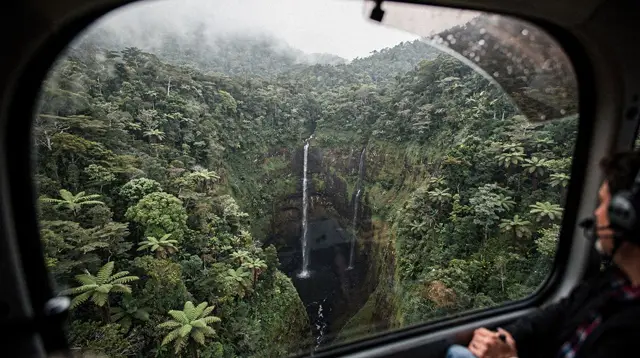
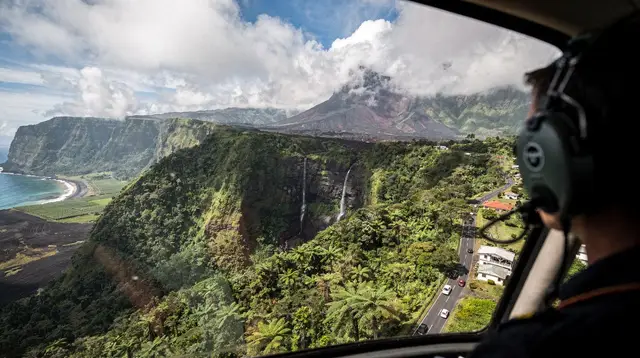
The single activity that condenses the island for a couple in under an hour is a helicopter flight, and it is worth the price for exactly that reason: it shows Cilaos, Salazie, Mafate’s ramparts and the Piton de la Fournaise’s crater rim from above without asking either of you to hike to see them. Flights leave early, from Saint-Gilles or Saint-Pierre, because cloud tends to build over the cirques from mid-morning; a 7 a.m. or 8 a.m. slot gives the clearest views.
a helicopter tour of the island departing from Saint-Gilles covers the classic circuit — Mafate, the Trou de Fer, the volcano’s enclos when conditions allow — in around 45 minutes, and it needs booking a few weeks ahead in high season since seats per flight are limited and weather cancellations push people onto the next available slot. If a fixed-wing option interests you instead, the helicopter and microlight flights guide compares both from the same departure point. Either way, treat the morning as weather-dependent: build one buffer day into the itinerary so a grey morning does not cost you the flight entirely.
A slow lagon evening
The west coast’s lagon, protected by its barrier reef from the Hermitage to Saint-Leu, is where the island keeps its calmest hours, and a sunset there needs no booking at all. Saint-Gilles-les-Bains and l’Hermitage face west, so the light lasts from around 6 p.m., shorter in austral winter, and a walk along the beach or a drink at a beachfront table works as well as any planned activity. Saint-Leu, twenty minutes south, adds a higher vantage point if you’d rather watch the sun drop from above the lagon than from the sand.
This is also the one place on the island where swimming together is straightforward and unrestricted in the way a coastal honeymoon usually implies: the lagon between the Hermitage and La Saline-les-Bains, and the supervised zones further south, are the areas where swimming and water sports are permitted. Outside the lagon and outside supervised or protected zones, bathing and nautical activities are banned by prefectural order because of shark risk, so this isn’t a corner to cut for a more adventurous swim elsewhere on the coast. For a couple, the restriction barely registers — the lagon itself is generous enough for an afternoon or an evening swim, and the best beaches guide lays out which stretches suit swimming versus walking.
If you’d rather be on the water than beside it, a short catamaran outing out of Saint-Gilles’ marina turns the same lagon into a different view of the coastline, and pairs naturally with the whale season below.
Whale season, without the promise
Between roughly June-July and October, humpback whales pass along Réunion’s west coast, and this is the one activity in this itinerary worth timing your whole trip around if seeing them matters to you. Boats leave from Saint-Gilles under an approach charter that sets minimum distances from the animals, which means sightings are managed responsibly but never guaranteed — a boat that finds nothing is still following the rules correctly, not failing at its job.
a cruise searching for whales and dolphins from Saint-Gilles runs during the season and is the more focused of the marine options; a snorkeling outing that looks for dolphins and whales in the water suits a couple who’d rather be in the lagoon than on deck when something surfaces nearby. Outside the June-to-October window, or on days when nothing appears, a calmer alternative is a snorkeling trip to see turtles in Saint-Gilles-les-Bains, which runs year-round and needs no season at all. The full picture of months, likely sightings and the charter’s rules is in the whale-watching guide, and a plainer look at the odds is in this piece on whale season.
Cilaos: the altitude change, done in one night
Cilaos is the piece of this itinerary that asks the most of you, and it’s worth the honesty upfront: the RN5 from Saint-Louis climbs through roughly 400 bends, takes about an hour without stopping, and is a genuinely tiring drive — not a scenic cruise. What it buys is a full change of register from the coast: thermal springs, a table d’hôte culture built around lentils and Cilaos wine, and cooler evening air that makes a good excuse for the one warm layer worth packing.
For a couple, one night is enough to justify the drive without turning the trip into a hiking expedition. Skip the canyoning day and the Piton des Neiges summit push — both belong to a different kind of trip, covered in the best hikes guide and the Piton des Neiges summit guide if a future visit tempts you toward them. Instead, arrive by mid-afternoon, book a thermal session or a simple table d’hôte dinner in advance since addresses are small and fill up, and drive back down the next morning before the heat builds. The Cilaos day-trip guide covers the same route for those doing it without an overnight stay, and the driving guide to the road’s 400 bends is useful reading before you get behind the wheel.
Putting the four pieces together
None of these four activities needs to happen on consecutive days, and stretching them out is the point: a five- to seven-day trip built around a base on the west coast, with the helicopter flight and whale-watching outing scheduled on the two clearest-looking mornings, a lagon evening whenever the mood fits, and the Cilaos night dropped in wherever the calendar allows.
| Piece | Where it happens | Booking lead time | Weather-dependent |
|---|---|---|---|
| Helicopter flight | Saint-Gilles or Saint-Pierre | Several weeks in high season | Yes — early morning only |
| Lagon sunset | Hermitage or Saint-Gilles | None | Mostly, for clear skies |
| Whale watching | Saint-Gilles marina | A few days, more in peak weeks | Partly — sea state matters |
| Cilaos night | Cilaos, via the RN5 | A few weeks for table d’hôte and thermal baths | No, but fog affects the drive |
A rough week could run: two nights on the coast to settle in and take the lagon evening, the helicopter flight on the clearest morning available, a day and night in Cilaos, back to the coast for the whale-watching outing, and a final slow day before flying out. The one-week itinerary and the shorter weekend and three-day versions give fuller day-by-day structures to adapt from, and the first-time visitors guide covers the basics — driving side, currency, language — that apply regardless of pace.
Where to stay and how to move between it all
Saint-Gilles-les-Bains and the Hermitage give the easiest base for this itinerary: close to the lagon, close to the marina for both the helicopter and boat departures, and roughly an hour from the start of the Cilaos climb. Saint-Leu, twenty minutes south, works nearly as well and adds paragliding as an option if one of you wants a solo adrenaline morning while the other reads on the beach — the where-to-stay guide compares both bases in more depth, and Saint-Gilles versus Saint-Leu narrows the choice further.
A rental car is close to essential for this trip: Réunion drives on the right, and while the coastal distances between Saint-Gilles, Saint-Leu and Saint-Pierre are short in kilometres, the Cilaos climb and any detour into the hills eat far more time than the map suggests. Car Jaune’s interurban buses cover the coast reasonably well but move slowly into the highlands, which makes them a poor fit for the Cilaos night on a short trip. The getting-around guide and renting a car guide cover the practical side.
What this itinerary leaves out, on purpose
This is not a guide to Mafate, to the Piton de la Fournaise summit trail, or to the island’s full list of waterfalls and viewpoints — all of that exists elsewhere on the site for a longer or more hiking-focused trip, in the things to do in Saint-Gilles and best viewpoints guides. Leaving it out here isn’t a judgment on those trips; it’s a recognition that a couple with four to seven days does better with fewer, better-timed activities than with an itinerary copied from a trekking guide.
One honest note on timing: if your trip falls between November and April, you’re in the austral summer and cyclone season, which runs opposite to what “summer” implies in Europe. It doesn’t make a trip impossible, and it’s not something to predict from a distance — no forecast this far out can tell you whether a cyclone will affect specific dates — but flexible bookings and travel insurance are worth having for that window. The cyclone season guide explains the alert system in full, and May to October, when whale season also runs, keeps things simpler on every front.
Frequently asked questions about a couple’s trip to Réunion Island
Is Mafate a good idea for a couple’s trip?
Mafate has no road, so reaching it means one or more days on foot with a night in a gîte booked well in advance. It suits a couple who already hike together and have the time; for a shorter, easier romantic stay, a helicopter flight over the cirque covers the same scenery without the multi-day commitment.
When is the best time for a romantic trip to Réunion Island, with whale watching included?
Humpback whales are present roughly from June-July to October, which overlaps the dry, cooler austral winter and the best hiking weather. Sightings are never guaranteed and are managed under an approach charter with minimum distances, so treat the boat trip as a chance, not a promise.
Do we need to book the helicopter flight and the Cilaos stay in advance?
Yes. Helicopter flights from Saint-Gilles or Saint-Pierre depend on clear morning weather and fill up in high season, and Cilaos’s thermal and table d’hôte addresses are small; booking a few weeks ahead, longer in the July-August and December-January peaks, avoids disappointment.
Is the road to Cilaos difficult, and is it worth it for a short stay?
The RN5 climbs through roughly 400 bends from Saint-Louis, about an hour without stopping, and it is genuinely tiring to drive. For a couple with one or two nights to spend, it is worth it for the thermal baths, the lentil and Cilaos-wine table d’hôte meals, and the change of altitude, without pushing on to a canyoning day or the Piton des Neiges summit.
Can we swim together anywhere on the west coast, or only in specific spots?
Swimming and water sports outside the lagon and supervised or protected zones are banned by prefectural order because of shark risk. Stick to the lagon between the Hermitage and La Saline, or Saint-Leu and Saint-Pierre’s supervised areas, and this is not a restriction that spoils a lagon afternoon — the lagon itself is the swimmable part of the coast.
Is Réunion Island expensive for a couple, and is it the same as Mauritius?
Réunion is a French overseas department, so prices run in euros and sit a little above mainland France for imported goods, without the resort-package pricing common to Mauritius. It is a separate island and a separate country from Mauritius, roughly 40 minutes away by air, with its own currency, entry rules and character.
What should we pack for a west-coast-and-Cilaos couple’s trip?
Light, breathable clothes and reef-safe sunscreen for the lagon days, plus a warm layer and a windbreaker for Cilaos evenings and any early helicopter or Maido departure, since temperatures drop fast with altitude even in the dry season.
Trip planning tours and activities on GetYourGuide
Verified deep-linked GetYourGuide tours. Book through these links and we earn a small commission at no cost to you.
GetYourGuide does not provide a product photo for this activity — the image shows the meeting point, photographed by us.