Five days in Réunion Island: the west coast and cirques
Why the Hauts and cirques, not a coastal loop
Five days is not enough to circle Réunion Island and also get up into the mountains, so this itinerary picks a side. A coastal road trip of the same length strings together Saint-Denis, the east coast and the wild south — real places, but mostly seen from the car. This version stays inland and up: two nights near the lagon at Saint-Gilles, one push up to the volcano, and two full days split between the cirques of Cilaos and Salazie. If you want the full loop instead, the one-week itinerary or the dedicated road trip around the island cover it properly rather than rushing it into five days.
One cirque is deliberately left out: Mafate has no road at all — it’s reached only on foot from the Maïdo, the Col des Bœufs or the Rivière des Galets, over one to three days. That doesn’t fit a car-based five-day trip. If Mafate is the point of your visit, look at the three-day Mafate trek or the Maïdo and Mafate guided hikes instead, and treat this itinerary as what it is: the accessible Hauts, not the wild interior.
Day 1: Saint-Gilles-les-Bains and the lagon
Land at Roland-Garros (RUN) or Pierrefonds (ZSE) and pick up your rental car — driving in Réunion Island is close to essential here, since public transport barely reaches the Hauts. Head for Saint-Gilles-les-Bains, your base for the first two nights.
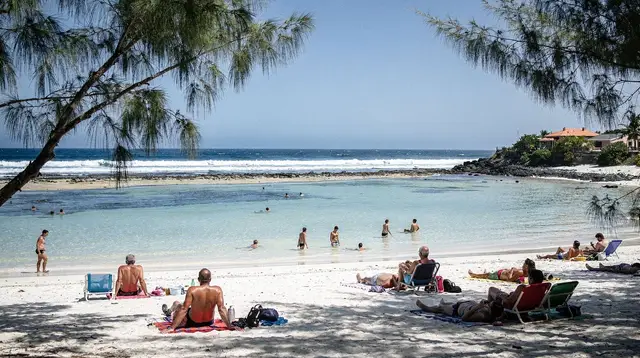
Spend the afternoon at the lagon: L’Hermitage and La Saline-les-Bains have the calmest, most sheltered water on the island, protected by the barrier reef inside the Réserve naturelle marine. This is one of the few stretches of coast where swimming is straightforwardly safe — outside the lagon and unsupervised zones, sea access is restricted by prefectural order because of shark risk, and that’s not a detail to skip past. Stay inside the marked lagon, and don’t step on the coral.
In the late afternoon or evening, a boat trip out from the Port de Saint-Gilles is a good way to see dolphins working the coast, and between roughly June/July and October, humpback whales pass offshore — never guaranteed, and always at a legally regulated distance.
a dolphin and whale watching trip out of Saint-Gilles-les-BainsFor things to do around town beyond the beach, see things to do in Saint-Gilles.
Day 2: Saint-Leu — paragliding, Kélonia and L’Étang-Salé
Saint-Leu, a 20–30 minute drive south along the coast, is one of the best tandem paragliding spots in Europe: pilots launch from the hillside above town with the lagoon laid out below, and flights run most mornings when conditions allow. If heights aren’t your thing, Kélonia, the sea turtle observatory, and the Stella Matutina sugar museum make a calmer alternative.
a tandem paragliding flight above the bay of Saint-LeuIn the afternoon, drive down to L’Étang-Salé for its black-sand beach and shaded filao forest, a change of scenery from the white sand further north. Both Saint-Leu and L’Étang-Salé have designated safe swimming zones; check local signage before going in anywhere that isn’t a marked beach. Full rundown here: things to do in Saint-Leu.
Day 3: Piton de la Fournaise
This is the long day. Piton de la Fournaise (2,632 m) is one of the most active volcanoes in the world, and the drive up from the coast to Bourg-Murat and the Route du Volcan takes a good two to two and a half hours from Saint-Gilles — leave before 6 a.m. Cloud typically rolls in over the crater area by mid-to-late morning, so an early start isn’t optional, it’s the difference between a clear view and a white-out.
The road crosses the Plaine des Sables, a stretch of black volcanic desert that looks nothing like the rest of the island, before reaching Pas de Bellecombe (2,311 m), the main overlook onto the volcano’s caldera. From there, the hike to the Dolomieu crater rim takes roughly five hours round trip on the marked trail — when it’s open. Access to the enclos is closed by the préfecture during eruptions or elevated volcanic alert, and Réunion’s volcano is watched closely by the OVPF-IPGP precisely because eruptions are frequent but not predictable. Don’t plan a trip around seeing lava; plan around seeing the caldera, and treat lava as a bonus if conditions allow it.
a guided hike into the Piton de la Fournaise calderaFor a different angle on the same mountain with none of the closure risk, a helicopter flight over the volcano gets you above the crater regardless of trail status.
a scenic helicopter flight over Piton de la FournaiseIf the weather or an alert rules out the hike, the Cité du Volcan museum in Bourg-Murat is a solid fallback — more on planning this day in Piton de la Fournaise volcano tours and self-drive or guided tour. Drive back down to Saint-Gilles, or push on and sleep closer to Saint-Louis if you’re tired — either way, don’t attempt Cilaos’s road on the same evening.
Day 4: Cilaos
This is where the itinerary turns inland for good. From Saint-Louis, the RN5 up to Cilaos is famous for its roughly 400 bends — reckon on close to an hour of continuous switchbacks with essentially no straight stretch, more if you’re behind a bus or feel carsick easily. It’s a striking drive, not a relaxing one; go slowly and take the bends seriously.
Cilaos itself sits in a natural amphitheatre of rock, and it’s the departure point for the Piton des Neiges (3,070 m) — the extinct volcano at the island’s centre and the highest point in the Indian Ocean, not to be confused with the very much active Piton de la Fournaise you climbed on day 3. Most people summit via an overnight stay at the Caverne Dufour refuge and a pre-dawn push for sunrise; that’s a separate trip in its own right (see the Piton des Neiges summit hike guide) and doesn’t fit this schedule.
With one day here, spend the morning in town — lentils, local wine, thermal baths — then get out on the water: Cilaos is the island’s canyoning capital, with routes like Fleur Jaune running through narrow, colourful volcanic rock with jumps and abseils suited to first-timers with a guide.
a canyoning descent at Fleur Jaune near Cilaos
As in the volcano, cloud tends to build over Cilaos by late morning, so plan any viewpoint stops (the Fenêtre des Makes, for one) for earlier in the day. More on the cirque at things to do in Cilaos.
Day 5: Salazie and Hell-Bourg
Salazie is Réunion’s greenest cirque and, unlike Cilaos, reachable by a more forgiving road from Saint-André — still mountain driving, but without 400 named bends. Expect roughly 45 minutes to an hour up from the coast depending on where you start, and the same rule applies: mist tends to settle in from late morning, so get moving early if you want clear views of the waterfalls.
The standout here is the Voile de la Mariée, a multi-strand waterfall visible from the road, and Hell-Bourg itself — a village of Creole houses classified among the Plus Beaux Villages de France, worth a couple of unhurried hours on foot. From Bélouve, further into the cirque, there’s a viewpoint over the Trou de Fer gorge, one of the most dramatic (and hardest to reach in full) sights on the island.
This is also the clearest contrast with Cilaos: Salazie feels closer, softer and greener, while Cilaos is starker, higher and more mineral. If you’re trying to decide which one deserves more time on a shorter trip, Cilaos vs Salazie lays out the trade-offs.
Head back toward Roland-Garros for your onward flight, or if you’re extending the trip, this is a natural point to pick up the coast and the parts this itinerary skipped — see east coast day trip from Saint-Gilles or wild south day trip from Saint-Gilles.
What this itinerary leaves out — and where to find it
Five days spent this way means no coastal loop, no wild south, and no full pass through the east coast. That’s a deliberate trade for spending real time in two cirques rather than driving past everything. If you have more time:
- The one-week itinerary adds the wild south and east coast.
- The three cirques in four days itinerary works Mafate in as well, on foot.
- Whale season in Réunion, four days is a good add-on between June and October if whale watching matters more than the cirques.
FAQ: planning five days between the west coast and the cirques
Is five days enough to see all of Réunion Island?
Not really, and this itinerary doesn’t try to. Five days is enough to properly experience Saint-Gilles, the volcano and two cirques, but it skips the coastal loop, the wild south and most of the east coast. For those, plan a week or more.
Can I visit Mafate as part of this itinerary?
No — Mafate has no road, so it can’t be worked into a car-based trip like this one. Reaching it means a dedicated one- to three-day trek on foot, booked separately with gîte reservations made well in advance.
How long does the drive to Cilaos actually take?
Plan on roughly an hour of continuous hairpin bends from Saint-Louis, not a fixed distance — the road climbs through around 400 bends and driving it in a rush is where most people have a bad time. Go early to beat the late-morning cloud at the top.
Is the road to Salazie as difficult as the road to Cilaos?
No. It’s still a mountain road with real climbing, but without the density of hairpins that defines the Cilaos route. Budget roughly 45 minutes to an hour up from Saint-André, and again, start early before the cloud sets in.
Will I be able to see lava at Piton de la Fournaise?
Maybe, maybe not — and no guide can promise it. The volcano is genuinely active, but the enclos can be closed by the préfecture during an eruption or an alert, and eruptions themselves are unpredictable even to the scientists monitoring the mountain. Build in a plan B, like the Cité du Volcan museum or a helicopter flight.
Why does this itinerary skip the coastal road trip everyone talks about?
Because doing both the coast and the cirques properly in five days isn’t realistic — something gets rushed. This version prioritizes the Hauts, where the scenery and pace of travel are different from the coast, and leaves the full coastal loop to a longer trip.
Do I need a 4x4 for Cilaos and Salazie?
No, a standard rental car handles both roads fine; they’re paved and well maintained, just narrow and heavily curved. What matters more than the vehicle is timing — driving up before the late-morning cloud rolls in.
tours.5 days
Verified deep-linked GetYourGuide tours. Book through these links and we earn a small commission at no cost to you.
GetYourGuide does not provide a product photo for this activity — the image shows the meeting point, photographed by us.